The Factor IX/F9 Antibody (CAB1578) is a high-quality antibody developed for reliable detection and analysis of target proteins. This antibody is produced using a polyclonal approach in rabbits, ensuring high reactivity and specificity for targeting the F9 protein in human samples. Validated for use in Western blot applications, this antibody binds specifically to the F9 protein, allowing for precise detection and analysis in different cell types. Its reliability and sensitivity make it an ideal choice for studies in fields such as developmental biology, stem cell research, and cancer biology where the F9 protein plays a crucial role.
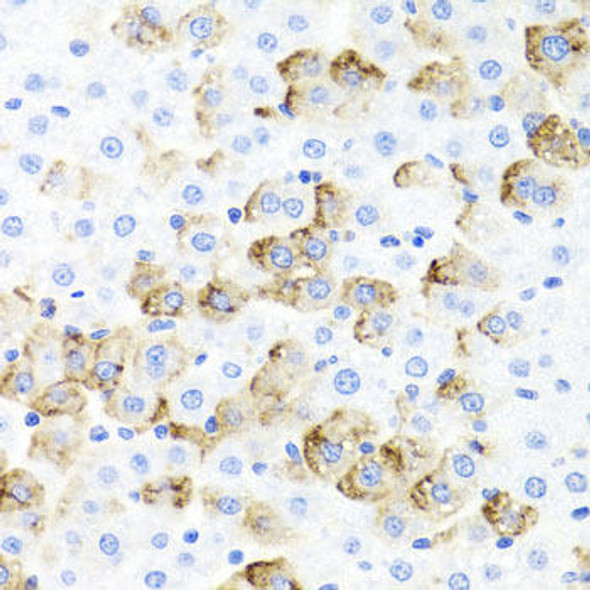
This antibody is validated for use in WB, ELISA, IF-P applications and has demonstrated reactivity against Human, Mouse, Rat samples.
Product Name:
Factor IX/F9 Antibody
SKU:
CAB1578
Size:
20μL, 100μL
Reactivity:
Human, Mouse, Rat
Conjugate:
Unconjugated
Immunogen:
Recombinant protein (or fragment).This information is considered to be commercially sensitive.
This gene encodes vitamin K-dependent coagulation factor IX that circulates in the blood as an inactive zymogen. This factor is converted to an active form by factor XIa, which excises the activation peptide and thus generates a heavy chain and a light chain held together by one or more disulfide bonds. The role of this activated factor IX in the blood coagulation cascade is to activate factor X to its active form through interactions with Ca+2 ions, membrane phospholipids, and factor VIII. Alterations of this gene, including point mutations, insertions and deletions, cause factor IX deficiency, which is a recessive X-linked disorder, also called hemophilia B or Christmas disease. Alternative splicing results in multiple transcript variants encoding different isoforms that may undergo similar proteolytic processing.
Purification Method
Affinity purification
Gene ID
2158
RRID
AB_2763199
Buffer Information
Store at -20℃. Avoid freeze / thaw cycles. Buffer: PBS containing 50% glycerol, preserved with proclin300 or sodium azide, pH 7.3.
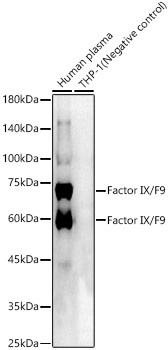
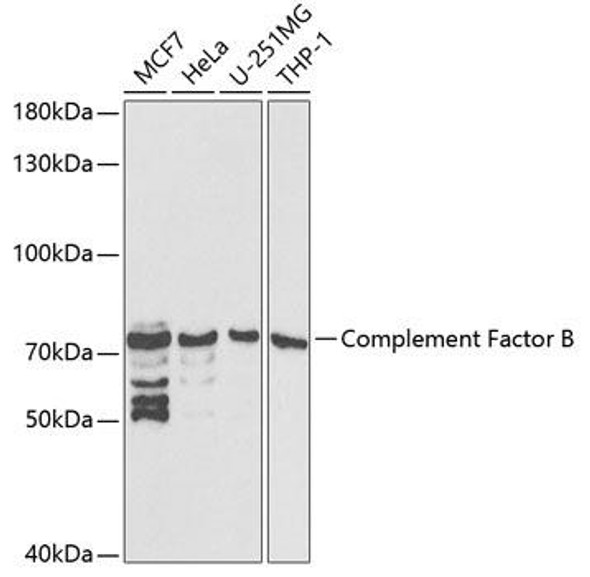
Western blot analysis of various lysates, using Factor IX / F9 Rabbit pAb (CAB1578) at 1:1000 dilution. Secondary antibody: HRP-conjugated Goat anti-Rabbit IgG (H+L) (CABS014) at 1:10000 dilution. Lysates/proteins: 25μg per lane. Blocking buffer: 3% nonfat dry milk in TBST. Detection: ECL Basic Kit (AbGn00020). Exposure time: 90s.
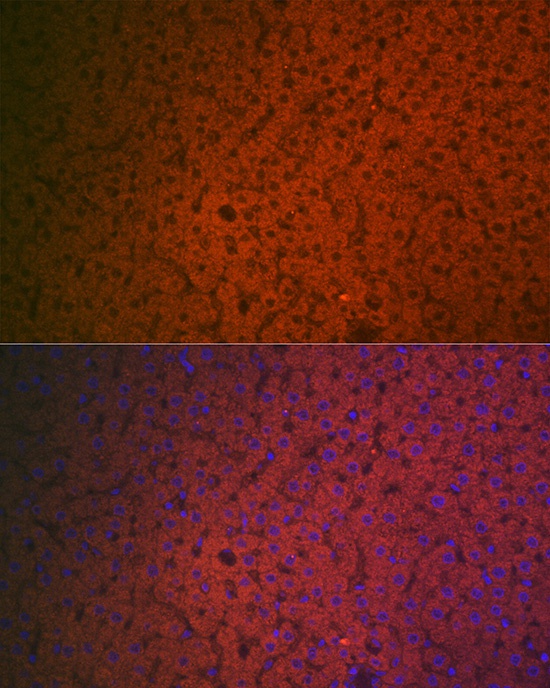
Immunofluorescence analysis of paraffin-embedded rat liver using Factor IX / F9 Rabbit pAb (CAB1578) at dilution of 1:100 (40x lens). Secondary antibody: Cy3-conjugated Goat anti-Rabbit IgG (H+L) (CABS007) at 1:500 dilution. Blue: DAPI for nuclear staining.
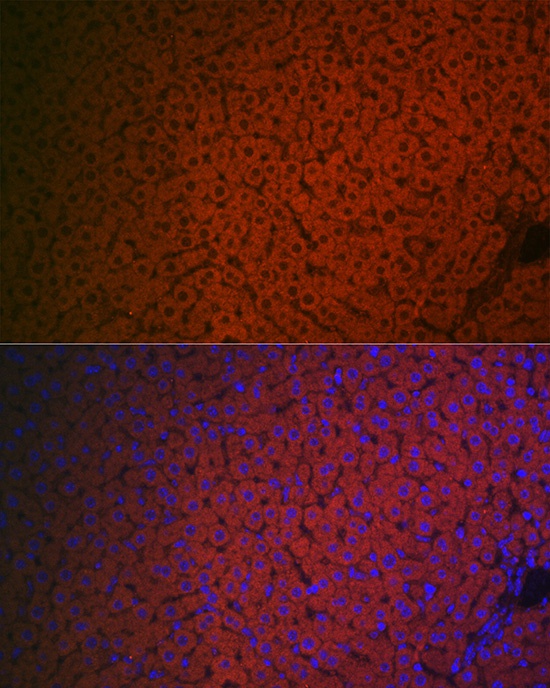
Immunofluorescence analysis of paraffin-embedded mouse liver using Factor IX / F9 Rabbit pAb (CAB1578) at dilution of 1:100 (40x lens). Secondary antibody: Cy3-conjugated Goat anti-Rabbit IgG (H+L) (CABS007) at 1:500 dilution. Blue: DAPI for nuclear staining.