

Description
HRP-conjugated Mouse anti-Rabbit IgG (H+L) (CABS079)
The HRP-conjugated Mouse anti-Rabbit IgG (H+L) (CABS079) is a high-quality antibody developed for reliable detection and analysis of target proteins. This antibody is conjugated with horseradish peroxidase (HRP), making it ideal for chemiluminescent detection methods. With high reactivity towards rabbit IgG, this secondary antibody allows for sensitive and accurate detection of primary antibodies in various samples. It is optimized for use in research involving rabbit primary antibodies, offering reliable and consistent results.
This antibody is validated for use in WB applications and has demonstrated reactivity against Rabbit samples.
| Product Name: | HRP-conjugated Mouse anti-Rabbit IgG (H+L) |
| SKU: | CABS079 |
| Size: | 50μL, 100μL, 200μL |
| Reactivity: | Rabbit |
| Conjugate: | HRP |
| Immunogen: | This information is considered to be commercially sensitive. | ||
| Tested Applications: | WB | ||
| Recommended Dilution: |
|
| Positive Sample: | HeLa |
| Observed MW: | 36kDa |
Secondary antibodies are affinity-purified antibodies which will work with target-specific primary antibody in the detection, sorting or purification of its specified target. Secondary antibodies offer increased versatility enabling users to use many detection systems (e.g. HRP, AP, fluorescence). They can also provide greater sensitivity through signal amplification as multiple secondary antibodies . Most commonly, secondary antibodies are generated by immunizing the host animal (different from host species of primary antibody) with a pooled population of normal immunoglobulins from the host species of primary antibody and can be further purified and modified (i.e. antibody fragmentation, label conjugation, etc.) to ensure well-characterized specificity to corresponding normal immunoglobulins.
| Purification Method | Affinity purification |
| RRID | AB_2864059 |
| Buffer Information | Store at -20℃. Avoid freeze / thaw cycles. Buffer: PBS with 0.75% BSA,50% glycerol,pH7.3. |
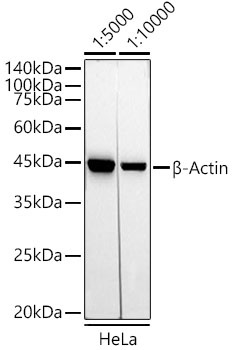 | Western blot analysis of lysates from HeLa cells, using β-Actin (AC026) antibody as the primary antibody at dilution of 1:10000. Secondary antibody: using HRP-conjugated AffiniPure Mouse Anti-Rabbit IgG (H+L) antibody (CABS079)) at 1:5000-1:10000 dilution. |


