The KCNJ3 Antibody (CAB9824) is a high-quality antibody developed for reliable detection and analysis of target proteins. This channel is involved in regulating potassium ion flow across cell membranes, affecting various physiological processes such as muscle contraction and neuronal signaling.Raised in rabbits, this polyclonal antibody has high reactivity with human samples and has been validated for use in Western blot applications. It specifically binds to the KCNJ3 protein, allowing for its detection and analysis in different cell types.
This antibody is validated for use in WB, ELISA applications and has demonstrated reactivity against Human, Mouse, Rat samples.
Product Name:
KCNJ3 Antibody
SKU:
CAB9824
Size:
20μL, 100μL
Reactivity:
Human, Mouse, Rat
Conjugate:
Unconjugated
Immunogen:
Synthetic peptide. This information is considered to be commercially sensitive.
Recommended starting concentration is 1 μg/mL. Please optimize the concentration based on your specific assay requirements.
Synonyms:
KGA, GIRK1, KIR3.1, KCNJ3
Positive Sample:
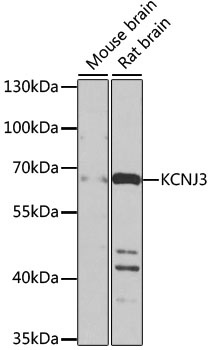
Mouse brain, Rat brain
Cellular Localization:
Membrane, Multi-Pass Membrane Protein.
Calculated MW:
57kDa
Observed MW:
56kDa
Potassium channels are present in most mammalian cells, where they participate in a wide range of physiologic responses. The protein encoded by this gene is an integral membrane protein and inward-rectifier type potassium channel. The encoded protein, which has a greater tendency to allow potassium to flow into a cell rather than out of a cell, is controlled by G-proteins and plays an important role in regulating heartbeat. It associates with three other G-protein-activated potassium channels to form a heteromultimeric pore-forming complex that also couples to neurotransmitter receptors in the brain and whereby channel activation can inhibit action potential firing by hyperpolarizing the plasma membrane. These multimeric G-protein-gated inwardly-rectifying potassium (GIRK) channels may play a role in the pathophysiology of epilepsy, addiction, Down's syndrome, ataxia, and Parkinson's disease. Alternative splicing results in multiple transcript variants encoding distinct proteins.
Purification Method
Affinity purification
Gene ID
3760
RRID
AB_2770055
Buffer Information
Store at -20℃. Avoid freeze / thaw cycles. Buffer: PBS containing 50% glycerol, preserved with proclin300 or sodium azide, pH 7.3.
Western blot analysis of various lysates using KCNJ3 Rabbit pAb (CAB9824) at 1:1000 dilution. Secondary antibody: HRP-conjugated Goat anti-Rabbit IgG (H+L) (CABS014) at 1:10000 dilution. Lysates/proteins: 25μg per lane. Blocking buffer: 3% nonfat dry milk in TBST. Detection: ECL Enhanced Kit (AbGn00021). Exposure time: 10s.