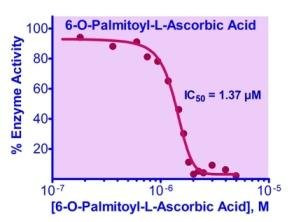
Description
Pyrophosphatase Inhibitor Assay Kit (BA0223) (BA0223)
The Pyrophosphatase Inhibitor Assay Kit (SKU: BA0223) is a quantitative colorimetric assay designed for the screening of potential pyrophosphatase inhibitors. Inorganic pyrophosphatase (EC 3.6.1.1) catalyses the hydrolysis of phosphoester bonds of inorganic pyrophosphate, releasing two orthophosphate molecules, and Family I pyrophosphatases are essential enzymes found in all kingdoms of life. This kit is based on a colorimetric pyrophosphatase assay and allows screening and evaluation of Family I pyrophosphatase modulators. It is a non-radioactive, fast and convenient assay that involves incubation of enzyme and inhibitor, addition of a single working reagent and incubation for 30 minutes, all at room temperature with no 37 degrees C incubator required. The homogeneous mix-incubate-measure format is robust, with a Z' factor of 0.59, and can be readily automated on HTS liquid handling systems for 96-well, 384-well and higher-density screening.
| Product Name: | Pyrophosphatase Inhibitor Assay Kit (BA0223) |
| SKU: | BA0223 |
| Detection Method: | Colorimetric inhibitor screening; read at 620 nm |
| Detection Range: | Not specified |
| Sample Type: | Test compounds (inhibitors); pyrophosphatase enzyme |
| Species Reactivity: | All |
| Assay Time: | Approximately 70 minutes |
| Kit Size: | 100 Assays |
| Equipment Required: | Microplate reader |
| Storage: | Store pyrophosphate at -20 degrees C and store all other components at 4 degrees C upon receiving. |
| Shelf Life: | 6 months after receipt |
| Shipping: | Room Temperature |
Inorganic pyrophosphatase (EC 3.6.1.1) catalyses the hydrolysis of phosphoester bonds of inorganic pyrophosphate, thereby releasing two orthophosphate molecules. Family I pyrophosphatases are essential enzymes found in all kingdoms of life and are responsible for maintaining the correct pyrophosphate equilibrium necessary to carry out nucleic acid and protein synthesis and to facilitate fatty acid beta oxidation. This inhibitor assay is based on a colorimetric pyrophosphatase assay and allows for screening of potential pyrophosphatase inhibitors.
- Safe: non-radioactive assay.
- Fast and convenient: the procedure involves incubation of enzyme and inhibitor, addition of a single working reagent and incubation for 30 minutes; room temperature assay with no 37 degrees C incubator needed.
- High-throughput: homogeneous mix-incubate-measure type assay that can be readily automated on HTS liquid handling systems, with a robust Z' factor of 0.59, and can be used in 96-well, 384-well and potentially higher density screening assays.
- High-throughput inhibitor screening and evaluation of Family I pyrophosphatase modulators.
Note: The below protocol is a sample protocol. Protocols are specific to each batch/lot. For the correct instructions please follow the protocol included in your kit.
| Step | Procedure |
| 1 | Dissolve test compounds in a solvent of choice (e.g. water, DMSO); it is prudent to first test the tolerance of any non-water solvent by the enzyme of choice, and yeast pyrophosphatase was found to tolerate up to 10% DMSO. |
| 2 | Prepare enzyme in an enzyme buffer such as 25 mM HEPES pH 7.2 with 5 mM MgCl2; the protocol is optimised for yeast pyrophosphatase, and enzyme should be diluted just prior to assay, running a serial enzyme dilution in water to determine the optimal concentration per well if using a different enzyme. |
| 3 | Avoid free phosphate (e.g. from detergent) in the enzyme buffer and test compounds as the assay is extremely sensitive; if the OD620nm for enzyme alone with the colour reagent is higher than 0.2, remove free phosphate by at least 3 washes with a 10 kDa NMWL membrane filter. Avoid EDTA and metals such as Zn, Co, Mn and Ca, and note that high protein concentrations can interfere through precipitation. |
| 4 | Transfer 40 microlitres of Enzyme into separate wells of a clear flat-bottom 96-well plate, reserving at least one well for the No Inhibitor Control and one for the No Enzyme Blank, adding 40 microlitres of Enzyme sample and 40 microlitres of Assay Buffer to the Control and Blank wells respectively; add 10 microlitres of the test-compound solvent solution to the Control and Blank wells. |
| 5 | To the remaining enzyme-containing wells, add 10 microlitres of the test compounds, tap the plate to mix and incubate for 10 minutes at room temperature to allow the inhibitor to block enzyme activity. |
| 6 | Prepare enough Working Reagent for all wells by mixing 1 microlitre of pyrophosphate and 45 microlitres of Assay Buffer per well, transfer 40 microlitres of Working Reagent to all wells, briefly tap the plate to mix and incubate for 30 minutes at room temperature. |
| 7 | Prepare enough Colour Development Reagent for all wells by mixing 100 parts POMG Reagent A and 1 part POMG Reagent B, add 20 microlitres of Colour Development Reagent to all wells, tap the plate thoroughly to mix, incubate for 30 minutes at room temperature and read optical density at 620 nm. |
Relative enzyme activity for a test compound is calculated as: Activity (%) = [(ODTest Cmpd - ODBlank) / (ODControl - ODBlank)] x 100%, where ODTest Cmpd, ODControl and ODBlank are the OD620nm values of the test compound, control and blank wells at 30 minutes.
| Component | Quantity | Storage |
| Assay Buffer | 8 mL | 4 degrees C |
| Pyrophosphate | 100 uL | -20 degrees C |
| Inhibitor | 100 uL | 4 degrees C |
| POMG Reagent A | 2.5 mL | 4 degrees C |
| POMG Reagent B | 120 uL | 4 degrees C |