Description
Acid Phosphatase Activity Assay Kit (BA0010) (BA0010)
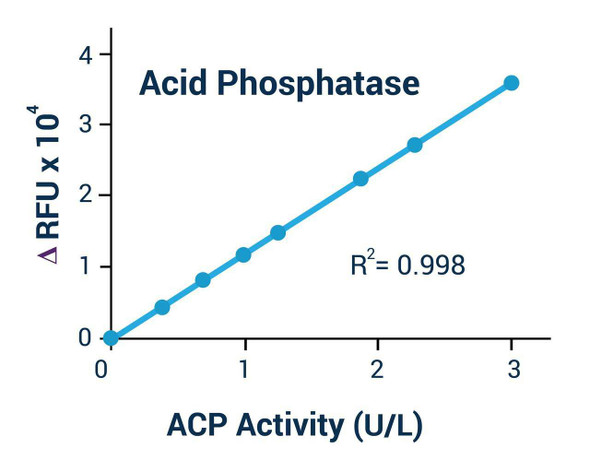
The Acid Phosphatase Activity Assay Kit (SKU: BA0010) provides a quantitative colorimetric kinetic method for determining acid phosphatase (ACP) activity in biological samples. Acid phosphatase catalyses the cleavage of phosphate groups from other molecules and is found in lysosomes, bone, spleen, liver, kidney and blood, with serum levels serving as a biomarker for prostatic carcinoma. The non-radioactive assay is based on the cleavage of p-nitrophenol from a synthetic substrate, which becomes intensely coloured after the stop reagent is added; the increase in absorbance at 405 nm is directly proportional to enzyme activity. Using only 20 µL of sample, the assay is linear from 0.05 to 60 U/L over a 30-minute reaction. Its homogeneous mix-incubate-measure format can be readily automated for processing thousands of samples per day.
| Product Name: | Acid Phosphatase Activity Assay Kit (BA0010) |
| SKU: | BA0010 |
| Detection Method: | Colorimetric (OD 405 nm) |
| Detection Range: | 0.05 to 60 U/L (20 µL sample, 30 min reaction) |
| Sample Type: | ['Plasma', 'Serum', 'Cell lysate', 'Tissue samples'] |
| Species Reactivity: | All |
| Assay Time: | 30 minutes |
| Kit Size: | 100 Assays |
| Equipment Required: | Microplate reader |
| Storage: | Standard and Stop Reagent at 4°C; all other reagents at -20°C |
| Shelf Life: | 6 months after receipt |
| Shipping: | Room Temperature |
Acid phosphatase (ACP) is an enzyme which catalyses the cleavage of phosphate groups from other molecules during digestion. Acid phosphatase can be found in lysosomes and becomes active after fusing with endosomes, acidifying the pH and creating an optimal environment for ACP. ACP can also be found in bone, spleen, liver, kidney and blood, and serum levels can be used as a biomarker for prostatic carcinoma. This non-radioactive, colorimetric assay is based on the cleavage of p-nitrophenol from a synthetic substrate. p-Nitrophenol becomes intensely coloured after addition of the stop reagent, and the increase in absorbance at 405 nm after addition of the stop reagent is directly proportional to the enzyme activity.
- Fast and sensitive. Linear detection range (20 µL sample): 0.05 to 60 U/L for a 30 minute reaction.
- High-throughput. Homogeneous mix-incubate-measure type assay that can be readily automated on HTS liquid handling systems for processing thousands of samples per day.
- Acid phosphatase activity determination in biological samples (e.g. plasma, serum, cell lysate, tissue samples).
Note: The below protocol is a sample protocol. Protocols are specific to each batch/lot. For the correct instructions please follow the protocol included in your kit.
| Step | Procedure |
| 1 | Prepare samples: dilute serum and plasma 2-5 fold. For tissue, rinse in Tris buffered saline (pH 7.4) to remove blood, homogenise 50 mg in approximately 200 µL 50 mM Tris buffer (pH 7.5) and centrifuge at 14,000 x g for 10 min at 4°C, using the supernatant. For cell lysate, collect cells by centrifugation at 2,000 x g for 5 min at 4°C, homogenise or sonicate in cold 50 mM Tris buffer (pH 7.5) at approximately one million cells per mL and centrifuge at 14,000 x g for 10 min at 4°C. |
| 2 | Equilibrate all components to the desired reaction temperature (e.g. 25°C or 37°C). Prepare standards by mixing 20 µL of 12.5 mM Nitrophenol standard with 230 µL dH2O to make a 1000 µM Premix, then dilute as described in the standard curve table. |
| 3 | Transfer 20 µL of each sample into separate wells and 20 µL of each standard into wells of a clear flat-bottom 96-well plate. |
| 4 | Prepare the Working Reagent by mixing, for each well, 85 µL assay buffer and 2 µL pNPP Liquid, then add 80 µL of Working Reagent to all standard and sample wells and tap the plate briefly to mix. |
| 5 | Incubate at 25°C (or the desired temperature) for 30 minutes, add 50 µL of Stop Reagent to each well and tap the plate briefly to mix. |
| 6 | Read OD405nm. |
Subtract the blank OD (water, standard #4) from the standard OD values and plot the change in OD against standard concentrations to determine the Slope. ACP Activity = [(ODSample - ODBlank) / (Time x Slope)] x n (U/L), where ODSample is the OD405nm value for each sample, ODBlank is the OD405nm value of water (standard #4) or the sample blank, Slope is from the linear regression of the standard points, Time is the reaction time (30 min) and n is the dilution factor. Unit definition: 1 Unit (U) of ACP will catalyse the conversion of 1 µmole of p-nitrophenyl phosphate to p-nitrophenol and phosphate per min at 25°C and pH 5.3.
| Component | Quantity | Storage |
| Assay Buffer | 12 mL | -20°C |
| pNPP Liquid | 280 µL | -20°C |
| Stop Reagent | 12 mL | 4°C |
| Standard | 1 mL | 4°C |