The AKR1C3 Monoclonal Antibody (CAB3884) is a high-quality antibody developed for reliable detection and analysis of target proteins. This antibody, generated in rabbits, exhibits high specificity and sensitivity in detecting AKR1C3 in human samples, making it a reliable choice for Western blot applications.AKR1C3, also known as 17-beta-hydroxysteroid dehydrogenase, plays a crucial role in the biosynthesis and metabolism of steroid hormones, making it a potential target for therapeutic interventions in cancer therapy.
This antibody is validated for use in WB, IF/ICC, ELISA applications and has demonstrated reactivity against Human, Mouse samples.
Product Name:
AKR1C3 Monoclonal Antibody
SKU:
CAB3884
Size:
20μL, 100μL
Reactivity:
Human, Mouse
Clone Number:
ARC0857
Conjugate:
Unconjugated
Immunogen:
Synthetic peptide. This information is considered to be commercially sensitive.
This gene encodes a member of the aldo/keto reductase superfamily, which consists of more than 40 known enzymes and proteins. These enzymes catalyze the conversion of aldehydes and ketones to their corresponding alcohols by utilizing NADH and/or NADPH as cofactors. The enzymes display overlapping but distinct substrate specificity. This enzyme catalyzes the reduction of prostaglandin (PG) D2, PGH2 and phenanthrenequinone (PQ), and the oxidation of 9alpha,11beta-PGF2 to PGD2. It may play an important role in the pathogenesis of allergic diseases such as asthma, and may also have a role in controlling cell growth and/or differentiation. This gene shares high sequence identity with three other gene members and is clustered with those three genes at chromosome 10p15-p14. Three transcript variants encoding different isoforms have been found for this gene.
Purification Method
Affinity purification
Gene ID
8644
RRID
AB_2863152
Buffer Information
Store at -20℃. Avoid freeze / thaw cycles. Buffer: PBS containing 50% glycerol and 0.05% BSA, preserved with proclin300 or sodium azide, pH 7.3.
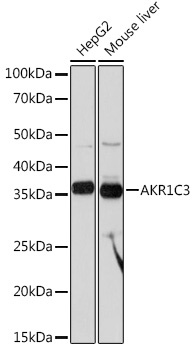
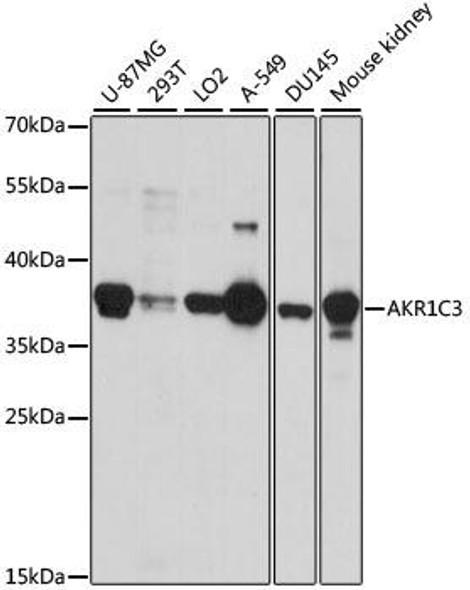
Western blot analysis of various lysates using AKR1C3 Rabbit mAb (CAB3884) at 1:1000 dilution. Secondary antibody: HRP-conjugated Goat anti-Rabbit IgG (H+L) (CABS014) at 1:10000 dilution. Lysates/proteins: 25μg per lane. Blocking buffer: 3% nonfat dry milk in TBST. Detection: ECL Basic Kit (AbGn00020). Exposure time: 10s.
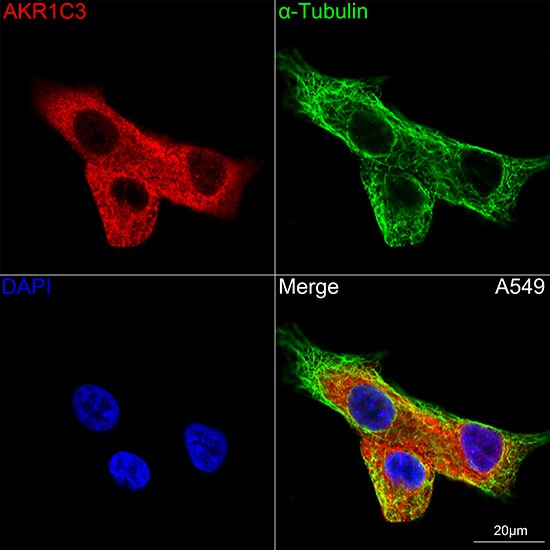
Confocal imaging of A549 cells using AKR1C3 Rabbit mAb (CAB3884,dilution 1:100)(Red). The cells were counterstained with α-Tubulin Mouse mAb (AC012,dilution 1:400) (Green). DAPI was used for nuclear staining (blue). Objective: 100x.




![Anti-AKR1C3 [R08-8G6] Monoclonal Antibody (AGMB01427)](https://cdn11.bigcommerce.com/s-h68l9z2lnx/images/stencil/590x590/products/272716/676250/anti-akr1c3-r08-8g6-monoclonal-antibody-agmb01427__34245.1773028831.jpg?c=2 "Anti-AKR1C3 [R08-8G6] Monoclonal Antibody (AGMB01427)")


