The FADD Antibody (CAB20252) is a high-quality antibody developed for reliable detection and analysis of target proteins. FADD (Fas-associated death domain protein) is a key adapter molecule involved in the death receptor-mediated apoptosis pathway, and this polyclonal antibody, raised in rabbits, specifically targets FADD protein in human samples.Validated for use in Western blot applications, the Anti-FADD Antibody offers high reactivity and specificity, enabling accurate detection and analysis of FADD in various cell types. This antibody is a valuable asset for studies in cell biology, cancer research, and the development of therapeutic strategies targeting the apoptosis pathway.
This antibody is validated for use in WB, IP, ELISA, IF-P applications and has demonstrated reactivity against Human, Mouse, Rat samples.
Product Name:
FADD Antibody
SKU:
CAB20252
Size:
20μL, 100μL
Reactivity:
Human, Mouse, Rat
Conjugate:
Unconjugated
Immunogen:
Recombinant protein (or fragment).This information is considered to be commercially sensitive.
Predicted to enable several functions, including caspase binding activity; death effector domain binding activity; and tumor necrosis factor receptor superfamily binding activity. Involved in several processes, including hematopoietic or lymphoid organ development; negative regulation of activation-induced cell death of T cells; and positive regulation of CD8-positive, alpha-beta cytotoxic T cell extravasation. Acts upstream of or within extrinsic apoptotic signaling pathway in absence of ligand; motor neuron apoptotic process; and regulation of programmed cell death. Predicted to be located in several cellular components, including cell body; cytosol; and membrane raft. Predicted to be part of CD95 death-inducing signaling complex and ripoptosome. Predicted to be active in cytoplasm. Is expressed in several structures, including alimentary system; brain; genitourinary system; hemolymphoid system gland; and liver and biliary system. Human ortholog(s) of this gene implicated in leukemia. Orthologous to human FADD (Fas associated via death domain).
Purification Method
Affinity purification
Gene ID
14082
Buffer Information
Store at -20℃. Avoid freeze / thaw cycles. Buffer: PBS containing 50% glycerol, preserved with proclin300 or sodium azide, pH 7.3.
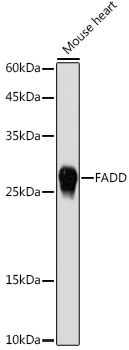
Western blot analysis of lysates from Mouse heart, using FADD Rabbit pAb (CAB20252) at 1:1000 dilution. Secondary antibody: HRP-conjugated Goat anti-Rabbit IgG (H+L) (CABS014) at 1:10000 dilution. Lysates/proteins: 25μg per lane. Blocking buffer: 3% nonfat dry milk in TBST. Detection: ECL Basic Kit (AbGn00020). Exposure time: 10s.
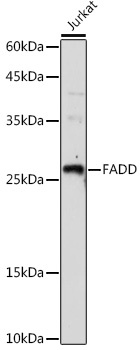
Western blot analysis of lysates from Jurkat cells, using FADD Rabbit pAb (CAB20252) at 1:1000 dilution. Secondary antibody: HRP-conjugated Goat anti-Rabbit IgG (H+L) (CABS014) at 1:10000 dilution. Lysates/proteins: 25μg per lane. Blocking buffer: 3% nonfat dry milk in TBST. Detection: ECL Basic Kit (AbGn00020). Exposure time: 180s.
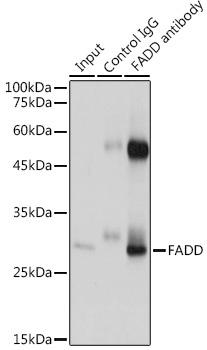
Immunoprecipitation analysis of 600 μg extracts of Mouse heart cells using 3 μg FADD antibody (CAB20252). Western blot was performed from the immunoprecipitate using FADD antibody (CAB20252) at a dilution of 1:1000.