
LPS ELISA Troubleshooting: The Importance of Sample Nature
Quick answer
A researcher measuring circulating lipopolysaccharide (LPS) in human serum with our LPS ELISA saw almost no color, even after 30 minutes with substrate. Samples had been tested neat and at 1:10, 1:100 and 1:1000, with no standard curve on the plate. A second run with the full standard curve gave an excellent curve, which confirmed the kit was working. Most samples still read at or below the blank. Circulating LPS is usually very low, often in the tens of pg/mL, so any dilution pushes it below the 7.8 pg/mL lowest standard. Run serum undiluted, always include the standard curve, and report values below the curve as “< LLOQ”.
On this page
The problem
A researcher wanted to compare serum LPS between patients with a chronic condition and healthy controls. The datasheet doesn't give a single dilution for LPS, because levels vary widely with disease and infection status. To save reagents, the team ran a small pilot on a few strips. They tested four patients and four controls neat and at 1:10, 1:100 and 1:1000, without running the standards.
After 30 minutes with substrate, the wells had barely turned blue. The team expected higher LPS in the patient samples, so they asked whether the kit was working and which dilution factor to use.
Snapshot of the data
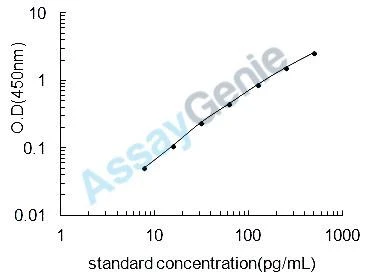
In the second run, which included the full standard curve, the curve itself looked textbook:
| Standard (pg/mL) | Mean OD 450 nm | Blank-corrected OD |
| 500 | 2.35 | 2.26 |
| 125 | 0.88 | 0.79 |
| 31.2 | 0.29 | 0.20 |
| 7.8 (lowest standard) | 0.14 | 0.05 |
| 0 (blank) | 0.09 | — |
The samples told a different story:
| Serum sample | Blank-corrected OD | Result |
| Most samples (1:10–1:1000) | −0.02 to 0.00 | Below blank – not quantifiable |
| Highest samples (neat) | 0.03–0.06 | At or just above the 7.8 pg/mL standard |
| Lab validation (healthy serum, neat) | Low range | ~10–50 pg/mL |
Values are illustrative and rounded to show the trend, not exact readings from any single run.
Why it happens
In a sandwich ELISA, a faint color is expected when there is little analyte, so a pale plate doesn't prove the kit has failed. Without standards on the plate, though, you can't tell “no target in the sample” from “no signal from the assay.” The standard curve is the only internal check that the antibodies, conjugate and substrate are all working.
Circulating LPS is low. Outside of acute sepsis, serum LPS usually sits in the low tens of pg/mL. With a lowest standard of 7.8 pg/mL, a 1:10 dilution already drops most samples below the curve. At 1:100 and 1:1000, there is nothing left to detect.
Serum also works against detection. LPS binds to LPS-binding protein (LBP) and to lipoproteins, and the bound form can hide the epitopes the antibodies recognize. LPS structure also varies between bacterial serotypes. This kit is validated with the common O55:B5 serotype and detects other common serotypes, but a rare serotype may be picked up less efficiently.
Our analysis
Because almost every well was negative, we asked the team to run the standard curve before changing anything else. That would set the minimum and maximum OD and show whether the problem came from the kit or from the samples. The pilot ODs for neat serum already looked similar to our lab's validation data, where undiluted serum read about 10–50 pg/mL.
The second run settled the question. The standard curve was excellent, so the kit was performing as expected. After blank subtraction, most samples gave negative ODs. Only a few neat samples produced a usable signal, and those sat right at the bottom of the curve. The researcher calculated values below 2 pg/mL for the positive samples. That falls below the lowest standard, so it is an extrapolation and should be reported as “< 7.8 pg/mL” rather than as a number.
Root cause
The kit worked. The samples simply contained low or undetectable LPS, and diluting them moved them further below the 7.8 pg/mL lower limit. Running the pilot without a standard curve made a true low-analyte result look like a kit failure. LPS bound to LBP or lipoproteins, or an uncommon serotype, may have lowered the measurable signal even more.
What we recommended
Key takeaway
A pale plate doesn't mean a failed kit, but only a standard curve can prove it. For low-abundance analytes like circulating LPS, start neat, keep the standards on the plate, and treat values below the lowest standard as “below the limit” rather than as zero or as an extrapolated number. For more help with dilutions and data analysis, visit our ELISA Support Hub →
FAQ
What dilution should I use for serum in the LPS ELISA?
For most serum samples, none. Circulating LPS is typically low, so start with undiluted serum and only dilute if neat samples read above the top standard.
Can I skip the standard curve in a pilot run to save wells?
It can work when samples land well inside the curve. If most wells come back negative, though, you can't tell a low sample from an assay problem without the standards, so include them whenever you are unsure.
My blank-corrected sample ODs are negative. What does that mean?
The sample produced no more signal than the blank, so it contains no detectable analyte at that dilution. Report it as below the lower limit of quantification.
Why might disease samples read lower than expected?
In serum, LPS binds LBP and lipoproteins, which can mask antibody epitopes. Serotype also matters: the kit is validated with O55:B5 and detects common serotypes, but a rare serotype may give a weaker signal.
Related reading
Calculating & Analyzing ELISA Data (standard curves, LLOQ) →
101 ELISA Troubleshooting Tips →
The ELISA Controls Guide (dilution linearity & matrix effects) →
Lipopolysaccharide (LPS) ELISA Kit →
SKU: UNEB0072 • Sandwich ELISA • Universal
| Detection range | 7.8–500 pg/mL |
| Assay time | ~3–4 hours |
| Sample types | Serum, plasma, cell culture supernatant, tissue samples & other biological fluids |
€649
View product →Samples reading at or below the blank?
Our PhD-level support team can review your plate layout, standard curve and dilutions and help you tell a low sample from an assay problem.
This article summarizes an anonymized customer support case for educational purposes. Data values are illustrative. Expected LPS concentrations and optimal dilutions vary by sample type, study population and serotype. Always validate conditions for your own samples and follow the protocol supplied with your kit lot.
Recent Posts
-
LPS ELISA Troubleshooting: The Importance of Sample Nature
Quick answer A researcher measuring circulating lipopolysaccharide (LPS) in human serum …25th Sep 2026 -

Sekundärantikörper wählen: Die Regel, die im Labor wirklich zählt
Sekundärantikörper wählen: Die Regel, die im Labor wirklich zählt Wählen Sie einen Sekundärantikörp …24th Sep 2026 -

Anticuerpos para IHC: cómo validarlos y evitar falsos positivos
Anticuerpos para IHC: cómo validarlos y evitar falsos positivos Use anticuerpos con evidencia publi …24th Sep 2026