Description
Calcium Assay Kit (Colorimetric) (BA0032) (BA0032)
The Calcium Assay Kit (Colorimetric) (SKU: BA0032) is designed to measure calcium directly in biological samples without any pretreatment. Calcium is measured to monitor diseases of the bone and disorders of calcium regulation; increased serum levels occur in hyperparathyroidism and metastatic bone lesions, while decreased levels are seen in hypoparathyroidism, nephrosis and rickets, and urinary calcium is important in the evaluation of kidney stones. This kit uses a phenolsulphonephthalein dye that forms a stable blue complex specifically with free calcium; the intensity measured at 612 nm is directly proportional to the calcium concentration. The optimised formulation minimises interference from magnesium, lipid, protein and bilirubin. The single working-reagent, three-minute procedure is readily automated for high-throughput work and can be run in either 96-well plate or cuvette format. Note that EDTA and other calcium chelators interfere with the assay.
| Product Name: | Calcium Assay Kit (Colorimetric) (BA0032) |
| SKU: | BA0032 |
| Detection Method: | Colorimetric; phenolsulphonephthalein dye complex measured at 612 nm |
| Detection Range: | 0.08 mg/dL (20 µM) to 20 mg/dL (5 mM) Ca2+ |
| Sample Type: | Blood, urine, saliva, food and beverages, water and soil |
| Species Reactivity: | All |
| Assay Time: | 3 min incubation |
| Kit Size: | 500 Assays |
| Equipment Required: | Microplate reader |
| Storage: | Store Reagent and Standard at 4°C. |
| Shelf Life: | 24 months after receipt. |
| Shipping: | Room Temperature |
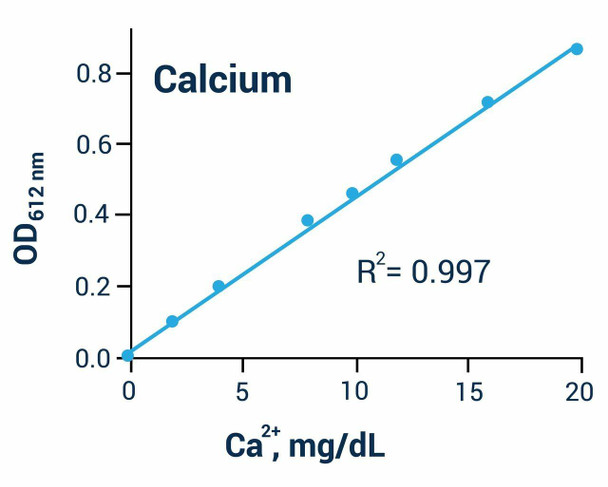
A colorimetric assay for the quantitative determination of calcium directly in biological samples. A phenolsulphonephthalein dye forms a stable blue complex specifically with free calcium; the intensity measured at 612 nm is directly proportional to the calcium concentration. Linear detection range is 0.08 mg/dL (20 µM) to 20 mg/dL (5 mM).
- Sensitive and accurate: uses as little as 5 µL of sample; linear detection range 0.08 to 20 mg/dL Ca2+.
- Simple and high-throughput: a single working reagent and a 3-minute incubation; readily automated.
- Improved reagent stability and versatility: enhanced reagent and signal stability; cuvette or 96-well plate assay.
- Low interference in biological samples: no pretreatment required, even in the presence of lipid, protein and minerals.
- Ca2+ in blood, urine and saliva.
- Drug discovery and pharmacology: effects of drugs on calcium metabolism.
- Food and beverages: calcium determination.
- Environment: calcium determination in water and soil.
Note: The below protocol is a sample protocol. Protocols are specific to each batch/lot. For the correct instructions please follow the protocol included in your kit.
| Step | Procedure |
| 1 | Dilute the standards as shown in the standards table. Transfer 5 µL of diluted standards and samples into wells of a clear-bottom 96-well plate. |
| 2 | Prepare enough working reagent by combining equal volumes of Reagent A and Reagent B. Add 200 µL working reagent and tap lightly to mix. |
| 3 | Incubate 3 min at room temperature and read the optical density at 570-650 nm (peak absorbance at 612 nm). |
| 4 | Cuvette format: transfer 15 µL diluted standards and samples to tubes, add 1000 µL working reagent, vortex, incubate 3 min and read at 612 nm. |
Subtract the blank OD (water, standard #8) from the standard OD values and plot OD against Ca2+ concentration to determine the slope. [Calcium] = (ODsample - ODblank) / slope (mg/dL). Conversions: 1 mg/dL Ca2+ equals 250 µM, 0.001% or 10 ppm.
| Component | Quantity | Storage |
| Reagent A | 50 mL | 4°C |
| Reagent B | 50 mL | 4°C |
| Calcium Standard (20 mg/dL Ca2+) | 1 mL | 4°C |