Description
FRAP Assay Kit (BA0216) (BA0216)
The FRAP Assay Kit (SKU: BA0216) offers a simple, high-throughput method for quantifying antioxidant capacity through the ferric reducing antioxidant potential (FRAP) assay. FRAP measures antioxidant capacity by an antioxidant's ability to reduce ferric iron (III) to ferrous iron (II), and antioxidants are of wide interest because oxidative stress contributes to the development of many conditions including Alzheimer's disease, Parkinson's disease, diabetes, rheumatoid arthritis and neurodegeneration. Antioxidants are also widely used as dietary supplements and as preservatives across foods, cosmetics and other products. In this improved assay Fe3+ is reduced by antioxidants to Fe2+, which specifically forms a coloured complex with a chromogen, and the colour intensity at 590 nm is proportional to the FRAP in the sample. The procedure involves addition of a single working reagent and a 40-minute incubation, and can be readily automated for thousands of samples per day. The optimised formulation offers enhanced reagent and signal stability.
| Product Name: | FRAP Assay Kit (BA0216) |
| SKU: | BA0216 |
| Detection Method: | Colorimetric detection at 590 nm (readable 510-630 nm). Antioxidants reduce Fe3+ to Fe2+, which specifically forms a coloured complex with a chromogen; the colour intensity is proportional to the ferric reducing antioxidant potential (FRAP) in the sample. |
| Detection Range: | Linear detection range 0.5 - 180 µM Fe3+ reduction potential in a 96-well plate assay |
| Sample Type: | Plant extracts, foods, vitamins, supplements and biological samples such as serum, plasma and urine |
| Species Reactivity: | All |
| Assay Time: | 40 minutes |
| Kit Size: | 250 Assays |
| Equipment Required: | Microplate reader |
| Storage: | Store Reagent A at room temperature and all other reagents at 4°C. |
| Shelf Life: | 12 months after receipt |
| Shipping: | Room Temperature |
This assay quantifies antioxidant capacity via the ferric reducing antioxidant potential. Antioxidants in the sample reduce Fe3+ to Fe2+, which then forms a coloured complex with a chromogen. The colour intensity, read at 590 nm (510-630 nm), is directly proportional to the FRAP in the sample and is quantified against a standard curve of reduced iron concentrations.
- Sensitive and accurate. Linear detection range 0.5 - 180 µM Fe3+ reduction potential in a 96-well plate assay.
- Simple and high-throughput. Addition of a single working reagent and a 40-minute incubation; readily automated for thousands of samples per day.
- Improved reagent stability and versatility. The optimised formulation offers greatly enhanced reagent and signal stability.
- Direct assays of FRAP in plant extracts, foods, vitamins, supplements and biological samples such as serum, plasma and urine.
Note: The below protocol is a sample protocol. Protocols are specific to each batch/lot. For the correct instructions please follow the protocol included in your kit.
| Step | Procedure |
| 1 | Sample preparation: avoid iron chelators (e.g. EDTA) and ensure samples are iron-free, free of oxidants and reactive oxygen species, and clear of precipitates or turbidity (centrifuge or filter if needed). Dilute urine samples 20-fold and serum and plasma samples 10-fold in dH2O prior to assay. |
| 2 | Standards: prepare 200 µL of 180 µM premix by mixing 20 µL of 1.8 mM Fe2+ Standard with 180 µL distilled water, then dilute to give standards of 180, 108, 54 and 0 µM. Transfer 50 µL of diluted standards and 50 µL of sample into a clear flat-bottom 96-well plate. |
| 3 | Prepare sufficient Working Reagent by mixing 20 volumes of Reagent A, 1 volume of Reagent B and 1 volume of Reagent C. Fresh reconstitution is recommended; equilibrate to room temperature before assay. |
| 4 | Add 200 µL Working Reagent to the wells and tap the plate to mix. |
| 5 | Incubate 40 minutes at room temperature and read optical density at 510-630 nm (peak absorbance 590 nm). (Cuvette procedure: transfer 250 µL standards and samples to tubes, add 1000 µL Working Reagent, vortex, incubate 40 minutes and read at 590 nm.) |
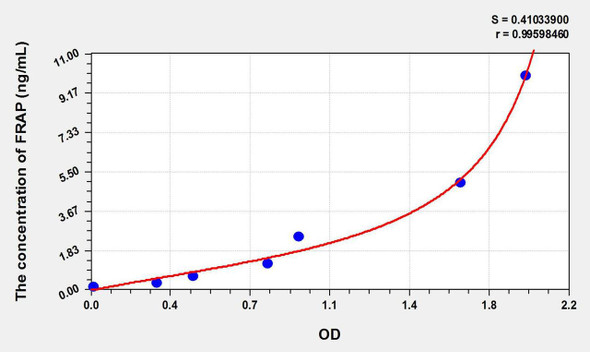
Subtract the OD of the water blank (Standard #4) from all other standard OD values and plot against the standard reduced iron concentrations to determine the slope by linear regression. [FRAP] = (ODSAMPLE - ODBLANK) / Slope (per µM) x n µM Fe3+ reduction potential, where n is the dilution factor (e.g. 10 for serum). Conversion: 1 µM Fe3+ reduction potential equals 0.5 µM Trolox equivalents. If the sample OD exceeds that of the 180 µM standard, dilute in water, repeat and multiply by the dilution factor.
| Component | Quantity | Storage |
| Reagent A | 50 mL | Room Temperature |
| Reagent B | 4 mL | 4°C |
| Reagent C | 4 mL | 4°C |
| Standard (1.8 mM Fe2+) | 1 mL | 4°C |