Description
Lead Ion (Pb2+) Fluorometric Assay Kit (MAES0537)
The Lead Ion (Pb2+) Fluorometric Assay Kit provides a sensitive and reliable method for quantifying lead ions in water samples. Lead is a persistent environmental contaminant with no safe exposure threshold, and monitoring its presence in water is critical for environmental analysis, public health, and toxicology research. This kit enables rapid, accurate determination of Pb2+ levels using a straightforward fluorometric workflow suitable for routine and high-throughput screening.
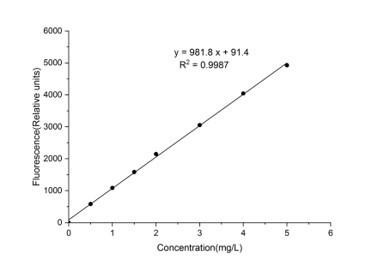
In this assay, lead ions form complexes with chromogenic reagents in the reaction system. When excited by 270 nm ultraviolet light, the complex emits blue fluorescence at 480 nm, and the fluorescence intensity is linearly proportional to the lead ion concentration. The Pb2+ content of a sample is determined by measuring fluorescence against a standard curve. With a detection range of 0.1–5.0 mg/L and high sensitivity (0.1 mg/L), the assay is read on a fluorescence microplate reader (Ex/Em = 270 nm/480 nm) and delivers results in a short, single-incubation protocol.
| Product Name: | Lead Ion (Pb2+) Fluorometric Assay Kit |
| SKU: | MAES0537 |
| Size: | 48T & 96T |
| Detection Method: | Fluorometric Method |
| Sensitivity: | 0.1 mg/L |
| Range: | 0.1–5.0 mg/L |
| Sample Type: | Water |
| Detection Instrument: | Fluorescence Microplate Reader (Ex/Em = 270 nm/480 nm) |
| Research Area: | Environmental Analysis |
| Other Reagents Required: | Concentrated Nitric Acid, Lead-Free Double Distilled Water |
| Storage: | Store reagents at 2–8°C or -20°C as specified per component for 12 months; keep light-sensitive reagents shaded from light. |
| Precision: | Inter-assay CV: 4.8–6.0% Intra-assay CV: 0.8–1.5% |
| Sample Volume: | 200 μL |
| Assay Time: | ~30 min |
Lead ions (Pb2+) form complexes with chromogenic reagents in the reaction system. When excited by 270 nm ultraviolet light, the complex emits blue fluorescence at 480 nm. The fluorescence intensity exhibits a linear relationship with the lead ion concentration, allowing the Pb2+ content of a sample to be calculated by measuring the fluorescence value against a standard curve.