The Mouse Polycystin-1 (PKD1) ELISA Kit is specifically designed for the accurate measurement of Polycystin-1 levels in mouse serum, plasma, and cell culture supernatants. This kit offers high sensitivity and specificity, ensuring precise and reliable results for a variety of research applications.Polycystin-1 is a key protein involved in the regulation of cell proliferation and differentiation, as well as cell-cell and cell-matrix interactions. Mutations in the PKD1 gene have been linked to the development of polycystic kidney disease (PKD), a serious genetic disorder characterized by the formation of fluid-filled cysts in the kidneys.
By accurately quantifying Polycystin-1 levels, researchers can gain valuable insights into the pathophysiology of PKD and potentially discover new therapeutic targets for the treatment of this debilitating condition. The Mouse Polycystin-1 (PKD1) ELISA Kit is a valuable tool for investigating the role of Polycystin-1 in health and disease, and for advancing our understanding of PKD.
Product Name:
Mouse Polycystin-1 (Pkd1) ELISA Kit
SKU:
MOEB2450
Size:
96T
Target:
Mouse Polycystin-1 (Pkd1)
Synonyms:
Autosomal dominant polycystic kidney disease 1 protein homolog
Assay Type:
Sandwich
Detection Method:
ELISA
Reactivity:
Mouse
Detection Range:
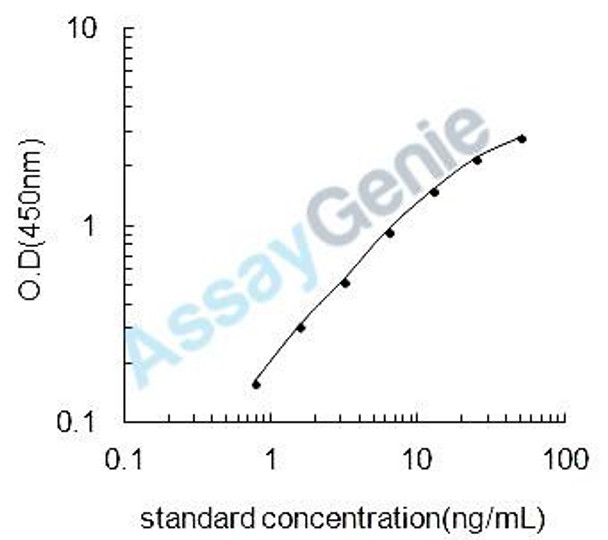
0.78-50ng/mL
Sensitivity:
0.39ng/mL
Intra CV:
9.1%
Inter CV:
11.1%
Linearity:
Sample
1:2
1:4
1:8
1:16
Serum(N=5)
107-117%
110-120%
101-110%
103-113%
EDTA Plasma(N=5)
90-98%
92-102%
86-98%
108-120%
Heparin Plasma(N=5)
100-110%
107-117%
101-111%
100-110%
Recovery:
Sample Type
Average(%)
Recovery Range(%)
Serum
99
93-105
Plasma
101
95-107
Function:
Involved in renal tubulogenesis (PubMed:24939912). Involved in fluid-flow mechanosensation by the primary cilium in renal epithelium (PubMed:12514735). Acts as a regulator of cilium length, together with PKD2 (PubMed:20096584). The dynamic control of cilium length is essential in the regulation of mechanotransductive signaling. The cilium length response creates a negative feedback loop whereby fluid shear-mediated deflection of the primary cilium, which decreases intracellular cAMP, leads to cilium shortening and thus decreases flow-induced signaling. May be an ion-channel regulator. Involved in adhesive protein-protein and protein-carbohydrate.
Uniprot:
O08852
Sample Type:
Serum, plasma, tissue homogenates, cell culture supernates and other biological fluids
Specificity:
Natural and recombinant mouse Polycystin-1
Sub Unit:
Interacts with PKD2. Interacts with PRKX; involved in differentiation and controlled morphogenesis of the kidney (By similarity). Interacts with NPHP1 (via SH3 domain) (PubMed:20856870). Interacts with PKD2L1 (PubMed:15548533). Interacts with BBS1, BBS4, BBS5 and TTC8. Interacts with RGS7.
Research Area:
Cardiovascular
Subcellular Location:
Cell membrane Multi-pass membrane protein Cell projection Cilium PKD1 localization to the plasma and ciliary membranes requires PKD2, is independent of PKD2 channel activity, and involves stimulation of PKD1 autocatalytic cleavage at the GPS domain (PubMed:12514735). Ciliary localization of PKD1 requires BBS1 and ARL6/BBS3 (PubMed:24939912). Cell surface localization requires GANAB (By similarity).
Storage:
Please see kit components below for exact storage details
Note:
For research use only
UniProt Protein Function:
PKD1: Involved in renal tubulogenesis. Involved in fluid-flow mechanosensation by the primary cilium in renal epithelium. Acts as a regulator of cilium length, together with PKD2. The dynamic control of cilium length is essential in the regulation of mechanotransductive signaling. The cilium length response creates a negative feedback loop whereby fluid shear-mediated deflection of the primary cilium, which decreases intracellular cAMP, leads to cilium shortening and thus decreases flow-induced signaling. May be an ion- channel regulator. Involved in adhesive protein-protein and protein-carbohydrate interactions. Defects in PKD1 are the cause of polycystic kidney disease autosomal dominant type 1 (ADPKD1). ADPKD is characterized by progressive formation and enlargement of cysts in both kidneys, typically leading to end-stage renal disease in adult life. Cysts also occurs in the liver and other organs. Its prevalence is estimated at about 1/1000. Belongs to the polycystin family. 3 isoforms of the human protein are produced by alternative splicing.Protein type: Membrane protein, multi-pass; Cell adhesion; Membrane protein, integralCellular Component: basolateral plasma membrane; cell projection; cell surface; cilium; cytoplasm; cytosol; Golgi apparatus; integral to membrane; lateral plasma membrane; membrane; motile primary cilium; nucleus; plasma membraneMolecular Function: calcium channel activity; carbohydrate binding; cation channel activity; protein binding; protein domain specific binding; protein kinase bindingBiological Process: blood vessel development; branching morphogenesis of a tube; calcium ion transport; cartilage condensation; cell cycle arrest; cell-cell adhesion; cytoplasmic sequestering of transcription factor; detection of mechanical stimulus; elevation of cytosolic calcium ion concentration; embryonic placenta development; establishment of cell polarity; G1/S-specific positive regulation of cyclin-dependent protein kinase activity; heart development; in utero embryonic development; JAK-STAT cascade; kidney development; liver development; nitrogen compound metabolic process; peptidyl-serine phosphorylation; positive regulation of protein binding; positive regulation of transcription from RNA polymerase II promoter; protein export from nucleus; regulation of cell adhesion
Autosomal dominant polycystic kidney disease 1 protein homolog
Protein Family:
Polycystin
UniProt Gene Name:
Pkd1
UniProt Entry Name:
PKD1_MOUSE
Component
Quantity (96 Assays)
Storage
ELISA Microplate (Dismountable)
8×12 strips
-20°C
Lyophilized Standard
2
-20°C
Sample Diluent
20ml
-20°C
Assay Diluent A
10mL
-20°C
Assay Diluent B
10mL
-20°C
Detection Reagent A
120µL
-20°C
Detection Reagent B
120µL
-20°C
Wash Buffer
30mL
4°C
Substrate
10mL
4°C
Stop Solution
10mL
4°C
Plate Sealer
5
-
Other materials and equipment required:
Microplate reader with 450 nm wavelength filter
Multichannel Pipette, Pipette, microcentrifuge tubes and disposable pipette tips
Incubator
Deionized or distilled water
Absorbent paper
Buffer resevoir
*Note: The below protocol is a sample protocol. Protocols are specific to each batch/lot. For the correct instructions please follow the protocol included in your kit.
Allow all reagents to reach room temperature (Please do not dissolve the reagents at 37°C directly). All the reagents should be mixed thoroughly by gently swirling before pipetting. Avoid foaming. Keep appropriate numbers of strips for 1 experiment and remove extra strips from microtiter plate. Removed strips should be resealed and stored at -20°C until the kits expiry date. Prepare all reagents, working standards and samples as directed in the previous sections. Please predict the concentration before assaying. If values for these are not within the range of the standard curve, users must determine the optimal sample dilutions for their experiments. We recommend running all samples in duplicate.
Step
1.
Add Sample: Add 100µL of Standard, Blank, or Sample per well. The blank well is added with Sample diluent. Solutions are added to the bottom of micro ELISA plate well, avoid inside wall touching and foaming as possible. Mix it gently. Cover the plate with sealer we provided. Incubate for 120 minutes at 37°C.
2.
Remove the liquid from each well, don't wash. Add 100µL of Detection Reagent A working solution to each well. Cover with the Plate sealer. Gently tap the plate to ensure thorough mixing. Incubate for 1 hour at 37°C. Note: if Detection Reagent A appears cloudy warm to room temperature until solution is uniform.
3.
Aspirate each well and wash, repeating the process three times. Wash by filling each well with Wash Buffer (approximately 400µL) (a squirt bottle, multi-channel pipette,manifold dispenser or automated washer are needed). Complete removal of liquid at each step is essential. After the last wash, completely remove remaining Wash Buffer by aspirating or decanting. Invert the plate and pat it against thick clean absorbent paper.
4.
Add 100µL of Detection Reagent B working solution to each well. Cover with the Plate sealer. Incubate for 60 minutes at 37°C.
5.
Repeat the wash process for five times as conducted in step 3.
6.
Add 90µL of Substrate Solution to each well. Cover with a new Plate sealer and incubate for 10-20 minutes at 37°C. Protect the plate from light. The reaction time can be shortened or extended according to the actual color change, but this should not exceed more than 30 minutes. When apparent gradient appears in standard wells, user should terminatethe reaction.
7.
Add 50µL of Stop Solution to each well. If color change does not appear uniform, gently tap the plate to ensure thorough mixing.
8.
Determine the optical density (OD value) of each well at once, using a micro-plate reader set to 450 nm. User should open the micro-plate reader in advance, preheat the instrument, and set the testing parameters.
9.
After experiment, store all reagents according to the specified storage temperature respectively until their expiry.
When carrying out an ELISA assay it is important to prepare your samples in order to achieve the best possible results. Below we have a list of procedures for the preparation of samples for different sample types.
Sample Type
Protocol
Serum
If using serum separator tubes, allow samples to clot for 30 minutes at room temperature. Centrifuge for 10 minutes at 1,000x g. Collect the serum fraction and assay promptly or aliquot and store the samples at -80°C. Avoid multiple freeze-thaw cycles. If serum separator tubes are not being used, allow samples to clot overnight at 2-8°C. Centrifuge for 10 minutes at 1,000x g. Remove serum and assay promptly or aliquot and store the samples at -80°C. Avoid multiple freeze-thaw cycles.
Plasma
Collect plasma using EDTA or heparin as an anticoagulant. Centrifuge samples at 4°C for 15 mins at 1000 × g within 30 mins of collection. Collect the plasma fraction and assay promptly or aliquot and store the samples at -80°C. Avoid multiple freeze-thaw cycles. Note: Over haemolysed samples are not suitable for use with this kit.
Urine & Cerebrospinal Fluid
Collect the urine (mid-stream) in a sterile container, centrifuge for 20 mins at 2000-3000 rpm. Remove supernatant and assay immediately. If any precipitation is detected, repeat the centrifugation step. A similar protocol can be used for cerebrospinal fluid.
Cell culture supernatant
Collect the cell culture media by pipette, followed by centrifugation at 4°C for 20 mins at 1500 rpm. Collect the clear supernatant and assay immediately.
Cell lysates
Solubilize cells in lysis buffer and allow to sit on ice for 30 minutes. Centrifuge tubes at 14,000 x g for 5 minutes to remove insoluble material. Aliquot the supernatant into a new tube and discard the remaining whole cell extract. Quantify total protein concentration using a total protein assay. Assay immediately or aliquot and store at ≤ -20 °C.
Tissue homogenates
The preparation of tissue homogenates will vary depending upon tissue type. Rinse tissue with 1X PBS to remove excess blood & homogenize in 20ml of 1X PBS (including protease inhibitors) and store overnight at ≤ -20°C. Two freeze-thaw cycles are required to break the cell membranes. To further disrupt the cell membranes you can sonicate the samples. Centrifuge homogenates for 5 mins at 5000xg. Remove the supernatant and assay immediately or aliquot and store at -20°C or -80°C.
Tissue lysates
Rinse tissue with PBS, cut into 1-2 mm pieces, and homogenize with a tissue homogenizer in PBS. Add an equal volume of RIPA buffer containing protease inhibitors and lyse tissues at room temperature for 30 minutes with gentle agitation. Centrifuge to remove debris. Quantify total protein concentration using a total protein assay. Assay immediately or aliquot and store at ≤ -20 °C.
Breast Milk
Collect milk samples and centrifuge at 10,000 x g for 60 min at 4°C. Aliquot the supernatant and assay. For long term use, store samples at -80°C. Minimize freeze/thaw cycles.