Description
Parallel Artificial Membrane Permeability Assay (PAMPA) Kit (BA0259) (BA0259)
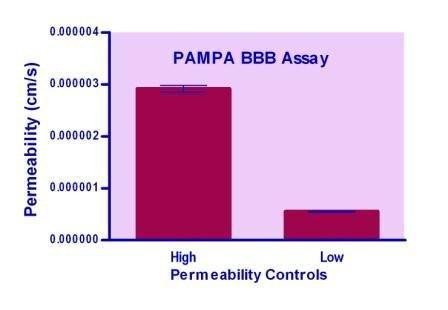
The Parallel Artificial Membrane Permeability Assay (PAMPA) Kit (SKU: BA0259) provides all the components needed to evaluate the gastrointestinal (GI) membrane permeability of test compounds. Membrane permeability is an important characteristic when assessing compounds as potential drug candidates, since drugs often need to cross cell membranes to reach their target of action. While permeability can be evaluated by cell-based methods, these are often expensive and time-consuming; parallel artificial membrane permeability assays offer a quick, inexpensive alternative. This kit supplies donor and acceptor plates, a working tray, dodecane, dried lecithin and high, medium and low permeability controls to run a complete GI permeability assay. Test compounds diffuse across an artificial lipid membrane and their passage is quantified by UV absorbance, allowing calculation of an effective permeability rate. The assay is simple, low-cost and can be readily automated as a high-throughput 96-well method for thousands of samples per day.
| Product Name: | Parallel Artificial Membrane Permeability Assay (PAMPA) Kit (BA0259) |
| SKU: | BA0259 |
| Detection Method: | Absorbance-based permeability assay. Test compounds diffuse across an artificial lipid membrane from a donor to an acceptor compartment over an incubation period; peak UV absorbance (200-500 nm) of the acceptor and equilibrium standard solutions is used to calculate the effective permeability rate (Pe). |
| Sample Type: | Test compounds prepared as 10 mM stock solutions in DMSO |
| Species Reactivity: | All |
| Assay Time: | 18 hours incubation (typically 16-24 hours) |
| Kit Size: | 96 Assays |
| Equipment Required: | Microplate reader |
| Storage: | Store the Permeability Controls, Dodecane and Dried Lecithin at -20°C upon receipt; store the Donor Plate, Acceptor Plate and Working Tray at room temperature. |
| Shelf Life: | 12 months after receipt |
| Shipping: | Room Temperature |
This assay measures the passive permeability of test compounds across an artificial lipid membrane. A lecithin-in-dodecane membrane separates a donor compartment (containing the test compound) from an acceptor compartment; after incubation, the peak UV absorbance of the acceptor solution and of equilibrium standards is measured (200-500 nm) and used to calculate the effective permeability rate (Pe) for each compound and permeability control.
- Convenient. Includes all necessary equipment to run a PAMPA plate.
- Simple and low-cost. The procedure is easy to follow and more affordable than cell-based permeability assays.
- High-throughput. Can be readily automated as a high-throughput 96-well plate assay for thousands of samples per day.
- Direct assays to assess the membrane permeability of test compounds.
Note: The below protocol is a sample protocol. Protocols are specific to each batch/lot. For the correct instructions please follow the protocol included in your kit.
| Step | Procedure |
| 1 | Equilibrate all components to room temperature and briefly centrifuge tubes before opening. Prepare a 4% lecithin-in-dodecane solution by resuspending the dried lecithin with 750 µL dodecane, pipetting repeatedly (~100 times) until fully solubilised (vortexing or sonication may assist). Prepare 10 mM test compound stock solutions in DMSO; the supplied Permeability Controls are provided as 10 mM DMSO solutions. |
| 2 | In separate tubes, prepare 500 µL of 500 µM test compound by mixing 25 µL of 10 mM stock with 475 µL PBS; dilute Permeability Controls to 500 µM in the same way. |
| 3 | Prepare 200 µM Equilibrium Standards for each compound and control by mixing 80 µL of 500 µM solution with 120 µL PBS. Prepare a Blank Control by mixing 5 µL DMSO with 245 µL PBS. Set the Equilibrium Standards and Blank Control aside for analysis the next day. |
| 4 | Add 300 µL PBS to the wells of the acceptor plate. |
| 5 | With the donor plate still in its tray, add 5 µL of 4% lecithin in dodecane directly to the well membranes, being careful not to puncture them. |
| 6 | Add 200 µL of each 500 µM test compound and Permeability Control to duplicate wells of the donor plate (run all variables in at least duplicate). |
| 7 | Carefully place the donor plate into the acceptor plate wells and incubate at room temperature or 37°C for 18 hours (or the desired 16-24 hour period). |
| 8 | Carefully remove the donor plate and collect the liquid in the acceptor plate wells (the Acceptor Solution). Add 100 µL of Acceptor Solution, Equilibrium Standards and Blank Control to the wells of a UV plate. |
| 9 | Read the absorbance spectrum from 200 nm to 500 nm in 10 nm intervals to determine the peak absorbance of the test compounds (peak absorbance for the High, Medium and Low Permeability Controls is 280 nm, 270 nm and 270 nm respectively). Analysis may alternatively be performed by HPLC, MS or other methods. |
Pe = C x -ln(1 - ODA / ODE) cm/s, where ODA is the absorbance of the Acceptor Solution minus Blank, ODE is the absorbance of the Equilibrium Standard minus Blank, and for an 18-hour incubation C = 7.72x10^-6. For a different incubation time, C = (V_D x V_A) / ((V_D + V_A) x Area x time), where Donor Volume V_D = 0.2 cm^3, Acceptor Volume V_A = 0.3 cm^3, Membrane Area = 0.24 cm^2 and time is in seconds (18 h = 64,800 s).
| Component | Quantity | Storage |
| Donor Plate | 1 Plate | Room Temperature |
| Acceptor Plate | 1 Plate | Room Temperature |
| Working Tray | 1 Plate | Room Temperature |
| Dodecane | 1.5 mL | -20°C |
| Dried Lecithin | 1 Tube | -20°C |
| High Permeability Control | 120 µL | -20°C |
| Medium Permeability Control | 120 µL | -20°C |
| Low Permeability Control | 120 µL | -20°C |