The Phospho-p38 MAPK-T180/Y182 Antibody (CABP0526) is a high-quality antibody developed for reliable detection and analysis of target proteins. This antibody, generated in rabbits, specifically recognizes the phosphorylated form of MAPK14 at threonine 180 and tyrosine 182 residues, crucial for its activation and function in cellular signaling pathways.MAPK14 is a key player in various cellular processes, including inflammation, stress response, and cell proliferation. Phosphorylation of MAPK14 at T180/Y182 is essential for its activation and subsequent downstream signaling events. The Phospho-MAPK14 antibody is validated for use in Western blot applications and is highly reactive with human samples, allowing for precise detection and quantification of phosphorylated MAPK14 in different cell types and experimental conditions.
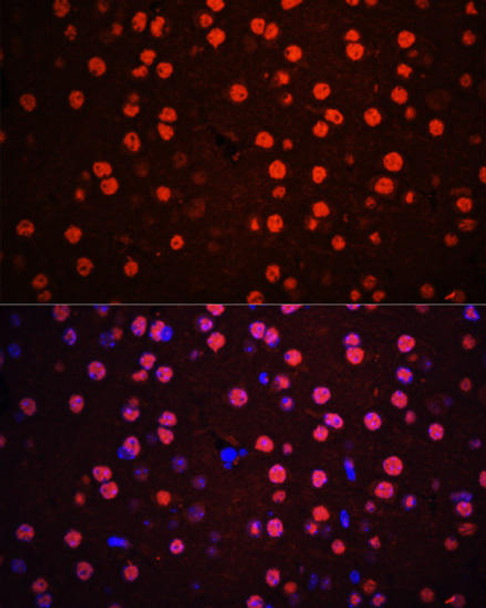
This antibody is validated for use in WB, ELISA, IF-P applications and has demonstrated reactivity against Human, Mouse, Rat samples.
Product Name:
Phospho-p38 MAPK-T180/Y182 Antibody
SKU:
CABP0526
Size:
20μL, 100μL
Reactivity:
Human, Mouse, Rat
Conjugate:
Unconjugated
Immunogen:
Synthetic peptide. This information is considered to be commercially sensitive.
Sequence:
MTGY V
Tested Applications:
WBELISAIF-P
Recommended Dilution:
WB
1:2000 - 1:20000
IF-P
1:50 - 1:200
ELISA
Recommended starting concentration is 1 μg/mL. Please optimize the concentration based on your specific assay requirements.
The protein encoded by this gene is a member of the MAP kinase family. MAP kinases act as an integration point for multiple biochemical signals, and are involved in a wide variety of cellular processes such as proliferation, differentiation, transcription regulation and development. This kinase is activated by various environmental stresses and proinflammatory cytokines. The activation requires its phosphorylation by MAP kinase kinases (MKKs), or its autophosphorylation triggered by the interaction of MAP3K7IP1/TAB1 protein with this kinase. The substrates of this kinase include transcription regulator ATF2, MEF2C, and MAX, cell cycle regulator CDC25B, and tumor suppressor p53, which suggest the roles of this kinase in stress related transcription and cell cycle regulation, as well as in genotoxic stress response. Four alternatively spliced transcript variants of this gene encoding distinct isoforms have been reported.
Purification Method
Affinity purification
Gene ID
5600 6300 5603 1432
RRID
AB_2771309
Buffer Information
Store at -20℃. Avoid freeze / thaw cycles. Buffer: PBS containing 50% glycerol, preserved with proclin300 or sodium azide, pH 7.3.
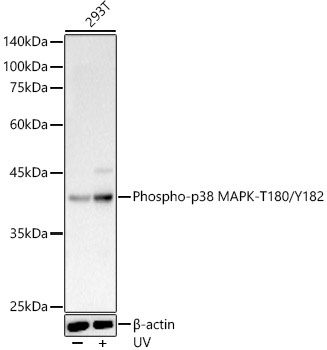
Western blot analysis of lysates from 293T cells, using Phospho-p38 MAPK-T180/Y182 Rabbit pAb (CABP0526) at 1:18000 dilution. 293T cells were treated with UV at room temperature for 15-30 minutes. Secondary antibody: HRP-conjugated Goat anti-Rabbit IgG (H+L) (CABS014) at 1:10000 dilution. Lysates/proteins: 25μg per lane. Blocking buffer: 3% nonfat dry milk in TBST. Detection: ECL Basic Kit (AbGn00020). Exposure time: 20s.
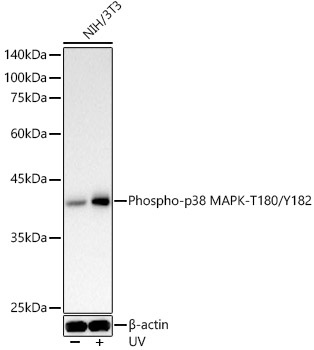
Western blot analysis of lysates from NIH/3T3 cells, using Phospho-p38 MAPK-T180/Y182 Rabbit pAb (CABP0526) at 1:18000 dilution. NIH/3T3 cells were treated with UV at room temperature for 15-30 minutes. Secondary antibody: HRP-conjugated Goat anti-Rabbit IgG (H+L) (CABS014) at 1:10000 dilution. Lysates/proteins: 25μg per lane. Blocking buffer: 3% nonfat dry milk in TBST. Detection: ECL Basic Kit (AbGn00020). Exposure time: 20s.