Description
Recombinant Mouse Adiponectin/Acrp30/ADIPOQ Protein
The Recombinant Mouse Adiponectin/Acrp30/ADIPOQ Protein is a high-quality recombinant protein designed for murine biological research applications. This protein serves as an essential reagent in mouse model studies, comparative immunology research, and preclinical therapeutic evaluations, enabling scientists to investigate Adiponectin/Acrp30/ADIPOQ biology and its relevance to human disease mechanisms through translational research approaches.
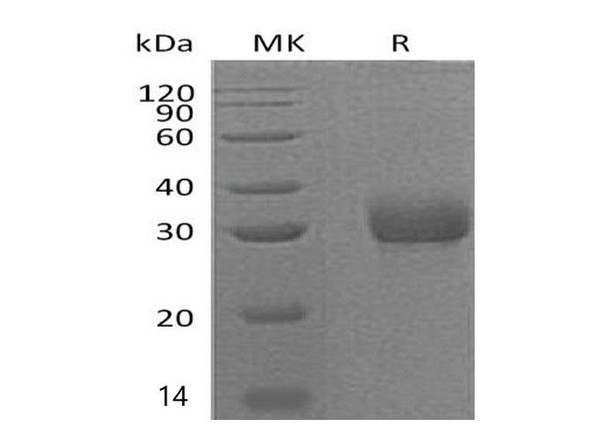
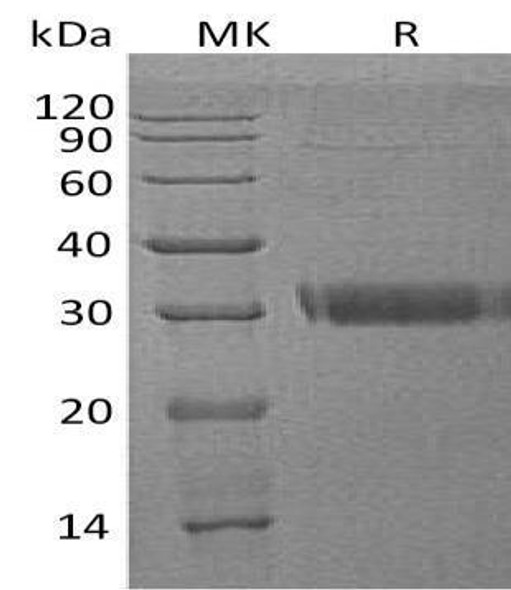
This product (SKU: RPCB1294) is produced using HEK293 cells and features a C-His tag for convenient detection and purification. The protein exhibits a calculated molecular weight of 25.76 kDa with an observed molecular weight of 30-35 kDa under denaturing conditions, achieving ≥ 90 % as determined by SDS-PAGE.. Functional bioactivity has been validated through rigorous quality control assays, confirming its suitability for demanding research applications.
Key Features
| High Purity by Affinity Chromatography | |
| Mammalian & Bacterial Expression Systems | |
| High lot-to-lot consistency via strict QC |
| Product Name: | Recombinant Mouse Adiponectin/Acrp30/ADIPOQ Protein |
| SKU: | RPCB1294 |
| Size: | 10 μg , 20 μg , 100 μg |
| Reactivity: | Mouse |
| Synonyms: | Adiponectin |
| Tag: | C-His |
| Expression Host: | HEK293 cells |
| Calculated MW: | 25.76 kDa |
| Observed MW: | 30-35 kDa |
| Gene ID: | 11450 |
| Protein Description: | High quality, high purity and low endotoxin recombinant Recombinant Mouse Adiponectin/Acrp30/ADIPOQ Protein (RPCB1294), tested reactivity in HEK293 cells and has been validated in SDS-PAGE.100% guaranteed. |
| Endotoxin: | < 0.1 EU/μg of the protein by LAL method. |
| Purity: | ≥ 90 % as determined by SDS-PAGE. |
| Formulation: | Lyophilized from a 0.22 μm filtered solution of PBS, pH 7.4. |
| Bio-Activity: | Measured by its binding ability in a functional ELISA. Immobilized Human TNFSF12 at 2 μg/mL (100 μL/well) can bind Human TNFRSF12A with a linear range of 0.1-2.3 ng/mL. |
| Reconstitution: | Centrifuge the vial before opening. Reconstitute to a concentration of 0.1-0.5 mg/mL in sterile distilled water. Avoid vortex or vigorously pipetting the protein. For long term storage, it is recommended to add a carrier protein or stablizer (e.g. 0.1% BSA, 5% HSA, 10% FBS or 5% Trehalose), and aliquot the reconstituted protein solution to minimize free-thaw cycles. |
| Storage: | Store at -20℃.Store the lyophilized protein at -20℃ to -80 ℃ up to 1 year from the date of receipt. After reconstitution, the protein solution is stable at -20℃ for 3 months, at 2-8℃ for up to 1 week. |
Adiponectin (ADIPOQ), or 30 kDa adipocyte complement-related protein (Acrp30) is a protein secreted by adipose tissue, which acts to reduce insulin resistance and atherogenic damage, but it also exerts actions in other tissues. Adiponectin mediates its actions in the periphery mainly via two receptors, AdipoR1 and AdipoR2. Adiponectin influences gonadotropin release, normal pregnancy, and assisted reproduction outcomes. Adiponectin, a beneficial adipokine, represents a major link between obesity and reproduction. Higher levels of adiponectin are associated with improved menstrual function and better outcomes in assisted reproductive cycles. Unlike other adipocytokines produced by adipose tissue, adiponectin appears to have anti-inflammatory, anti-diabetic, and anti-atherogenic properties. Several clinical studies demonstrate the inverse relationship between plasma adiponectin levels and several inflammatory markers including C-reactive protein. Adiponectin attenuates inflammatory responses to multiple stimuli by modulating signaling pathways in a variety of cell types. The anti-inflammatory properties of adiponectin may be a major component of its beneficial effects on cardiovascular and metabolic disorders including atherosclerosis and insulin resistance. Additionally, it is important factor in chronic liver diseases and chronic kidney diseases. Some cancer cell types express adiponectin receptors. Thus Adiponectin may act on tumour cells directly by binding and activating adiponectin receptors and downstream signalling pathways.
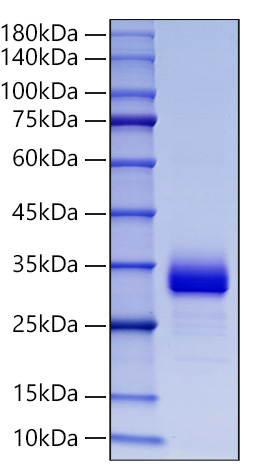 | Recombinant Mouse Adiponectin/Acrp30/ADIPOQ Protein was determined by SDS-PAGE under reducing conditions with Coomassie Blue. |