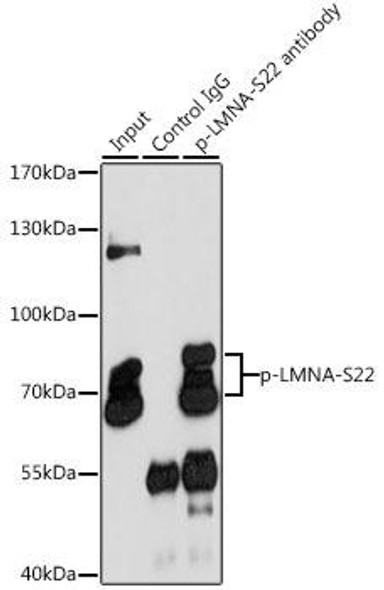
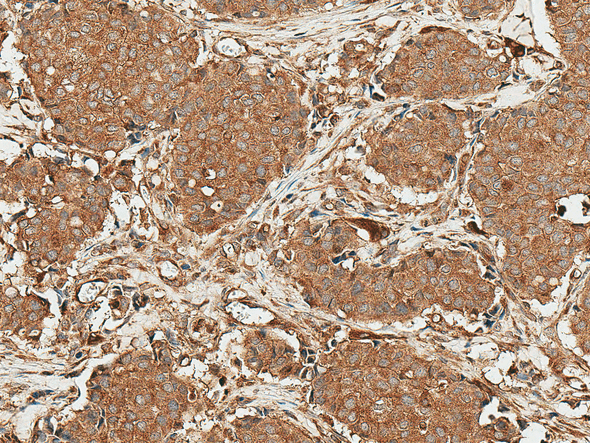
Slo1 Antibody [S22] is a rabbit recombinant monoclonal antibody directed against Slo1, offered by Assay Genie for research applications. Reported applications include WB, IHC and ICC/IF. Reported reactivity: Human, Mouse and Rat. Supplied as IgG Kappa, purified by AmMag™ Ultra AT Protein A MagBeads.
Slo1, also known as the BK (Big Potassium) channel or BKα, is a voltage- and calcium-activated potassium channel highly expressed in neurons and smooth muscle. It plays a critical role in regulating membrane excitability by facilitating the repolarization phase of action potentials and modulating neurotransmitter release. Slo1 channel activity is finely tuned by intracellular Ca²⁺ levels and membrane potential, and is further regulated by auxiliary KCNMB subunits. This dynamic regulation enables Slo1 to influence synaptic transmission, motor coordination, and responses to ethanol. Notably, Slo1 dysfunction has been implicated in a range of neurological and neuromuscular disorders, including epilepsy, ataxia, hypertension, and muscular dystrophy. Recent studies suggest that Slo1 may also contribute to neurodegenerative disease mechanisms by altering neuronal firing patterns and calcium homeostasis. Its interaction with dystrophin-related pathways further underscores its relevance in neuromuscular integrity. Given its broad physiological roles and disease associations, Slo1 is emerging as a promising target for therapeutic intervention and biomarker development in neurodegenerative research. This antibody is also available conjugated to ATTO 390, ATTO 488, ATTO 594, APC, Biotin, FITC, HRP, PerCP and RPE. Supplied in 100 µg. For research use only; not for diagnostic or therapeutic procedures.
Product Name:
Slo1 Antibody [S22]
Product SKU:
STMA00229
Size:
100 µg
Target:
Slo1
Host Species:
Rabbit
Antibody Type:
Recombinant Monoclonal
Clone ID:
S22
Research Areas:
Cancer, Cell Signaling, Neuroscience, Ion Channels, Potassium Channels, Calcium-Activated Potassium Channels, Cardiovascular System
Buffer:
PBS pH 7.4, 0.02% Proclin 300, 50% glycerol
Storage & Shipping:
Store at -20°C. Shipped on Blue Ice or 4°C. Conjugated variants should be stored according to the product label.
Format:
Liquid
Applications:
WB, IHC, ICC/IF
Antibody Isotype:
IgG Kappa
Purification:
AmMag™ Ultra AT Protein A MagBeads
Concentration:
1mg/ml
Reactivity:
Human, Mouse, Rat
Recommended Dilution:
WB (1:1000), IHC (1:100), ICC/IF (1:100); optimal dilutions for assays should be determined by the user.
Specificity:
Detects C-terminus of Slo1, epitope mapped to within AA #690-715 (PKLMRHDPLLIPGNDQIDNMDSNVKK).
Guarantee:
12 months from date of dispatch
Immunogen:
Fusion protein, AA #690-1196 (cytoplasmic C-terminus) of mouse Slo1. Epitope mapped to within AA #690-715 (PKLMRHDPLLIPGNDQIDNMDSNVKK).
Immunogen Species:
Mouse
Accession Number:
AAA39746.1
Gene ID:
16531
Swiss-Prot:
Q08460
Cellular Localization:
Cell Membrane, Nucleus
Tissue Specificity:
Widely expressed. Found in glandular tissues, smooth and skeletal muscles, and in neural tissues.
1. Yang, C.T., Zeng X.H., Xia X.M., and Lingle C.J. (2009). Interactions between β Subunits of the KCNMB Family and Slo3: β4 Selectively Modulates Slo3 Expression and FunctionPloS One. 4(7): e6135. DOI: 10.1371/journal.pone.0006135 2. Latorre, R., & Brauchi, S. (2006). Large conductance Ca2+-activated K+ (BK) channel: Activation by Ca2+ and voltage. Biological Research, 39(3), 385-401. DOI: 10.4067/s0716-97602006000300003 3. Petkov G. V. (2014). Central role of the BK channel in urinary bladder smooth muscle physiology and pathophysiology. American journal of physiology. Regulatory, integrative and comparative physiology, 307(6), R571–R584. DOI: 10.1152/ajpregu.00142.2014 4. Pathak, D., Guan, D., & Foehring, R. C. (2016). Roles of specific Kv channel types in repolarization of the action potential in genetically identified subclasses of pyramidal neurons in mouse neocortex. Journal of neurophysiology, 115(5), 2317–2329. DOI: 10.1152/jn.01028.2015 5. Kim, H., Pierce-Shimomura, J. T., Oh, H. J., Johnson, B. E., Goodman, M. B., & McIntire, S. L. (2009). The dystrophin complex controls bk channel localization and muscle activity in Caenorhabditis elegans. PLoS genetics, 5(12), e1000780. DOI: 10.1371/journal.pgen.1000781

![Western blot analysis with Rabbit Anti- Slo1 Monoclonal Antibody, Clone S22 (STMA00229) showing detection of Human Slo1 protein in a transient over-expression (OE) lysate (OriGene LY400815). Block: 2% skim milk + 2% BSA for 1 hour at RT. Primary Antibody: Rabbit Anti-Mouse Slo1 Recombinant Monoclonal [S22] (STMA00229) at 1:1000 for 2 hours at RT. Secondary Antibody: at 1:5000 for 1 hour at RT.](https://cdn11.bigcommerce.com/s-h68l9z2lnx/images/stencil/1280x1280/products/279995/757183/SMC-625_Slo1_Antibody_S22_WB_Human-OE-lysate_1__81767.1785409585.png?c=2?imbypass=on "Western blot analysis with Rabbit Anti- Slo1 Monoclonal Antibody, Clone S22 (STMA00229) showing detection of Human Slo1 protein in a transient over-expression (OE) lysate (OriGene LY400815). Block: 2% skim milk + 2% BSA for 1 hour at RT. Primary Antibody: Rabbit Anti-Mouse Slo1 Recombinant Monoclonal [S22] (STMA00229) at 1:1000 for 2 hours at RT. Secondary Antibody: at 1:5000 for 1 hour at RT.")
![Western blot analysis with Rabbit Anti- Slo1 Monoclonal Antibody, Clone S22 (STMA00229) showing detection of Human Slo1 protein in a transient over-expression (OE) lysate (OriGene LY400815). Block: 2% skim milk + 2% BSA for 1 hour at RT. Primary Antibody: Rabbit Anti-Mouse Slo1 Recombinant Monoclonal [S22] (STMA00229) at 1:1000 for 2 hours at RT. Secondary Antibody: at 1:5000 for 1 hour at RT.](https://cdn11.bigcommerce.com/s-h68l9z2lnx/images/stencil/608x608/products/279995/757183/SMC-625_Slo1_Antibody_S22_WB_Human-OE-lysate_1__81767.1785409585.png?c=2 "Western blot analysis with Rabbit Anti- Slo1 Monoclonal Antibody, Clone S22 (STMA00229) showing detection of Human Slo1 protein in a transient over-expression (OE) lysate (OriGene LY400815). Block: 2% skim milk + 2% BSA for 1 hour at RT. Primary Antibody: Rabbit Anti-Mouse Slo1 Recombinant Monoclonal [S22] (STMA00229) at 1:1000 for 2 hours at RT. Secondary Antibody: at 1:5000 for 1 hour at RT.")