Description
Acid Phosphatase Assay Kit (Fluorometric) (BA0156) (BA0156)
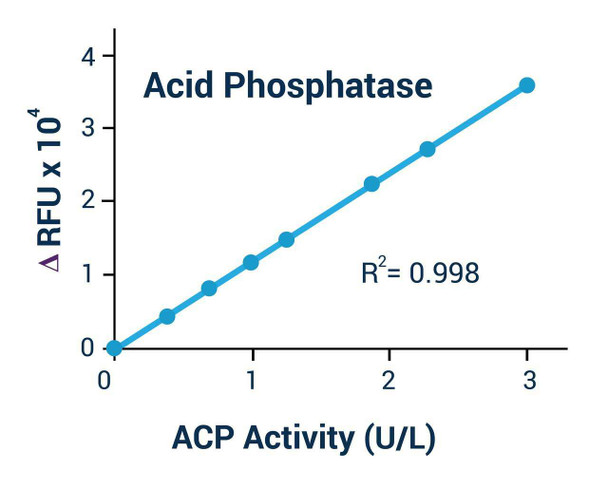
The Acid Phosphatase Assay Kit (SKU: BA0156) provides a non-radioactive fluorometric method for measuring acid phosphatase (ACP) activity in biological samples. Acid phosphatase catalyses the cleavage of phosphate groups from other molecules during digestion and is found in lysosomes as well as in bone, spleen, liver, kidney and blood, where serum levels can act as a biomarker for prostatic carcinoma. This assay is based on the cleavage of a synthetic substrate, releasing methylumbelliferone, which becomes intensely fluorescent after addition of the stop reagent. The increase in fluorescence at 360/450 nm after the stop reagent is added is directly proportional to the enzyme activity. The homogeneous mix-incubate-measure format is readily automated for high-throughput use.
| Product Name: | Acid Phosphatase Assay Kit (Fluorometric) (BA0156) |
| SKU: | BA0156 |
| Detection Method: | Fluorometric (kinetic) |
| Detection Range: | 0.008 - 10 U/L (30 min reaction) |
| Sample Type: | Plasma, serum, cell lysate and tissue samples |
| Species Reactivity: | All |
| Assay Time: | 30 minutes |
| Kit Size: | 100 Assays |
| Equipment Required: | Microplate reader |
| Storage: | Store all components at -20 C upon receipt. |
| Shelf Life: | 6 months after receipt |
| Shipping: | Room Temperature |
A non-radioactive kinetic fluorometric assay for the quantitative determination of acid phosphatase activity. Acid phosphatase cleaves a synthetic substrate to release methylumbelliferone, which fluoresces intensely after addition of a stop reagent; the increase in fluorescence at 360/450 nm is proportional to enzyme activity. The homogeneous format is suitable for high-throughput screening.
- Fast and sensitive, with a linear detection range of 0.008 - 10 U/L (30 min reaction, 20 uL sample)
- Non-radioactive assay
- Convenient homogeneous mix-incubate-measure format
- Readily automated on HTS liquid-handling systems
- Acid phosphatase activity determination in biological samples such as plasma, serum, cell lysate and tissue samples
Note: The below protocol is a sample protocol. Protocols are specific to each batch/lot. For the correct instructions please follow the protocol included in your kit.
| Step | Procedure |
| 1 | Prepare samples: dilute serum and plasma 2-5 fold; homogenise tissue in 50 mM Tris buffer (pH 7.5) and centrifuge; prepare cell lysates in cold 50 mM Tris buffer and centrifuge. Use the supernatant for assay. |
| 2 | Equilibrate all components to the desired reaction temperature (e.g. 25 C or 37 C). |
| 3 | Prepare standards: mix 25 uL of Standard with 475 uL water (100 uM premix) and dilute to 100, 60, 30 and 0 uM. Transfer 20 uL of each standard and 20 uL of each sample into wells of a black flat-bottom 96-well plate. |
| 4 | Prepare Working Reagent per well by mixing 85 uL Assay Buffer and 1 uL MUP Substrate. Add 80 uL to all wells and tap briefly to mix. |
| 5 | Incubate at 25 C (or the desired temperature) for 30 min, then add 50 uL Stop Reagent to each well and tap to mix. |
| 6 | Read fluorescence at 360/450 nm. |
Subtract the water blank from the standard values and plot the change in fluorescence against standard concentration to determine the slope. Calculate ACP Activity = (F_SAMPLE - F_BLANK) / (Time x Slope) x n (U/L), where Time is the reaction time (30 min) and n is the dilution factor. One unit of ACP catalyses the conversion of 1 umole of 4-methylumbelliferyl phosphate per minute at 25 C and pH 5.3.
| Component | Quantity | Storage |
| Assay Buffer | 12 mL | -20 C |
| MUP Substrate | 120 uL | -20 C |
| Stop Reagent | 12 mL | -20 C |
| Standard | 120 uL | -20 C |