The ATP1B3 Monoclonal Antibody (CAB19637) is a high-quality antibody developed for reliable detection and analysis of target proteins. This polyclonal antibody, produced in rabbits, is suitable for various research applications, including Western blot, immunofluorescence, and immunohistochemistry.ATP1B3, a subunit of the Na+/K+-ATPase pump, plays a crucial role in maintaining cellular homeostasis and regulating cell signaling pathways. Dysregulation of ATP1B3 expression or function has been implicated in various diseases, including neurological disorders, cardiovascular diseases, and cancer.
This antibody is validated for use in WB, IHC-P, ELISA applications and has demonstrated reactivity against Human, Mouse, Rat samples.
Product Name:
ATP1B3 Monoclonal Antibody
SKU:
CAB19637
Size:
20μL, 100μL
Reactivity:
Human, Mouse, Rat
Clone Number:
ARC2205
Conjugate:
Unconjugated
Immunogen:
Synthetic peptide. This information is considered to be commercially sensitive.
The protein encoded by this gene belongs to the family of Na+/K+ and H+/K+ ATPases beta chain proteins, and to the subfamily of Na+/K+ -ATPases. Na+/K+ -ATPase is an integral membrane protein responsible for establishing and maintaining the electrochemical gradients of Na and K ions across the plasma membrane. These gradients are essential for osmoregulation, for sodium-coupled transport of a variety of organic and inorganic molecules, and for electrical excitability of nerve and muscle. This enzyme is composed of two subunits, a large catalytic subunit (alpha) and a smaller glycoprotein subunit (beta). The beta subunit regulates, through assembly of alpha/beta heterodimers, the number of sodium pumps transported to the plasma membrane. The glycoprotein subunit of Na+/K+ -ATPase is encoded by multiple genes. This gene encodes a beta 3 subunit. This gene encodes a beta 3 subunit. A pseudogene exists for this gene, and it is located on chromosome 2.
Purification Method
Affinity purification
Gene ID
483
Buffer Information
Store at -20℃. Avoid freeze / thaw cycles. Buffer: PBS containing 50% glycerol and 0.05% BSA, preserved with proclin300 or sodium azide, pH 7.3.
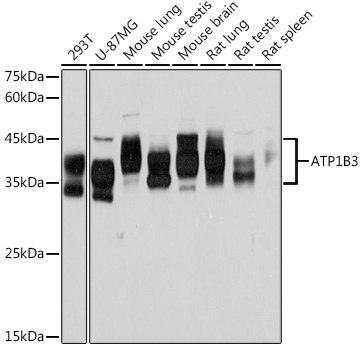
Western blot analysis of various lysates using ATP1B3 Rabbit mAb (CAB19637) at 1:1000 dilution. Secondary antibody: HRP-conjugated Goat anti-Rabbit IgG (H+L) (CABS014) at 1:10000 dilution. Lysates/proteins: 25μg per lane. Blocking buffer: 3% nonfat dry milk in TBST. Detection: ECL Basic Kit (AbGn00020). Exposure time: 60s.
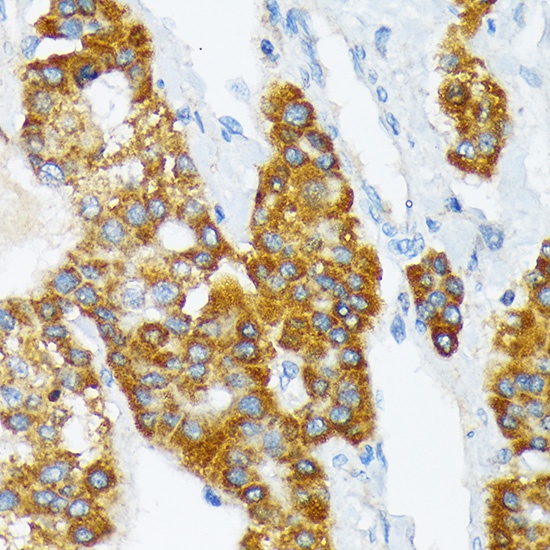
Immunohistochemistry analysis of paraffin-embedded Human liver cancer using ATP1B3 Rabbit mAb (CAB19637) at dilution of 1:100 (40x lens). Microwave antigen retrieval performed with 0.01M Tris/EDTA Buffer (pH 9.0) prior to IHC staining.



![Anti-ATP1B3 [R02-1B4] Monoclonal Antibody (AGMB02009)](https://cdn11.bigcommerce.com/s-h68l9z2lnx/images/stencil/590x590/products/273298/679941/anti-atp1b3-r02-1b4-monoclonal-antibody-agmb02009__19962.1773040476.jpg?c=2 "Anti-ATP1B3 [R02-1B4] Monoclonal Antibody (AGMB02009)")
![Anti-ATP1B3 [R09-8T3] Monoclonal Antibody (AGMB03141)](https://cdn11.bigcommerce.com/s-h68l9z2lnx/images/stencil/590x590/products/274430/678189/anti-atp1b3-r09-8t3-monoclonal-antibody-agmb03141__88522.1773034954.jpg?c=2 "Anti-ATP1B3 [R09-8T3] Monoclonal Antibody (AGMB03141)")