The Pan-Crotonyl-K Antibody (CAB20502) is a high-quality antibody developed for reliable detection and analysis of target proteins. This antibody, produced in rabbits, demonstrates high reactivity with crotonylated lysine residues in various samples, making it a valuable tool for studying protein crotonylation in biological systems.Crotonylation is a newly discovered histone modification that plays a role in gene expression and chromatin remodeling. The Anti-Pan Crotonyl K Antibody binds specifically to crotonylated lysine residues, allowing for the detection and analysis of crotonylated proteins in various cell types and tissues. This antibody is validated for use in applications such as Western blot, immunoprecipitation, and immunofluorescence, providing researchers with a versatile tool for studying the role of protein crotonylation in various physiological and pathological processes.
This antibody is validated for use in WB, ELISA applications and has demonstrated reactivity against Human, Mouse, Rat samples.
Product Name:
Pan-Crotonyl-K Antibody
SKU:
CAB20502
Size:
20μL, 100μL
Reactivity:
Human, Mouse, Rat
Conjugate:
Unconjugated
Immunogen:
Synthetic peptide. This information is considered to be commercially sensitive.
Tested Applications:
WBELISA
Recommended Dilution:
WB
1:500 - 1:1000
ELISA
Recommended starting concentration is 1 μg/mL. Please optimize the concentration based on your specific assay requirements.
Positive Sample:
HeLa treated with Sodium crotonate, NIH/3T3 treated with Sodium crotonate, Mouse brain, Mouse testis, Rat brain, Rat testis
Observed MW:
10-250kDa
Lysine crotonylation (Kcr) was first discovered about 10 years ago, as a PTM of histone. It was revealed that Kcr is an evolutionarily conserved and common PTM that occurs in both core histone and some non-histone proteins in a variety of organisms. Similar to other types of PTM, Kcr is a reversible modification. The classic histone acetyltransferases (HATs), p300/CBP, PCAF, and MOF, are responsible for most crotonylation events, while the histone deacetylases (HDACs) HDAC1/2/3 and SIRT1/2/3 reverse these reactions . The chromodomain protein CDYL acts as a crotonyl-CoA hydratase to negatively regulate histone Kcr by reducing substrate supply. CDYL-regulated Kcr of RPA1 plays an important role in homologous recombination (HR)-mediated DNA repair (23), while HDAC-regulated histone crotonylation is reduced after DNA damage .
Purification Method
Affinity purification
Buffer Information
Store at -20℃. Avoid freeze / thaw cycles. Buffer: PBS with 0.09% Sodium azide,50% glycerol,pH7.3.
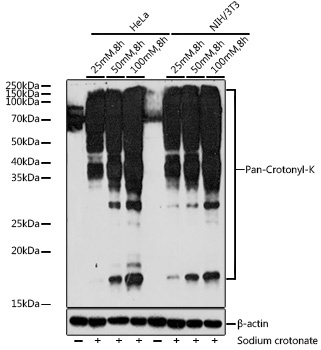
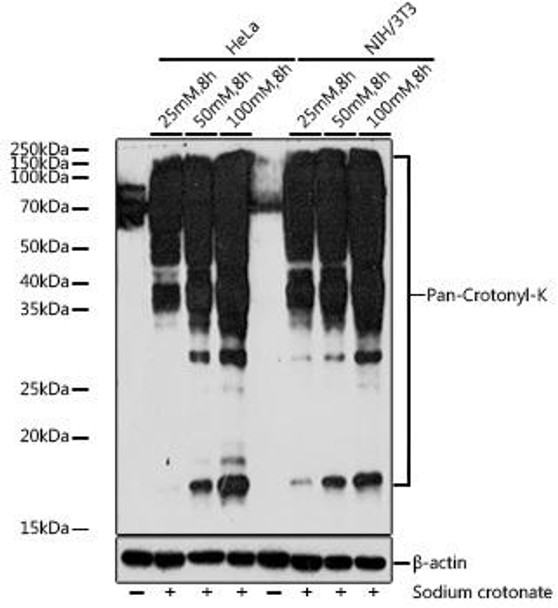
Western blot analysis of various lysates using Pan-Crotonyl-K Rabbit pAb (CAB20502) at 1:1000 dilution. HeLa and NIH/3T3 cells were treated with Sodium crotonate for 8 hours. Secondary antibody: HRP-conjugated Goat anti-Rabbit IgG (H+L) (CABS014) at 1:10000 dilution. Lysates/proteins: 25μg per lane. Blocking buffer: 3% nonfat dry milk in TBST. Detection: ECL Basic Kit (AbGn00020). Exposure time: 180s.
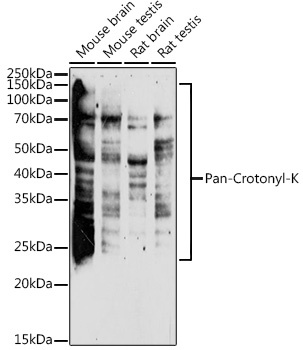
Western blot analysis of various lysates using Pan-Crotonyl-K Rabbit pAb (CAB20502) at 1:1000 dilution. Secondary antibody: HRP-conjugated Goat anti-Rabbit IgG (H+L) (CABS014) at 1:10000 dilution. Lysates/proteins: 25μg per lane. Blocking buffer: 3% nonfat dry milk in TBST. Detection: ECL Enhanced Kit (AbGn00021). Exposure time: 180s.