Description
BCP Albumin Assay Kit (BA0030) (BA0030)
The BCP Albumin Assay Kit (SKU: BA0030) measures albumin directly in biological samples without any pretreatment. Albumin is the most abundant plasma protein, accounting for around 60% of total serum protein, and maintains colloid osmotic pressure while binding and transporting fatty acids, bile acids, bilirubin, calcium and drugs. Serum albumin is a reliable prognostic indicator for morbidity and mortality, liver disease, nephrotic syndrome and malnutrition. This kit uses bromocresol purple, which forms a coloured complex specifically with albumin; the intensity measured at 610 nm is directly proportional to the albumin concentration. The optimised formulation substantially reduces interference from substances in raw samples, and the single working-reagent, five-minute procedure is readily automated for high-throughput work. As bromocresol purple reacts differently with albumins from different species, an albumin standard matched to the sample species should be used.
| Product Name: | BCP Albumin Assay Kit (BA0030) |
| SKU: | BA0030 |
| Detection Method: | Colorimetric; bromocresol purple complex measured at 610 nm |
| Detection Range: | 0.3 g/dL (45 µM) to 5 g/dL (750 µM) albumin |
| Sample Type: | Serum, urine, biological preparations |
| Species Reactivity: | All |
| Assay Time: | 5 min incubation |
| Kit Size: | 250 Assays |
| Equipment Required: | Microplate reader |
| Storage: | Store Reagent at 4°C and Standard at -20°C. |
| Shelf Life: | 17 months after receipt. |
| Shipping: | Room Temperature |
A colorimetric assay for the quantitative determination of albumin directly in biological samples. The assay uses bromocresol purple, which forms a coloured complex specifically with albumin; the intensity measured at 610 nm is directly proportional to albumin concentration. Detection range is 0.3 g/dL (45 µM) to 5 g/dL (750 µM).
- Sensitive and accurate: uses as little as 20 µL of sample; detection range 0.3 to 5 g/dL albumin.
- Simple and high-throughput: a single working reagent and a 5-minute incubation; readily automated.
- Improved reagent stability and versatility: enhanced reagent and signal stability; cuvette or 96-well plate assay.
- Low interference in biological samples: no pretreatment required, even in the presence of lipid and protein.
- Albumin in serum, urine and biological preparations.
- Drug discovery and pharmacology: effects of drugs on albumin metabolism.
Note: The below protocol is a sample protocol. Protocols are specific to each batch/lot. For the correct instructions please follow the protocol included in your kit.
| Step | Procedure |
| 1 | Bring the reagents to room temperature and shake before use. Because bromocresol purple reacts differently with albumins from different species, use an albumin standard matched to the sample species. |
| 2 | Dilute the standards in distilled water as shown in the standards table and dilute serum samples 2-fold. Transfer 20 µL of diluted standards and samples to wells of a clear-bottom plate. |
| 3 | Add 200 µL working reagent and tap lightly to mix, avoiding bubble formation. |
| 4 | Incubate 5 min at room temperature and read the optical density at 590-630 nm (peak absorbance at 610 nm). |
| 5 | Cuvette format: transfer 60 µL Blank, Standards and samples to tubes, add 1000 µL working reagent, incubate 5 min and read at 610 nm. |
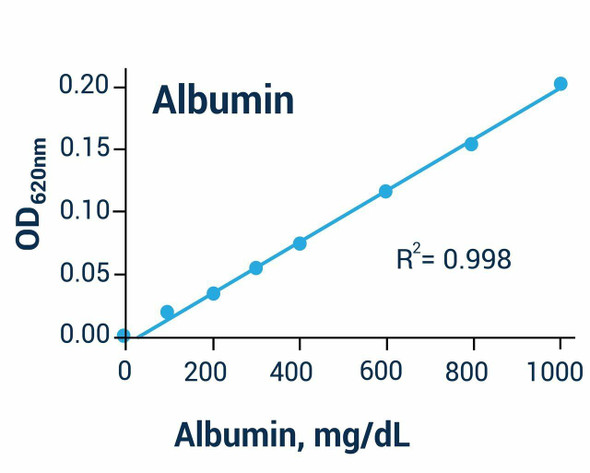
Subtract the blank OD (water, standard #8) from the standard OD values and plot OD against concentration. Use the standard curve to determine the sample albumin concentration. Conversions: 0.1 g/dL albumin equals 15 µM, 0.1% or 1000 ppm.
| Component | Quantity | Storage |
| Reagent | 50 mL | 4°C |
| Albumin Standard (5 g/dL BSA) | 2 mL | -20°C |