The Caspase-1 p20 Monoclonal Antibody (CAB23429) is a high-quality antibody developed for reliable detection and analysis of target proteins. This antibody, specifically designed for detecting the p20 subunit of Caspase-1, is ideal for use in Western blot applications and immunohistochemistry.Caspase-1 is a key player in the inflammatory response, as it is responsible for the processing and activation of pro-inflammatory cytokines such as IL-1β and IL-18. The p20 subunit is a crucial part of the active Caspase-1 enzyme, making it a significant target for research aimed at understanding and modulating inflammatory signaling pathways.This monoclonal antibody, developed and validated by AssayGenie, offers high specificity and sensitivity in detecting Caspase-1 p20 in human samples.
This antibody is validated for use in WB, ELISA applications and has demonstrated reactivity against Human samples.
Product Name:
Caspase-1 p20 Monoclonal Antibody
SKU:
CAB23429
Size:
20μL, 100μL
Reactivity:
Human
Clone Number:
ARC60705
Conjugate:
Unconjugated
Immunogen:
Synthetic peptide. This information is considered to be commercially sensitive.
Recommended starting concentration is 1 μg/mL. Please optimize the concentration based on your specific assay requirements.
Synonyms:
ICE, P45, IL1BC, Caspase-1 p20
Positive Sample:
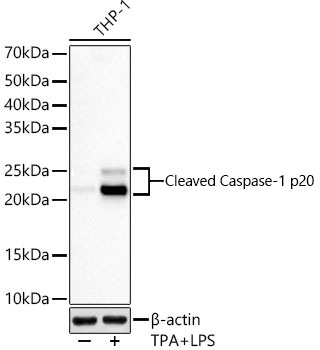
THP-1 treated with TPA and LPS
Cellular Localization:
Cytoplasm, Cell Membrane .
Calculated MW:
10KDa/29KDa/35KDa/42KDa/45KDa
Observed MW:
20-25kDa
This gene encodes a protein which is a member of the cysteine-aspartic acid protease (caspase) family. Sequential activation of caspases plays a central role in the execution-phase of cell apoptosis. Caspases exist as inactive proenzymes which undergo proteolytic processing at conserved aspartic residues to produce 2 subunits, large and small, that dimerize to form the active enzyme. This gene was identified by its ability to proteolytically cleave and activate the inactive precursor of interleukin-1, a cytokine involved in the processes such as inflammation, septic shock, and wound healing. This gene has been shown to induce cell apoptosis and may function in various developmental stages. Studies of a similar gene in mouse suggest a role in the pathogenesis of Huntington disease. Alternative splicing results in transcript variants encoding distinct isoforms.
Purification Method
Affinity purification
Gene ID
834
Buffer Information
Store at -20℃. Avoid freeze / thaw cycles. Buffer: PBS with 0.09% Sodium azide,0.05% BSA,50% glycerol,pH7.3.
Western blot analysis of lysates from THP-1 cells using Cleaved Caspase-1 p20 Rabbit mAb (CAB23429) at 1:2000 dilution. THP-1 cells were treated with PMA/TPA (80 nM) at 37℃ for overnight and LPS (1 μg/ml) at 37℃ for 6 hours. Secondary antibody: HRP-conjugated Goat anti-Rabbit IgG (H+L) (CABS014) at 1:10000 dilution. Lysates/proteins: 25μg per lane. Blocking buffer: 3% nonfat dry milk in TBST. Detection: ECL Basic Kit (AbGn00020). Exposure time: 30s.




![Anti-Caspase 1 [R05-7H1] Monoclonal Antibody (AGMB01605)](https://cdn11.bigcommerce.com/s-h68l9z2lnx/images/stencil/590x590/products/272894/680474/anti-caspase-1-r05-7h1-monoclonal-antibody-agmb01605__14491.1773042159.jpg?c=2 "Anti-Caspase 1 [R05-7H1] Monoclonal Antibody (AGMB01605)")