Description
Histamine Assay Kit (BA0120) (BA0120)
This Histamine Assay Kit (SKU: BA0120) provides a fast and sensitive colorimetric method for the quantitative determination of histamine in food, beverage and agricultural samples. Histamine is a biogenic amine that is naturally present in many foods and body cells, and it may accumulate as a contaminant in fish such as tuna and mackerel when they are improperly handled or stored. Consumption of foods containing high levels of histamine can cause an allergy-like food poisoning known as scombroid poisoning. The assay is based on histamine dehydrogenase catalysed oxidation of histamine, in which the electron mediator formed reduces a formazan (MTT) reagent. The intensity of the resulting colour, measured at 565 nm, is directly proportional to the histamine concentration in the sample. The procedure requires only 20 µL of sample and a single working reagent, making it well suited to high-throughput screening.
| Product Name: | Histamine Assay Kit (BA0120) |
| SKU: | BA0120 |
| Detection Method: | Colorimetric (565 nm; range 520-600 nm) |
| Detection Range: | 0.0025 to 1 mM histamine (96-well plate assay) |
| Sample Type: | Food, beverage and agricultural products (fish, meat, cheese, wine, etc.) |
| Species Reactivity: | All |
| Assay Time: | 30 minutes |
| Kit Size: | 100 Assays |
| Equipment Required: | Microplate reader |
| Storage: | Store all components at -20°C upon receipt. |
| Shelf Life: | 6 months after receipt. |
| Shipping: | Gel Pack |
The kit uses histamine dehydrogenase catalysed oxidation of histamine, in which the formed electron mediator reduces a formazan (MTT) reagent. The intensity of the product colour, measured at 565 nm, is directly proportional to the histamine concentration in the sample.
- Fast and sensitive, using only 20 µL of sample with a linear detection range of 0.0025 to 1 mM histamine in a 96-well plate assay.
- Convenient: the procedure involves adding a single working reagent and reading the absorbance after 30 minutes at room temperature, with no 37°C heater required.
- High-throughput 'add-mix-read' type assay that can be readily automated for thousands of samples per day.
- Direct assay of histamine in food, beverage and agricultural products.
Note: The below protocol is a sample protocol. Protocols are specific to each batch/lot. For the correct instructions please follow the protocol included in your kit.
| Step | Procedure |
| 1 | Sample preparation: clear and slightly coloured samples may be assayed directly; it is prudent to test several dilutions to determine an optimal dilution factor n. |
| 2 | Solid samples (fish, meat, etc.) can be homogenised in 0.05% acetic acid (typically 800 µL of 0.05% acetic acid per 200 mg sample) followed by filtration or centrifugation (e.g. 10 min at 14,000 rpm); cheese samples should be heated at 60°C in 0.05% acetic acid to melt and then homogenised. |
| 3 | Beverage samples can be assayed directly; check the pH and adjust to 6-8 with NaOH or HCl, and degas carbonated samples by gentle stirring before assay. |
| 4 | Prepare 200 µL of 1 mM Premix by mixing 10 µL of the Standard (20 mM) with 190 µL distilled water, then dilute the standards in 1.5-mL centrifuge tubes as described in the standard table. |
| 5 | Transfer 20 µL of each standard into separate wells of a clear, flat-bottom 96-well plate, and transfer 20 µL of each sample into two separate wells (one sample blank well and one sample well). |
| 6 | Prepare sufficient Working Reagent for all sample and standard wells by mixing, per well, 85 µL Assay Buffer plus 1 µL HDH Enzyme. |
| 7 | Add 80 µL Working Reagent to the four standards and the sample wells, and add 80 µL Assay Buffer (no HDH Enzyme) to the sample blank wells; tap the plate to mix briefly and thoroughly and incubate for 30 minutes at room temperature. |
| 8 | Read the optical density at 565 nm (520-600 nm). |
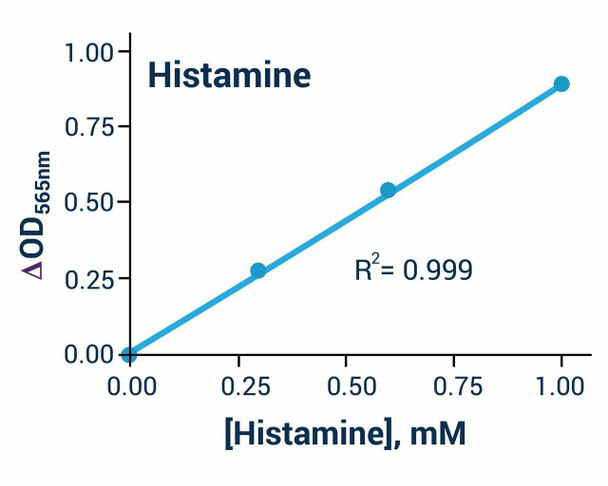
Subtract the blank value (standard #4) from the standard values and plot the change in OD against standard concentrations to determine the slope. [Histamine] = (ODSAMPLE - ODBLANK) / Slope (mM^-1) x n (mM), where ODSAMPLE and ODBLANK are the optical density readings of the sample and sample blank and n is the sample dilution factor. If the sample OD is higher than the OD for the 1 mM standard, dilute the sample in water and repeat, multiplying the result by the dilution factor. Conversions: 1 mM histamine equals 11.1 mg/dL, or 111 ppm.
| Component | Quantity | Storage |
| Assay Buffer | 10 mL | -20°C |
| Standard (20 mM Histamine) | 1.0 mL | -20°C |
| HDH Enzyme | 120 µL | -20°C |