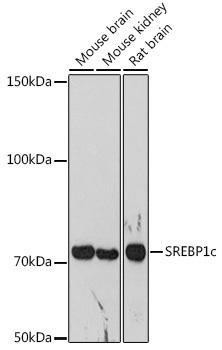
Lipid homeostasis is governed by transcription factors that sense sterol and fatty acid status and reciprocally control synthesis, uptake, and oxidation, with imbalance contributing to dyslipidemia, hepatic steatosis, atherosclerosis, and cancer. The sterol regulatory element-binding proteins are membrane-bound factors activated by regulated proteolysis when lipid levels fall. SREBP-1 predominantly induces genes for fatty acid and triglyceride synthesis, whereas SREBP-2 preferentially activates the cholesterol biosynthetic program. Key lipogenic enzymes under SREBP control include FASN, the multifunctional fatty acid synthase that produces palmitate de novo, and ACC, which generates the malonyl-CoA precursor and committed substrate for fatty acid synthesis; malonyl-CoA also suppresses fatty acid oxidation. Cholesterol synthesis is rate-limited by HMGCR, the target of statin drugs, whose expression is driven by SREBP-2. Counterbalancing lipogenesis, the peroxisome proliferator-activated receptors are nuclear receptors activated by lipid ligands: PPAR-gamma is the master regulator of adipocyte differentiation and lipid storage and a target of insulin-sensitizing thiazolidinediones, while PPAR-alpha promotes fatty acid catabolism in liver and muscle by inducing the oxidative machinery. A central effector of oxidation is CPT1A, which controls the rate-limiting entry of long-chain fatty acids into mitochondria for beta-oxidation and is itself inhibited by malonyl-CoA, integrating synthesis and breakdown. Because these synthetic and oxidative arms are reciprocally regulated, perturbation of any single node reverberates across the entire lipid economy, and the SREBP and PPAR factors frequently antagonize one another to set the prevailing metabolic state of a tissue. Examining SREBP-1, SREBP-2, FASN, ACC, PPAR-gamma, PPAR-alpha, CPT1A, and HMGCR together reveals how cells partition lipids between storage, synthesis, and energy production. This pack brings together validated antibodies against these key targets to enable rigorous study of lipid metabolism and its transcriptional control.


![Anti-Fatty Acid Synthase (FASN) [ARC0377] Monoclonal Antibody (CAB19050)](https://cdn11.bigcommerce.com/s-h68l9z2lnx/images/stencil/1280x1280/products/279089/756048/lipid-metabolism-srebpppar-antibody-sampler-pack__50320.1785068834.jpg?c=2?imbypass=on "Anti-Fatty Acid Synthase (FASN) [ARC0377] Monoclonal Antibody (CAB19050)")