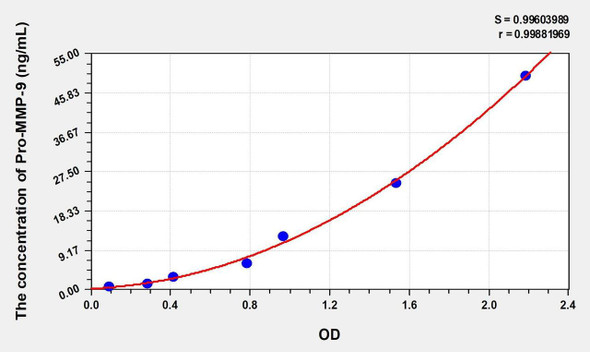
The Mouse Pro-MMP-9 ELISA Kit is expertly designed to facilitate the precise quantitative analysis of Pro-Matrix Metalloproteinase-9 (Pro-MMP-9) levels in a variety of biological samples. Pro-MMP-9, also known as Progelatinase B, is an essential enzyme involved in extracellular matrix remodeling and tissue repair processes. This proenzyme plays a critical role in activating active MMP-9, which contributes to various physiological and pathological conditions, including tissue regeneration, metastasis, and inflammation. Accurate measurement of Pro-MMP-9 levels is crucial for understanding its functions in regulating the extracellular matrix dynamics and its implications in tissue remodeling and cell migration processes. By quantifying Pro-MMP-9 expression, researchers can gain insights into its involvement in various cellular activities and disease progression, particularly in conditions associated with tissue remodeling and matrix degradation. The Mouse Pro-MMP-9 ELISA Kit from Assay Genie offers exceptional sensitivity and specificity, ensuring dependable and reproducible results. With stringent quality control measures in place, this kit delivers robust performance and user-friendly protocols, making it an ideal choice for research endeavors focused on investigating the roles of Pro-Matrix Metalloproteinase-9 in biological processes and disease pathogenesis.
This ELISA kit uses the Sandwich-ELISA principle. The micro ELISA plate provided in this kit has been pre-coated with an antibody specific to the target protein. Standards or samples are added to the micro ELISA plate wells and bind to the immobilized antibody. A biotinylated detection antibody specific to the target protein is then added, followed by Avidin-Horseradish Peroxidase (HRP) conjugate. Free components are washed away. The substrate solution is added to each well, resulting in a color change. Only wells containing the target protein, detection antibody, and HRP conjugate will develop a blue color. The reaction is terminated by the addition of stop solution, resulting in a yellow color. The optical density (OD) is measured at 450 nm ± 2 nm. The OD value is directly proportional to the concentration of the target protein in the sample and is determined using a standard curve.