The Phospho-ErbB3/HER3-Y1222 Monoclonal Antibody (CABP1052) is a high-quality antibody developed for reliable detection and analysis of target proteins. This antibody, developed using rabbit monoclonal technology, exhibits high specificity and sensitivity for detecting phosphorylated ERBB3 in human samples, making it an invaluable resource for studies in cancer biology and signal transduction research.ERBB3, a member of the epidermal growth factor receptor (EGFR) family, plays a key role in regulating cell proliferation and differentiation. Phosphorylation of ERBB3 at tyrosine 1222 is associated with activation of downstream signaling cascades that promote cell growth and survival, making it a focal point for investigating various cellular processes.
This antibody is validated for use in WB, ELISA applications and has demonstrated reactivity against Human samples.
Product Name:
Phospho-ErbB3/HER3-Y1222 Monoclonal Antibody
SKU:
CABP1052
Size:
20μL, 100μL
Reactivity:
Human
Clone Number:
ARC1599
Conjugate:
Unconjugated
Immunogen:
Synthetic peptide. This information is considered to be commercially sensitive.
Sequence:
LGYE Y
Tested Applications:
WBELISA
Recommended Dilution:
WB
1:500 - 1:2000
ELISA
Recommended starting concentration is 1 μg/mL. Please optimize the concentration based on your specific assay requirements.
Cell Membrane, Secreted, Single-Pass Type I Membrane Protein.
Calculated MW:
148kDa
Observed MW:
185kDa
This gene encodes a member of the epidermal growth factor receptor (EGFR) family of receptor tyrosine kinases. This membrane-bound protein has a neuregulin binding domain but not an active kinase domain. It therefore can bind this ligand but not convey the signal into the cell through protein phosphorylation. However, it does form heterodimers with other EGF receptor family members which do have kinase activity. Heterodimerization leads to the activation of pathways which lead to cell proliferation or differentiation. Amplification of this gene and/or overexpression of its protein have been reported in numerous cancers, including prostate, bladder, and breast tumors. Alternate transcriptional splice variants encoding different isoforms have been characterized. One isoform lacks the intermembrane region and is secreted outside the cell. This form acts to modulate the activity of the membrane-bound form. Additional splice variants have also been reported, but they have not been thoroughly characterized.
Purification Method
Affinity purification
Gene ID
2065
RRID
AB_2863925
Buffer Information
Store at -20℃. Avoid freeze / thaw cycles. Buffer: PBS containing 50% glycerol and 0.05% BSA, preserved with proclin300 or sodium azide, pH 7.3.
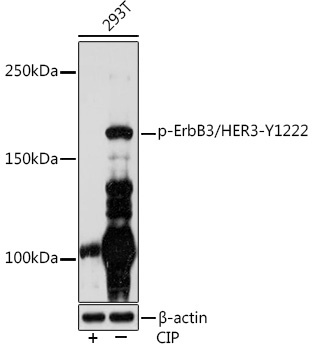
Western blot analysis of lysates from 293T cells, using Phospho-ErbB3/HER3-Y1222 Rabbit mAb (CABP1052) at 1:1000 dilution. 293T cells were treated with CIP(20uL/400ul) at 37℃ for 1 hour. Secondary antibody: HRP-conjugated Goat anti-Rabbit IgG (H+L) (CABS014) at 1:10000 dilution. Lysates/proteins: 25μg per lane. Blocking buffer: 3% BSA. Detection: ECL Enhanced Kit (AbGn00021). Exposure time: 3min.





![Anti-Phospho-ErbB3 / HER3 (Tyr1222) [R53-7S-8] Monoclonal Antibody (AGMB05293)](https://cdn11.bigcommerce.com/s-h68l9z2lnx/images/stencil/590x590/products/276578/676921/anti-phospho-erbb3-her3-tyr1222-r53-7s-8-monoclonal-antibody-agmb05293__13676.1773030980.jpg?c=2 "Anti-Phospho-ErbB3 / HER3 (Tyr1222) [R53-7S-8] Monoclonal Antibody (AGMB05293)")
![Anti-ErbB3 / HER3 [R05-3F7] Monoclonal Antibody (AGMB02475)](https://cdn11.bigcommerce.com/s-h68l9z2lnx/images/stencil/590x590/products/273764/676696/anti-erbb3-her3-r05-3f7-monoclonal-antibody-agmb02475__32727.1773030260.jpg?c=2 "Anti-ErbB3 / HER3 [R05-3F7] Monoclonal Antibody (AGMB02475)")
![Anti-ErbB3 / HER3 [R04-8J6] Monoclonal Antibody (AGMB04107)](https://cdn11.bigcommerce.com/s-h68l9z2lnx/images/stencil/590x590/products/275396/677437/anti-erbb3-her3-r04-8j6-monoclonal-antibody-agmb04107__87155.1773032567.jpg?c=2 "Anti-ErbB3 / HER3 [R04-8J6] Monoclonal Antibody (AGMB04107)")