
Rat GPX1 ELISA Kit (RTEB0206) in Oxidative Stress Research

Summary
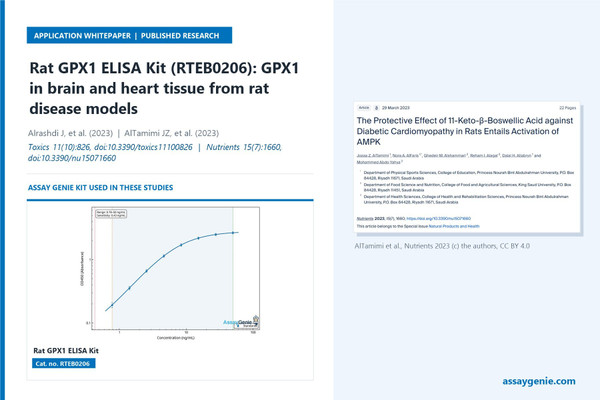
Assay Genie's Rat Glutathione peroxidase 1 (Gpx1) ELISA Kit (RTEB0206) is a sandwich ELISA that two published studies used to measure glutathione peroxidase (GPX) in rat tissue homogenates. Alrashdi et al. (2023) measured GPX in brain homogenate from rats with pentylenetetrazol (PTZ)-induced kindling treated with rosemary extract. AlTamimi et al. (2023) measured GPX in left-ventricular homogenate from streptozotocin (STZ)-diabetic rats treated with 11-keto-β-boswellic acid (AKBA).
Key takeaways
- RTEB0206 quantified GPX in PBS tissue homogenate supernatants: brain [1] and left ventricle [2].
- PTZ kindling lowered brain GPX; rosemary extract and valproic acid raised it compared with PTZ alone [1].
- STZ diabetes lowered left-ventricular GPX; AKBA raised it, and the AMPK inhibitor compound C weakened that effect [2].
- The kit measures GPX1 protein, not enzyme activity or glutathione, and neither study described total-protein normalisation or gave GPX units in the text.
Product cited in these studies

Rat Glutathione peroxidase 1 (Gpx1) ELISA Kit (RTEB0206)
Used by Alrashdi et al. (2023) in brain homogenate and by AlTamimi et al. (2023) in left-ventricle homogenate.
View kit →At a glance
| Study | Model / species | Sample type | Product | What it measured | Key role in study |
|---|---|---|---|---|---|
| Alrashdi et al., 2023, Toxics [1] | Male Wistar rats; PTZ kindling ± Rosmarinus officinalis (RO) extract or valproic acid; 5 groups of 8 | Brain tissue homogenate in PBS (region not specified) | Rat GPX1 ELISA Kit (RTEB0206) (catalogue number matched to GPX by list position) | Total brain GPX, with MDA, SOD and GSH | Antioxidant-defence readout for the protective effect of RO |
| AlTamimi et al., 2023, Nutrients [2] | Male Wistar rats; STZ-induced diabetes ± AKBA ± compound C (AMPK inhibitor); 5 groups of 8 | Left-ventricle (LV) homogenate in ice-cold PBS | Rat GPX1 ELISA Kit (RTEB0206) (named directly as the GPX kit) | Total LV GPX, with MDA, SOD, GSH, HO-1 and Nrf2 | Antioxidant readout testing whether AKBA's effect depends on AMPK |
Why measure glutathione peroxidase 1 in rat tissue?
Glutathione peroxidases are a family of enzymes that reduce hydrogen peroxide and organic hydroperoxides to water or the matching alcohols. GPX1 is the most abundant member. It is a cytosolic and mitochondrial selenoprotein, with a selenocysteine residue in its active site, and it is expressed in almost every tissue, including brain and heart. Each catalytic cycle uses two molecules of reduced glutathione (GSH) and releases oxidised glutathione (GSSG). Glutathione reductase then regenerates GSH using NADPH. GPX1 is distinct from GPX4, the phospholipid hydroperoxide isoform best known for its role in ferroptosis.
Because GPX1 sits at the point where cellular peroxide is cleared, its level is often read together with superoxide dismutase (which makes hydrogen peroxide from superoxide), GSH (the co-substrate) and malondialdehyde (MDA, a lipid-peroxidation product). A fall in GPX and GSH with a rise in MDA is the usual pattern of oxidative stress in seizure, diabetic and toxic-injury models. Treatments that restore the antioxidant panel are often linked to the Nrf2 pathway, which controls many antioxidant and detoxifying genes.
An ELISA for GPX1 measures the amount of the protein, not its catalytic activity. This distinction matters when results are compared with studies that used a coupled NADPH-consumption activity assay.

How the product was used
Alrashdi et al. (2023): rosemary extract in PTZ-kindled rats
Research question. The authors examined whether an extract of Rosmarinus officinalis L. (rosemary, RO) protects against the neurobehavioural and neurobiological changes of PTZ-induced epilepsy in male rats, through antioxidant, anti-apoptotic and anti-inflammatory actions [1].
Experimental design. Forty male Wistar rats (150–170 g, 7–9 weeks old) were divided into five groups of eight: control, RO alone (100 mg/kg), PTZ, PTZ + RO and PTZ + valproic acid (VA, 300 mg/kg) as a positive control. RO or VA was given 30 min before PTZ. Kindling was produced by repeated PTZ injections until rats reached seizure score 5. The paper gives two different PTZ doses in separate Methods sections, so no dose is stated here. Endpoints included seizure scoring, the Morris water maze, passive avoidance, hippocampal histology and a brain biochemical panel.
Samples. Each brain was split in half, one half for histology and the other for biochemistry. Brain tissue was homogenised in phosphate-buffered saline (pH 7.4) and centrifuged at 1000 × g, and the supernatants were stored at −20 °C. The paper does not name the brain region homogenised, and no total-protein normalisation is described.
Assay workflow as reported. The authors measured “total levels” of SOD, TNF-α, GPX, IL-6 and GSH with ELISA-based kits from Assay Genie (London, UK), following the manufacturer's instructions with eight samples per group [1]. The catalogue numbers are printed as a list in the same order as the analytes, and RTEB0206 is third, matching GPX. The match is by list position; the paper does not pair the number with GPX in a single phrase. It is consistent with AlTamimi et al., who name RTEB0206 directly as their GPX kit [2]. MDA was measured with a separate kit from another supplier. Groups were compared by one-way ANOVA with Tukey's post hoc test.
How the readout supported the conclusion. Brain GPX was lower in PTZ rats than in control or RO-alone rats, and higher in both the PTZ + RO and PTZ + VA groups than with PTZ alone. RO alone raised GPX above control. The paper does not compare the RO and VA groups for GPX, and does not state whether PTZ + RO returned to control. The authors combined GPX with restored GSH and SOD and lower MDA to conclude that RO protects the brain through its antioxidant (GSH, SOD and GPX), anti-apoptotic and anti-inflammatory properties.
AlTamimi et al. (2023): AKBA, AMPK and diabetic cardiomyopathy
Research question. The authors tested the hypothesis that the cardioprotective effect of 11-keto-β-boswellic acid (AKBA) in STZ-diabetic rats depends on activation of AMPK [2].
Experimental design. Male Wistar rats (160 ± 20 g) were made diabetic with a single intraperitoneal dose of STZ (65 mg/kg). Rats with fasting glucose above 320 mg/dl one week later were classed as diabetic. Five groups of eight were studied: control, AKBA alone (10 mg/kg, oral), STZ, STZ + AKBA, and STZ + AKBA + compound C (an AMPK inhibitor, 0.2 mg/kg i.p., given 6 h before AKBA). All treatments ran daily for 8 weeks. Endpoints included LV haemodynamics, serum cardiac enzymes, histology, energy-metabolism enzymes, Nrf2 and NF-κB signalling, oxidative stress and apoptosis.
Samples. After haemodynamic measurements, rats were killed and the LVs were dissected on ice and stored at −80 °C. Frozen LV tissue was homogenised in ice-cold neutral PBS and centrifuged at 12,000 × g for 20 min at 4 °C, and the supernatant was used for the ELISA panel. GPX was measured only in LV homogenate; plasma was used for glucose and insulin, and serum for cardiac enzymes and lipids. No total-protein normalisation is described.
Assay workflow as reported. The Chemicals section names the GPX kit explicitly as Cat. No. RTEB0206 from Assay Genie (London, UK) [2], within a panel that also covered SOD, TNF-α, IL-6 and GSH. MDA came from a different supplier. All measurements followed each kit's instructions with n = 8 samples per group, and data were analysed by one-way ANOVA. The figure legends give the significance threshold as “p < 0.5”, which conflicts with the 0.05 in the statistics section, so no p-values are quoted here.
How the readout supported the conclusion. LV GPX was lower in STZ-diabetic rats than in controls, together with GSH, SOD and HO-1. AKBA raised GPX both in control rats and in diabetic rats. In rats given compound C with AKBA, GPX and the other antioxidants were lower than with AKBA alone (the paper's printed comparator in this sentence contains a typo). The authors read this as evidence that AKBA's antioxidant and Nrf2-related effects in the diabetic heart depend on AMPK. They also note that the data remain observational and that AMPK-deficient models would be needed to confirm the mechanism.

Cross-study insights
- Matrix. Both studies applied RTEB0206 to PBS tissue homogenate supernatants, brain [1] and left ventricle [2]. Neither used it on serum or plasma, although both are listed sample types on the product page.
- Preparation differed. Both studies held tissue at −80 °C before homogenising. Brain homogenate was spun at 1000 × g and the supernatant stored at −20 °C [1]. LV homogenate was spun at 12,000 × g for 20 min at 4 °C and kept at −80 °C [2]. The lower speed may leave more debris in the supernatant.
- Protein, not activity. Both papers report “total levels” of GPX from an ELISA. Neither paper ran a GPX activity assay, so the data describe enzyme abundance. Abundance and activity can diverge, for example when selenium status or oxidative inactivation changes.
- No normalisation or units. Neither paper describes a total-protein assay or gives GPX units in the text. Tissue data are easier to compare between studies when both are reported.
- Panel design. In both studies GPX was one of four antioxidant/oxidant markers (MDA, SOD, GSH, GPX), read as a group rather than as a mechanistic endpoint on its own.
- Reporting. The kit number is explicit in one paper [2] and position-matched in the other [1]. Pairing each analyte directly with its catalogue number makes methods easier to verify.
Practical considerations for rat GPX1 ELISA in tissue
Generic best practice, not reported by either study:
- Choose the right kit for the question. RTEB0206 measures GPX1 protein. It does not measure glutathione (GSH) or peroxidase activity; use a dedicated GSH assay or an activity assay where those are the endpoints.
- Homogenise cold. Use ice-cold buffer with protease inhibitors, keep a fixed tissue-to-buffer ratio and clear homogenates thoroughly before assay.
- Normalise. Measure total protein (for example, BCA) in the same supernatant and express GPX1 per mg protein.
- Store at −80 °C in single-use aliquots and avoid repeated freeze–thaw cycles.
- Check the range. The product page gives a detection range of 0.78–50 ng/mL and a sensitivity of 0.4 ng/mL. Pilot a dilution series so that control and treated samples fall on the standard curve.
- Validate the matrix. Run spike-recovery and dilution-linearity tests on pooled homogenate before a full study, and run samples in duplicate.
Measuring GPX1 in rat samples?
The Rat GPX1 ELISA Kit cited in these studies is available from Assay Genie, with expert technical support.
View the Rat GPX1 ELISA Kit →Frequently asked questions
What does the Rat GPX1 ELISA Kit (RTEB0206) measure?
It is a sandwich ELISA for rat glutathione peroxidase 1 protein. The product page lists a 96-test format, a detection range of 0.78–50 ng/mL and a sensitivity of 0.4 ng/mL, with serum, plasma, tissue homogenates and cell culture supernates as sample types. It measures GPX1 amount, not enzyme activity or glutathione.
Is a GPX ELISA the same as a GPX activity assay?
No. An ELISA counts GPX1 protein using antibodies, whereas an activity assay measures how fast a sample reduces peroxide, usually by following NADPH consumption in a coupled reaction. Protein and activity can differ when selenium supply, oxidation or inhibitors affect the enzyme, so state clearly which one was measured.
Why measure GPX in brain tissue in epilepsy models?
Repeated seizures increase reactive oxygen species and lipid peroxidation in the brain. GPX, SOD, GSH and MDA are therefore common oxidative-stress endpoints in PTZ kindling. Alrashdi et al. (2023) reported lower brain GPX after PTZ kindling and higher levels in rats also given rosemary extract or valproic acid.
Is glutathione peroxidase reduced in diabetic cardiomyopathy?
In STZ-diabetic rat models, cardiac antioxidant defences often fall as hyperglycaemia drives oxidative stress. AlTamimi et al. (2023) reported lower left-ventricular GPX, GSH, SOD and HO-1 in STZ-diabetic rats, which rose with AKBA. This effect was weakened when AMPK was blocked with compound C.
References
- Alrashdi J, Albasher G, Alanazi MM, Al-Qahtani WS, Alanezi AA, Alasmari F. Effects of Rosmarinus officinalis L. extract on neurobehavioral and neurobiological changes in male rats with pentylenetetrazol-induced epilepsy. Toxics. 2023;11(10):826. doi:10.3390/toxics11100826.
- AlTamimi JZ, AlFaris NA, Alshammari GM, Alagal RI, Aljabryn DH, Yahya MA. The protective effect of 11-keto-β-boswellic acid against diabetic cardiomyopathy in rats entails activation of AMPK. Nutrients. 2023;15(7):1660. doi:10.3390/nu15071660.
Recent Posts
-
Rat GPX1 ELISA Kit (RTEB0206) in Oxidative Stress Research
SummaryAssay Genie's Rat Glutathione peroxidase 1 (Gpx1) ELISA Kit (RTEB0206) is a sandwich ELISA …24th Nov 2026 -
Rat IL-6 CLIA Kit (RTES00015) in Colon and Testis Toxicity
SummaryAssay Genie's Rat IL-6 CLIA Kit (RTES00015) is a sandwich chemiluminescent immunoassay for …23rd Nov 2026 -
Rat IL-6 ELISA Kit (RTEB0061) in Epilepsy and Heart Research
SummaryAssay Genie's Rat IL-6 ELISA Kit (RTEB0061) is a sandwich ELISA that two published studies …23rd Nov 2026