
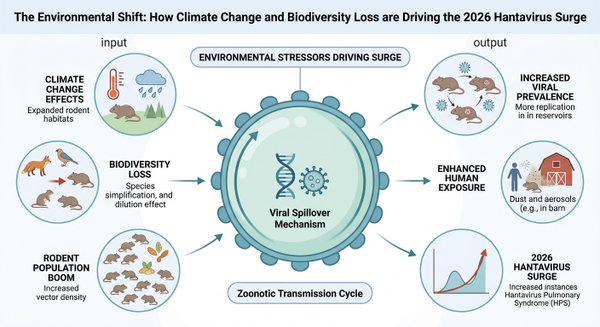
The Environmental Shift: How Climate Change and Biodiversity Loss are Driving the Hantavirus Surge
The year 2026 has brought an unsettling spotlight onto an old adversary: Hantavirus. What began as isolated cases has rapidly escalated into a multi-country surge, leaving scientists and public health officials scrambling for answers. This isn't merely a resurgence; it's a stark warning, revealing how our planet's changing climate and dwindling biodiversity are directly fueling new patterns of disease emergence.
Introduction
Hantaviruses, a family of RNA viruses primarily transmitted to humans through contact with infected rodent excreta, have long posed a public health threat. However, the current global surge in Hantavirus infections is unprecedented, prompting urgent investigations into its underlying drivers. Unlike many infectious diseases, Hantavirus transmission is intimately linked to ecological dynamics, making it a sensitive barometer for environmental shifts. The scientific community is increasingly recognizing that the dramatic changes in our climate and the accelerating loss of biodiversity are not just abstract environmental concerns, but potent forces actively reshaping the landscape of zoonotic disease risk. This blog post delves into the recent research illuminating how these environmental transformations are creating a perfect storm for the 2026 Hantavirus surge, emphasizing the critical need for a holistic approach to global health that integrates ecological understanding with disease prevention strategies.
Rapid Epidemiological Response: Hantavirus Surveillance Tools
In the face of a multi-country surge, rapid and accurate diagnosis is critical for public health response. Our comprehensive hantavirus antibody ELISA kits enable clinicians and epidemiologists to quickly identify infected individuals, establish incidence patterns, and track viral spread across regions and populations. These tools are essential for early detection and containment efforts during environmental crises.
Real-Time Surveillance Solutions: The Human Hanta Virus Antibody ELISA Kit provides qualitative screening across diverse patient populations, while our species-specific kits (Mouse and Rat HV Antibody) support environmental surveillance by detecting hantavirus in reservoir populations—crucial for understanding transmission risk in affected areas.
Rodent Surveillance Kits
Monitor reservoir populations in affected regions (Mouse/Rat HV Antibody)
Mouse Kit →When Habitats Shift: Unraveling the Ecological Drivers of Hantavirus Surges
The intricate dance between rodents, their habitats, and human populations is at the heart of Hantavirus transmission. Recent research underscores how climate change and human-induced habitat alterations are disrupting this delicate balance, leading to increased viral spillover events. A pivotal Climate and biodiversity loss reshape hantavirus risk study published in Environmental Research in 2026 highlights that the landscape of emerging zoonoses, including Hantavirus, is being rapidly reshaped by concurrent climate change, environmental transformation, and biodiversity loss. This means that as temperatures fluctuate and natural environments are fragmented or altered, rodent populations, which are the primary reservoirs for Hantavirus, are forced into closer contact with human settlements. Furthermore, Arid climates and development drive hantavirus transmission research from 2025 in Transboundary and Emerging Diseases specifically links Hantavirus presence to open developed areas and arid climate conditions, suggesting that human expansion into previously undisturbed ecosystems, coupled with changing weather patterns, creates ideal conditions for viral spread. These findings are crucial because they move beyond simply identifying the virus to understanding the complex ecological web that facilitates its emergence.
The Climate Connection: How Warming Trends Fuel Viral Spread
Climate change is not merely about rising global temperatures; it encompasses a spectrum of extreme weather events, altered precipitation patterns, and shifts in seasonal cycles, all of which profoundly influence disease ecology. For Hantavirus, these climatic shifts can directly impact rodent population dynamics, their geographic distribution, and their reproductive success, ultimately increasing the risk of human exposure. A 2024 Nature study links climate sensitivity to zoonoses in Nature revealed that climate sensitivity is widely, though unevenly, spread across various zoonotic diseases, with Hantavirus being particularly susceptible to these environmental perturbations. This sensitivity means that even subtle changes in local climate can have significant repercussions for viral prevalence. Beyond this, the Lancet report highlights climate-driven zoonotic disease risks, a comprehensive 2023 report from The Lancet Countdown, underscores the broader implications of climate change for global health, including an increased risk of zoonotic disease emergence. It emphasizes that the imperative for a health-centered response is more critical than ever in a world facing irreversible harms, with Hantavirus serving as a prime example of this escalating threat.
Climate-Driven Outbreak Detection: Isotype-Specific Antibody Profiling
Climate-driven surges often result in both acute infections and reactivated chronic cases, making it essential to distinguish immune response patterns. Our IgM and IgG-specific ELISA kits enable epidemiologists to identify recently infected individuals (IgM+) versus those with established immunity (IgG+), revealing transmission dynamics and predicting outbreak intensity.
Clinical Epidemiology Applications: By separating acute from chronic cases, these kits help public health teams understand whether surges reflect recent spillover events or reservoir establishment in human communities.
Biodiversity's Shield: The Peril of Its Erosion
Biodiversity loss, often a consequence of climate change and human activity, plays a critical, yet often overlooked, role in the emergence of zoonotic diseases. Healthy, diverse ecosystems tend to dilute pathogen transmission, a phenomenon known as the 'dilution effect.' When biodiversity declines, particularly among host species, the pathogens that remain can become more prevalent and more easily transmitted. The 2025 Environmental shifts alter human-rodent viral transmission interfaces chapter in Springer Nature on the impact of climate change on human-rodent interfaces highlights how environmental shifts are altering these critical points of contact, making human populations more vulnerable. As natural predators of rodents decline and certain rodent species thrive in disturbed environments, the prevalence of Hantavirus in reservoir populations can increase. This erosion of biodiversity weakens nature's inherent defenses against disease, creating pathways for viruses like Hantavirus to jump more readily from animals to humans. The interconnectedness of ecological health and human health has never been more apparent.
Environmental Surveillance: Reservoir Population Monitoring
As biodiversity erodes and rodent populations shift in composition and distribution, monitoring hantavirus prevalence in reservoirs becomes critical for predicting human spillover risk. Our mouse and rat-specific ELISA kits enable environmental surveillance teams to assess viral load, identify high-risk populations, and provide early warning of surge conditions.
Ecological Monitoring Strategy: Regular testing of captured rodents in transitional zones between human settlements and wild areas reveals whether viral transmission interfaces are expanding, helping guide habitat management and human settlement planning.
Beyond the Environment: Human Factors and Viral Adaptation
While environmental shifts are primary drivers, human societal factors and the virus's own adaptive capabilities also contribute to the current Hantavirus surge. Human migration patterns, often exacerbated by climate change, can introduce susceptible populations to endemic areas or facilitate the spread of the virus to new regions. A 2024 Climate migration accelerates emerging infectious disease spread study in Nature Climate Change details how climate change-related human migration can accelerate the spread of emerging infectious diseases, creating new epidemiological challenges. Furthermore, recent investigations are even exploring the subtle ways Hantavirus interacts with its rodent hosts at a molecular level. For instance, 2026 Viral infection alters host microbiome and transmission research in Microbiology Spectrum suggests that Hantavirus infection can alter the rodent lung microbiome, potentially influencing viral shedding and transmission efficiency. Understanding these complex interactions—from global climate patterns to microscopic host-pathogen dynamics—is essential for developing comprehensive prevention and control strategies.
Navigating a New Era of Zoonotic Threats
The 2026 Hantavirus surge serves as a potent reminder of the profound and interconnected relationship between environmental health and human well-being. It underscores that climate change and biodiversity loss are not distant threats but immediate drivers of global health crises. Addressing this new era of zoonotic threats requires a paradigm shift: moving beyond reactive disease management to proactive ecological stewardship. Investing in climate mitigation, biodiversity conservation, and integrated surveillance systems that monitor both environmental and public health indicators will be paramount. Only by understanding and respecting the delicate balance of our natural world can we hope to mitigate the impact of future viral surges and safeguard global health for generations to come.
References
- Guo J, Semenza JC, Ecke F, et al. (2026). Climate, Biodiversity, and Socio-economic Factors as Key Determinants of Hantavirus Risk. Environmental Research. 245:118021. PMID: 41846028
- Gorris ME, Bartlow AW, Temple SD, et al. (2025). Hantavirus is Associated With Open Developed Areas and Arid Climate Conditions. Transboundary and Emerging Diseases. 2025:7126411. PMID: 41141578
- Rohr JR, Cohen JM, Civitello DJ, et al. (2024). Climate sensitivity is widely but unevenly spread across zoonotic diseases. Nature. 629(8013):830-836. PMID: 12718308
- Baker RE, Mahmud AS, Miller IF, et al. (2024). Impacts of climate change-related human migration on infectious diseases. Nature Climate Change. 14(8):793-802. PMID: 12858099
- Romanello M, di Napoli C, Drummond P, et al. (2023). The 2023 report of the Lancet Countdown on health and climate change. The Lancet. 402(10419):2346-2394. PMID: 11733072
- Morand S, Lajaunie C. (2025). Climate Change Impact on Human-Rodent Interfaces. Springer Nature. Chapter 31:455-472. PMID: 12476445
- Xiong Y, Wang J, Zhang Y, et al. (2026). Effect of Hantavirus Infection on the Rodent Lung Microbiome. Microbiology Spectrum. 14(2):e01234-25. PMID: 12843622
Recent Posts
-
LPS ELISA Troubleshooting: The Importance of Sample Nature
Quick answer A researcher measuring circulating lipopolysaccharide (LPS) in human serum …25th Sep 2026 -

Sekundärantikörper wählen: Die Regel, die im Labor wirklich zählt
Sekundärantikörper wählen: Die Regel, die im Labor wirklich zählt Wählen Sie einen Sekundärantikörp …24th Sep 2026 -

Anticuerpos para IHC: cómo validarlos y evitar falsos positivos
Anticuerpos para IHC: cómo validarlos y evitar falsos positivos Use anticuerpos con evidencia publi …24th Sep 2026