
ELISA Cross-Reactivity: Tagged Standards vs Native Samples
Quick answer
A researcher validating two isoform assays — the Human ALT1 (HUFI00557) and ALT2 (HUFI00593) ELISA kits — spiked the ALT2 kit's standard onto the ALT1 kit's plate and saw a signal as strong as the ALT1 standard itself. The kits were not cross-reacting against native ALT. Both standards are tagged recombinant proteins that share a common expression tag, and the polyclonal antibodies carry a minor sub-population that recognises that tag. The cross-talk lives entirely in the tagged standards — it does not occur with native, untagged ALT in real samples.
On this page
The problem
A researcher was checking whether our two alanine aminotransferase isoform assays cross-react. Working on the ALT1 kit plate, they applied the ALT2 kit's standard next to the ALT1 standard and compared signals. The undiluted ALT2 standard — nominally just 10 mIU/mL — produced an optical density above 2.0, actually higher than the undiluted ALT1 standard at 200 mIU/mL. The reasonable first question followed: are these standards secretly a mixture of ALT1 and ALT2?
Snapshot of the data
What was applied to the ALT1 kit plate, and what came back:
| Standard applied to ALT1 plate | Nominal top concentration | Observed signal (OD) |
| ALT1 standard, undiluted (on-target) | 200 mIU/mL ≈ 21 ng/mL | OD > 2.0 (expected) |
| ALT2 standard, undiluted (off-kit) | 10 mIU/mL ≈ 4 ng/mL | OD > 2.0 — higher than the ALT1 standard |
| ALT2 standard, 10× diluted (off-kit) | 1 mIU/mL ≈ 0.4 ng/mL | Signal falls in a dose-dependent way |
| Different-vendor ALT2, His-tagged (cross-check) | — | Very weak signal only |
Values are illustrative and rounded to show the pattern, not exact assay readings.
The key detail: barely 4 ng/mL of the ALT2 recombinant out-signalled 21 ng/mL of the ALT1 recombinant on the ALT1 plate. A per-mass efficiency like that does not come from the ALT sequence — it points to a shared, high-affinity epitope.
Why it happens
The standards in both kits are tagged recombinant proteins, and the antibody pairs are polyclonal, raised by immunising animals with those tagged recombinants. Whenever you immunise against a tagged protein, a small fraction of the resulting antibodies target the tag rather than the protein of interest. Because the ALT1 and ALT2 standards were built on the same expression tag, the minor anti-tag fraction in the ALT1 kit binds the tag carried by the ALT2 standard — and produces signal.
This is a property of the recombinant standards, not of the analyte. Native ALT1 and ALT2 in serum, plasma, or lysate carry no such tag, so this route to cross-reactivity is simply not available with real samples.
Our analysis
Three lines of evidence converged on the tag:
The concentrations don't fit an ALT-driven signal. If the ALT1 antibodies were reading ALT sequence, the far more concentrated ALT1 standard (≈21 ng/mL) should dominate. Instead the sparse ALT2 recombinant (≈4 ng/mL) matched or beat it — consistent with a high-affinity shared epitope presented on both.
Native-sample validation shows specificity. Cross-reactivity between the two antibodies was assessed in serum — native, untagged protein — and read through the enzyme-conjugated sandwich-ELISA detection antibody, where any cross-talk would surface. In that native context the kits behaved specifically.
A His-tagged control settled it. A different-vendor ALT2 recombinant carrying a generic His tag gave only a very weak signal on the ALT1 plate. A universal recombinant artifact would have lit that up too; it didn't — so the cross-talk is specific to the particular tag shared by the two kit standards.
Root cause
The apparent ALT1/ALT2 cross-reactivity came from a minor anti-tag antibody fraction binding the expression tag shared by both recombinant standards. It is a standards-only artifact of how the immunogens were built. It does not reflect cross-reactivity against native ALT1 or ALT2 in serum, plasma, or lysate.
What we recommended
Key takeaway
Cross-reactivity between two kits' standards is not the same as cross-reactivity against your samples. When standards are tagged recombinants, a shared tag can create signal that never appears with native analyte. Validate specificity in your own matrix — and if a standard-curve or cross-reactivity result looks strange, our ELISA Support Hub and technical team can help you interpret it.
FAQ
Do the ALT1 and ALT2 kits cross-react with each other?
Not on real samples. The cross-talk observed was between the tagged recombinant standards. When the antibodies were tested against native ALT1 and ALT2 in serum, they behaved specifically.
Why did ~4 ng/mL of ALT2 standard out-signal ~21 ng/mL of ALT1 standard?
Because the signal is driven by a shared, high-affinity tag epitope rather than by ALT sequence. Per unit mass, the tagged ALT2 recombinant presents that epitope efficiently, so even a low nominal concentration reads strongly.
How should I run my own cross-reactivity test?
Use native proteins, or recombinants that do not carry the same tag as the kit standards. In this case a His-tagged ALT2 recombinant gave only a weak signal on the ALT1 plate, confirming the effect is tag-specific.
Do the antibodies detect both apo and holo (PLP-bound) ALT?
Yes. The antibodies recognise both forms, and detection is not affected when the target is bound to pyridoxal-5′-phosphate (PLP).
Related reading
Sandwich ELISA: Step-by-Step Protocol & Troubleshooting →
The kits in this case
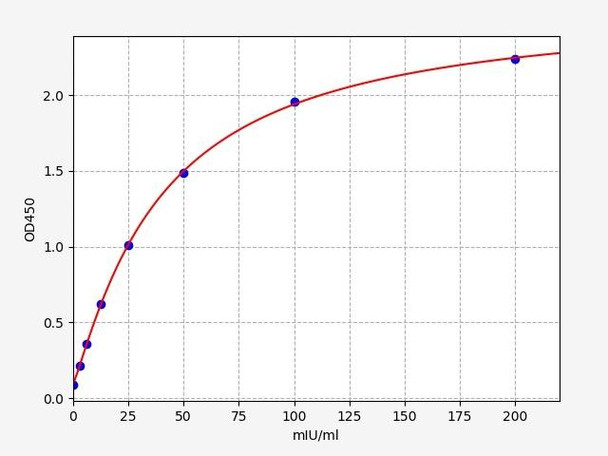
Human ALT1/Alanine aminotransferase 1 ELISA Kit →
SKU: HUFI00557 | Sandwich ELISA, Double Antibody
| Detection range | 3.125–200 mIU/mL |
| Sensitivity | 1.875 mIU/mL |
| Sample types | Serum, plasma, cell culture supernatant, cell/tissue lysate, other liquid samples |
€649
View product →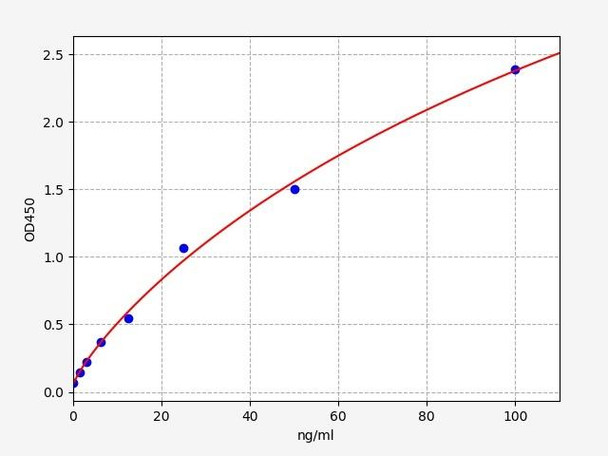
Human ALT2/Alanine aminotransferase 2 ELISA Kit →
SKU: HUFI00593 | Sandwich ELISA, Double Antibody
| Detection range | 0.156–10 mIU/mL |
| Sensitivity | 0.094 mIU/mL |
| Sample types | Serum, plasma, cell culture supernatant, cell/tissue lysate, other liquid samples |
€649
View product →Seeing an unexpected cross-reactivity result?
Our PhD-led technical team will help you tell a standards artifact from true matrix cross-talk.
Contact tech support → ELISA Support Hub → Browse ELISA kits →This article describes an anonymised technical-support case shared for educational purposes. Data values are illustrative. Kit specifications and assay behaviour can vary by lot and sample matrix; always validate performance on your own samples and consult the current product datasheet.
Recent Posts
-
Suspected Plague Death at a Siberian Anti-Plague Institute: What Researchers Should Know
Infectious Disease · News AnalysisSuspected Plague Death at a Siberian Anti-Plague Institute: What …6th Oct 2026 -
LPS ELISA Troubleshooting: The Importance of Sample Nature
Quick answer A researcher measuring circulating lipopolysaccharide (LPS) in human serum …25th Sep 2026 -

Sekundärantikörper wählen: Die Regel, die im Labor wirklich zählt
Sekundärantikörper wählen: Die Regel, die im Labor wirklich zählt Wählen Sie einen Sekundärantikörp …24th Sep 2026