Description
Glutathione Peroxidase Assay Kit (BA0117) (BA0117)
The Glutathione Peroxidase Assay Kit (SKU: BA0117) provides a simple, direct and high-throughput colorimetric method for measuring glutathione peroxidase (GPX, EC 1.11.1.9) activity. GPX protects cells from oxidative damage by removing free peroxide, helping to prevent lipid peroxidation of cellular membranes. This improved assay directly measures NADPH consumption in the coupled GPX and glutathione reductase reactions; the decrease in optical density at 340 nm is directly proportional to the enzyme activity in the sample. The kit is suitable for a range of biological samples and for evaluating the effects of drugs on GPX activity.
| Product Name: | Glutathione Peroxidase Assay Kit (BA0117) |
| SKU: | BA0117 |
| Detection Method: | Colorimetric (340 nm) |
| Detection Range: | 40 - 800 U/L GPX activity |
| Sample Type: | Serum, plasma, tissue and cell extracts |
| Species Reactivity: | All |
| Assay Time: | 4 minutes (kinetic read) |
| Kit Size: | 100 Assays |
| Equipment Required: | Microplate reader |
| Storage: | -20C |
| Shelf Life: | 6 months after receipt, 3 weeks after reconstitution |
| Shipping: | Gel Pack |
A colorimetric kinetic assay for glutathione peroxidase activity that measures NADPH consumption at 340 nm. NADPH and glutathione are supplied dried and are reconstituted before use.
- Sensitive and accurate using a 10 uL sample, with a linear detection range of 40 - 800 U/L GPX activity
- Direct assay of GPX activity in biological samples
- Studying the effects of drugs on GPX activity
Note: The below protocol is a sample protocol. Protocols are specific to each batch/lot. For the correct instructions please follow the protocol included in your kit.
| Step | Procedure |
| 1 | Sample preparation: liquid samples such as non-haemolysed serum and plasma can be assayed directly. Homogenise tissue (10 mg) and cells (10^6) in 200 uL cold PBS and centrifuge for 10 min at 14,000 rpm; use the clear supernatant. |
| 2 | Reagent Preparation: equilibrate components to room temperature and centrifuge tubes. Reconstitute NADPH with 400 uL distilled water (31 mM) and Glutathione with 540 uL distilled water (100 mM); keep on ice. Reconstituted reagents are stable for three weeks at -20C. |
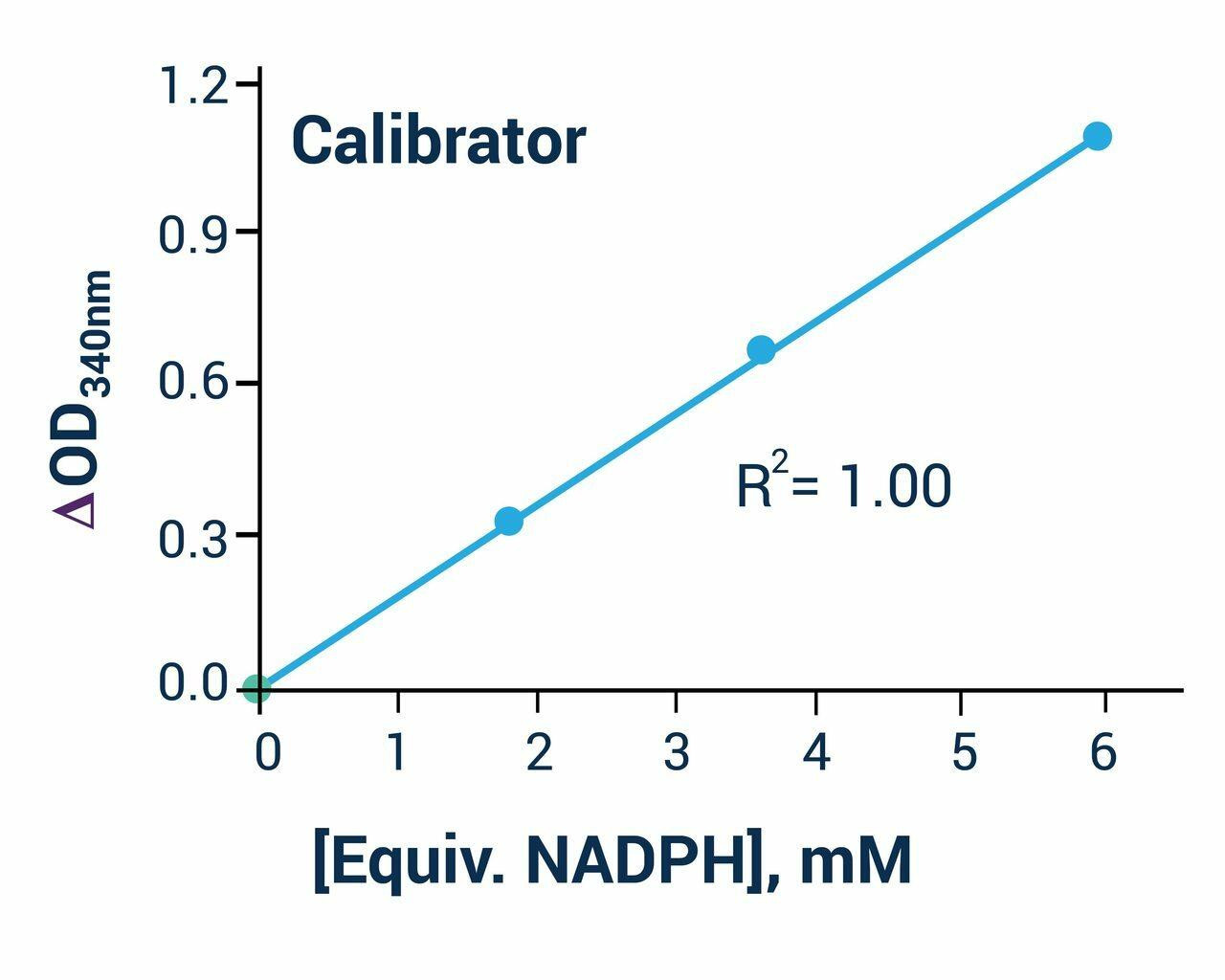
| 3 | Standards and Samples: the Calibrator is equivalent to 6 mM NADPH; dilute per the table. Transfer 10 uL of each standard into a clear flat-bottom 96-well plate and add 190 uL Assay Buffer. Add 10 uL of each sample into separate wells and include a background control of 10 uL Assay Buffer. |
| 4 | Assay: prepare Working Reagent per well from 90 uL Assay Buffer, 5 uL Glutathione, 3 uL 35 mM NADPH and 2 uL GR Enzyme; add 90 uL quickly to sample and control wells and tap to mix. Prepare the peroxide substrate solution fresh, then add 100 uL to all sample and control wells and mix. |
| 5 | Immediately read OD340nm at time zero (OD0) and again at 4 minutes (OD4). |
Use the 4-minute OD values for the NADPH standards; subtract the blank and plot delta-OD against concentration to obtain the slope. Compute delta-ODS = OD0 - OD4 for samples and delta-ODB for the background control. GPX Activity (U/L) = (delta-ODS - delta-ODB) / (Slope x 4 min) x 1000 x n, where n is the dilution factor. One unit produces 1 umole of GS-SG per minute at pH 7.6 and room temperature. If activity exceeds 800 U/L or initial OD340nm exceeds 1.5, dilute and repeat.
| Component | Quantity | Storage |
| Assay Buffer | 25 mL | -20C |
| GR Enzyme | 250 uL | -20C |
| Glutathione | Dried | -20C |
| NADPH | Dried | -20C |
| Calibrator | 500 uL | -20C |
| Peroxide Solution | 50 uL | -20C |