
Urea Assays
Assay the urea cycle and beyond
The urea cycle clears nitrogenous waste as urea. Our kits let you measure urea and ammonia directly, plus the enzymes, amino acids and metabolites that feed the pathway — with fast, sensitive plate-reader protocols.
Which urea assay do you need?
From urea and ammonia to the amino acids and TCA intermediates that feed the cycle — pick a step to filter the range.
All urea & nitrogen assays
Filter by pathway area or search by analyte or product code.
Why choose these assays?
Fast, robust nitrogen-metabolism assays for the plate reader.
Fast & sensitive
Some urea assays use just 5 µL of sample with a 20-minute, single-reagent protocol.
Minimal interference
Direct measurement on raw biological samples with no ammonia interference or pretreatment for the urea kit.
Pathway coverage
Urea and ammonia plus the enzymes, amino acids and TCA intermediates around the cycle.
Flexible samples
Validated across serum, plasma, urine, milk, culture media, food and environmental samples.
The urea cycle at a glance
The urea cycle converts toxic ammonia, produced by amino-acid breakdown, into urea for excretion. It links amino-acid metabolism, the TCA cycle (via fumarate and aspartate) and nitrogen balance.
Measuring urea and ammonia alongside the relevant enzymes and intermediates helps dissect nitrogen handling in liver function, metabolism and disease models.
- Nitrogen: urea, ammonia, arginase, tyrosine ammonia-lyase
- Amino acids & transaminases: glutamate, aspartate, ALT, AST
- TCA intermediates: fumarate, malate, oxaloacetate
- Cofactors: ADP/ATP, NAD(P)/NADH, phosphate
FAQs
How much sample does the urea assay need?
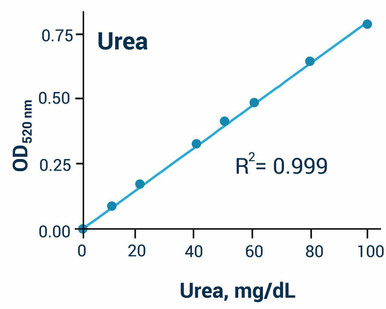
The Urea Assay Kit is sensitive enough to use around 5 µL of sample, with a linear range from roughly 0.08 mg/dL to 100 mg/dL urea in a 96-well format.
Does the urea assay suffer ammonia interference?
No. The urea assay is designed to run directly on raw biological samples without ammonia interference and without pretreatment.
Why measure amino acids and TCA intermediates here?
The urea cycle is fed by amino-acid nitrogen and connects to the TCA cycle through fumarate and aspartate, so transaminase and intermediate assays help place urea production in its metabolic context.
What sample types are supported?
Depending on the kit, validated samples include serum, plasma, urine, milk, cell and tissue culture, food, beverage and environmental samples.
Building a nitrogen-metabolism panel?
Our PhD-level technical team can help you choose the right combination of urea, ammonia and enzyme assays.