Description
HDL and LDL/VLDL Assay Kit (BA0066) (BA0066)
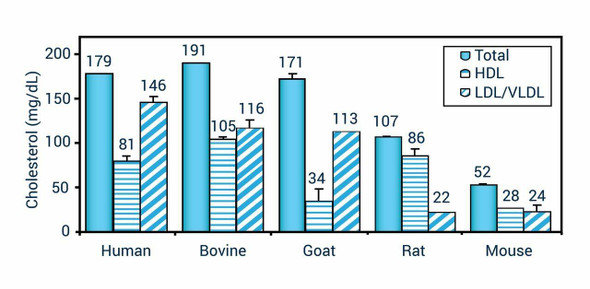
The HDL and LDL/VLDL Assay Kit (SKU: BA0066) provides a simple, direct and automation-ready procedure for measuring cholesterol concentrations in high-density lipoprotein (HDL) and low-density/very-low-density lipoprotein (LDL/VLDL) fractions, which are strong predictors of coronary heart disease. Functional HDL offers protection by removing cholesterol from cells and atheroma, whereas higher LDL and lower functional HDL are strongly associated with cardiovascular disease. The balance between these lipoproteins is genetically determined but can be modified by medication, food choices and other factors. The kit is based on an improved PEG precipitation method in which HDL and LDL/VLDL are separated, and cholesterol is determined using a single working reagent that combines cholesterol ester hydrolysis, oxidation and colour reaction in one step. The colour intensity at 570 nm, or fluorescence at excitation/emission 530/585 nm, is directly proportional to cholesterol concentration.
| Product Name: | HDL and LDL/VLDL Assay Kit (BA0066) |
| SKU: | BA0066 |
| Detection Method: | Colorimetric or Fluorometric |
| Detection Range: | Colorimetric 1 to 100 mg/dL; fluorometric 0.2 to 10 mg/dL cholesterol |
| Sample Type: | Serum samples |
| Species Reactivity: | All |
| Assay Time: | 30 minutes plus precipitation step |
| Kit Size: | 100 Assays |
| Equipment Required: | Microplate reader |
| Storage: | -20C |
| Shelf Life: | 6 months after receipt |
| Shipping: | Gel Pack |
Quantitative colorimetric or fluorometric determination of HDL and LDL/VLDL cholesterol. An improved PEG precipitation method separates the fractions, and cholesterol is measured with a single working reagent read at 570 nm or fluorometrically at excitation/emission 530/585 nm.
- Sensitive and accurate
- Colorimetric linear detection range 1 to 100 mg/dL; fluorometric 0.2 to 10 mg/dL
- Convenient room-temperature assay with no 37C heater required
- Separates HDL and LDL/VLDL fractions by PEG precipitation
- Direct assays of HDL and LDL/VLDL cholesterol in serum samples
- Pharmacology: evaluation of drugs on cholesterol metabolism
Note: The below protocol is a sample protocol. Protocols are specific to each batch/lot. For the correct instructions please follow the protocol included in your kit.
| Step | Procedure |
| 1 | Sample preparation. Bring all reagents except enzyme mix to room temperature and use non-haemolysed serum. Transfer 20 uL serum into a tube, add 20 uL Precipitation Reagent, vortex and centrifuge 5 minutes at 9,500 x g. Transfer 24 uL supernatant into a clean tube with 96 uL Assay Buffer (HDL). Add 40 uL PBS to the pellet, mix, transfer 24 uL into another tube with 96 uL Assay Buffer (LDL/VLDL). Mix 12 uL serum with 108 uL Assay Buffer (Total). Mix 5 uL 300 mg/dL cholesterol with 145 uL Assay Buffer (Standard). |
| 2 | Assay. Transfer 50 uL Assay Buffer (Blank), 50 uL Standard, 50 uL Total, 50 uL HDL and 50 uL LDL/VLDL into wells of a clear flat-bottom 96-well plate. For each reaction well, mix 55 uL Assay Buffer with 1 uL Enzyme Mix and 1 uL Dye Reagent, add 50 uL working reagent to each well and tap to mix. Incubate 30 minutes at room temperature and read OD at 570 nm. |
| 3 | Fluorimetric procedure. Dilute the samples and standard 1:10 in Assay Buffer, transfer 50 uL each into a black plate, add 50 uL working reagent, incubate 30 minutes at room temperature and read fluorescence at excitation 530 nm and emission 585 nm. |
Cholesterol concentrations are calculated relative to the 100 mg/dL standard: [fraction] = (ODfraction - ODblank) / (ODstandard - ODblank) x 100 mg/dL for Total, HDL and LDL/VLDL. The equivalent fluorescence-based equations apply for the fluorimetric procedure.
| Component | Quantity | Storage |
| PBS | 2 x 1.5 mL | -20C |
| Assay Buffer | 20 mL | -20C |
| Dye Reagent | 120 uL | -20C |
| Precipitation Reagent | 1.5 mL | -20C |
| Enzyme Mix | 120 uL | -20C |
| Standard (300 mg/dL cholesterol) | 1 mL | -20C |