The B4GALT1 Polyclonal Antibody (CAB21847) is a high-quality antibody developed for reliable detection and analysis of target proteins. This gene is one of seven beta-1,4-galactosyltransferase (beta4GalT) genes. They encode type II membrane-bound glycoproteins that appear to have exclusive specificity for the donor substrate UDP-galactose; all transfer galactose in a beta1,4 linkage to similar acceptor sugars: GlcNAc, Glc, and Xyl. Each beta4GalT has a distinct function in the biosynthesis of different glycoconjugates and saccharide structures. As type II membrane proteins, they have an N-terminal hydrophobic signal sequence that directs the protein to the Golgi apparatus and which then remains uncleaved to function as a transmembrane anchor. By sequence similarity, the beta4GalTs form four groups: beta4GalT1 and beta4GalT2, beta4GalT3 and beta4GalT4, beta4GalT5 and beta4GalT6, and beta4GalT7. This gene is unique among the beta4GalT genes because it encodes an enzyme that participates both in glycoconjugate and lactose biosynthesis. For the first activity, the enzyme adds galactose to N-acetylglucosamine residues that are either monosaccharides or the nonreducing ends of glycoprotein carbohydrate chains. The second activity is restricted to lactating mammary tissues where the enzyme forms a heterodimer with alpha-lactalbumin to catalyze UDP-galactose + D-glucose <=> UDP + lactose. The two enzymatic forms result from alternate transcription initiation sites and post-translational processing. Two transcripts, which differ only at the 5' end, with approximate lengths of 4.1 kb and 3.9 kb encode the same protein. The longer transcript encodes the type II membrane-bound, trans-Golgi resident protein involved in glycoconjugate biosynthesis. The shorter transcript encodes a protein which is cleaved to form the soluble lactose synthase.
This antibody is validated for use in WB, ELISA applications and has demonstrated reactivity against Human samples.
Product Name:
B4GALT1 Polyclonal Antibody
SKU:
CAB21847
Size:
100μL, 20μL
Reactivity:
Human
Conjugate:
Unconjugated
Immunogen:
Recombinant protein (or fragment).This information is considered to be commercially sensitive.
Tested Applications:
WBELISA
Recommended Dilution:
WB
1:500 - 1:2000
ELISA
Recommended starting concentration is 1 μg/mL. Please optimize the concentration based on your specific assay requirements.
Cell Membrane, Cell Projection, Cell Surface, Golgi Apparatus, Golgi Stack Membrane, Secreted, Single-Pass Type Ii Membrane Protein, Filopodium.
Calculated MW:
44kDa
Observed MW:
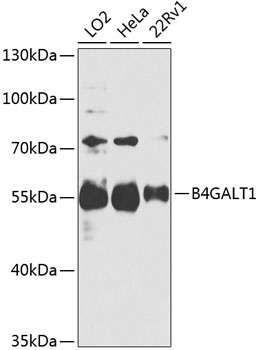
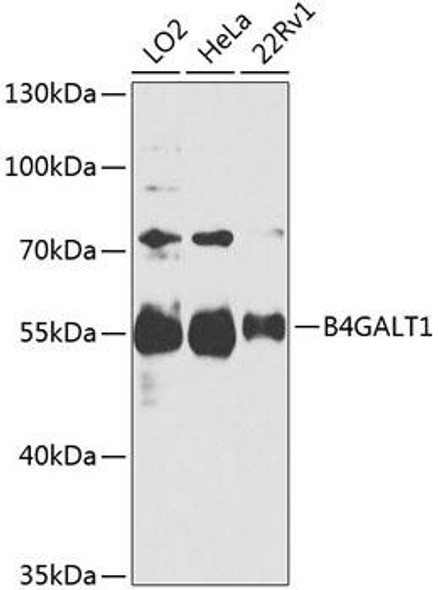
Refer to figures
This gene is one of seven beta-1,4-galactosyltransferase (beta4GalT) genes. They encode type II membrane-bound glycoproteins that appear to have exclusive specificity for the donor substrate UDP-galactose; all transfer galactose in a beta1,4 linkage to similar acceptor sugars: GlcNAc, Glc, and Xyl. Each beta4GalT has a distinct function in the biosynthesis of different glycoconjugates and saccharide structures. As type II membrane proteins, they have an N-terminal hydrophobic signal sequence that directs the protein to the Golgi apparatus and which then remains uncleaved to function as a transmembrane anchor. By sequence similarity, the beta4GalTs form four groups: beta4GalT1 and beta4GalT2, beta4GalT3 and beta4GalT4, beta4GalT5 and beta4GalT6, and beta4GalT7. This gene is unique among the beta4GalT genes because it encodes an enzyme that participates both in glycoconjugate and lactose biosynthesis. For the first activity, the enzyme adds galactose to N-acetylglucosamine residues that are either monosaccharides or the nonreducing ends of glycoprotein carbohydrate chains. The second activity is restricted to lactating mammary tissues where the enzyme forms a heterodimer with alpha-lactalbumin to catalyze UDP-galactose + D-glucose <=> UDP + lactose. The two enzymatic forms result from alternate transcription initiation sites and post-translational processing. Two transcripts, which differ only at the 5' end, with approximate lengths of 4.1 kb and 3.9 kb encode the same protein. The longer transcript encodes the type II membrane-bound, trans-Golgi resident protein involved in glycoconjugate biosynthesis. The shorter transcript encodes a protein which is cleaved to form the soluble lactose synthase.
Purification Method
Affinity purification
Gene ID
2683
Buffer Information
Store at -20℃. Avoid freeze / thaw cycles. Buffer: PBS containing 50% glycerol, preserved with proclin300 or sodium azide, pH 7.3.
Western blot analysis of various lysates using B4GALT1 Rabbit pAb (CAB21847) at 1:1000 dilution. Secondary antibody: HRP-conjugated Goat anti-Rabbit IgG (H+L) (AS014) at 1:10000 dilution. Lysates/proteins: 25μg per lane. Blocking buffer: 3% nonfat dry milk in TBST. Detection: ECL Enhanced Kit (AbGn00021). Exposure time: 90s.