The CBLB Antibody (CAB2014) is a high-quality antibody developed for reliable detection and analysis of target proteins. This gene encodes an E3 ubiquitin-protein ligase which promotes proteosome-mediated protein degradation by transferring ubiquitin from an E2 ubiquitin-conjugating enzyme to a substrate. The encoded protein is involved in the regulation of immune response by limiting T-cell receptor, B-cell receptor, and high affinity immunoglobulin epsilon receptor activation. Studies in mouse suggest that this gene is involved in antifungal host defense and that its inhibition leads to increased fungal killing. Manipulation of this gene may be beneficial in implementing immunotherapies for a variety of conditions, including cancer, autoimmune diseases, allergies, and infections.
This antibody is validated for use in WB, ELISA applications and has demonstrated reactivity against Human, Mouse, Rat samples.
Product Name:
CBLB Antibody
SKU:
CAB2014
Size:
100μL, 20μL
Reactivity:
Human, Mouse, Rat
Conjugate:
Unconjugated
Immunogen:
Synthetic peptide. This information is considered to be commercially sensitive.
Tested Applications:
WBELISA
Recommended Dilution:
WB
1:500 - 1:1000
ELISA
Recommended starting concentration is 1 μg/mL. Please optimize the concentration based on your specific assay requirements.
Synonyms:
Cbl-b, RNF56, Nbla00127, CBLB
Positive Sample:
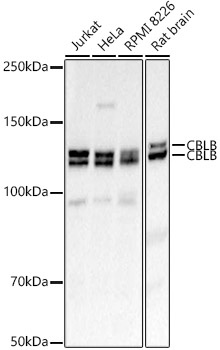
Jurkat, HeLa, RPMI 8226, Mouse spleen, Rat brain
Cellular Localization:
Cytoplasm.
Calculated MW:
109kDa
Observed MW:
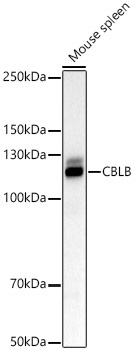
125kDa/130kDa
This gene encodes an E3 ubiquitin-protein ligase which promotes proteosome-mediated protein degradation by transferring ubiquitin from an E2 ubiquitin-conjugating enzyme to a substrate. The encoded protein is involved in the regulation of immune response by limiting T-cell receptor, B-cell receptor, and high affinity immunoglobulin epsilon receptor activation. Studies in mouse suggest that this gene is involved in antifungal host defense and that its inhibition leads to increased fungal killing. Manipulation of this gene may be beneficial in implementing immunotherapies for a variety of conditions, including cancer, autoimmune diseases, allergies, and infections.
Purification Method
Affinity purification
Gene ID
868
RRID
AB_2764038
Buffer Information
Store at -20℃. Avoid freeze / thaw cycles. Buffer: PBS containing 50% glycerol, preserved with proclin300 or sodium azide, pH 7.3.
Western blot analysis of various lysates, using CBLB Rabbit pAb (CAB2014) at 1:1000 dilution. Secondary antibody: HRP-conjugated Goat anti-Rabbit IgG (H+L) (AS014) at 1:10000 dilution. Lysates/proteins: 25μg per lane. Blocking buffer: 3% nonfat dry milk in TBST. Detection: ECL Basic Kit (AbGn00020). Exposure time: 10s.
Western blot analysis of lysates from Mouse spleen, using CBLB Rabbit pAb (CAB2014) at 1:1000 dilution. Secondary antibody: HRP-conjugated Goat anti-Rabbit IgG (H+L) (AS014) at 1:10000 dilution. Lysates/proteins: 25μg per lane. Blocking buffer: 3% nonfat dry milk in TBST. Detection: ECL Basic Kit (AbGn00020). Exposure time: 10s.