The CD209 Antibody (CAB1466) is a high-quality antibody developed for reliable detection and analysis of target proteins. This gene encodes a C-type lectin that functions in cell adhesion and pathogen recognition. This receptor recognizes a wide range of evolutionarily divergent pathogens with a large impact on public health, including leprosy and tuberculosis mycobacteria, the Ebola, hepatitis C, HIV-1 and Dengue viruses, and the SARS-CoV acute respiratory syndrome coronavirus. The protein is organized into four distinct domains: a C-terminal carbohydrate recognition domain, a flexible tandem-repeat neck domain, a transmembrane region and an N-terminal cytoplasmic domain involved in internalization. This gene is closely related in terms of both sequence and function to a neighboring gene, CLEC4M (Gene ID: 10332), also known as L-SIGN. The two genes differ in viral recognition and expression patterns, with this gene showing high expression on the surface of dendritic cells. Polymorphisms in the neck region are associated with protection from HIV-1 infection, while single nucleotide polymorphisms in the promoter of this gene are associated with differing resistance and susceptibility to and severity of infectious disease, including rs4804803, which is associated with SARS severity. RRID AB_2761536 Gene ID 30835 Swiss Prot Synonym CDSIGN; CLEC4L; DC-SIGN; DC-SIGN1; hDC-SIGN; CD209
This antibody is validated for use in WB, IF/ICC, ELISA applications and has demonstrated reactivity against Human, Mouse, Rat samples.
Product Name:
CD209 Antibody
SKU:
CAB1466
Size:
100μL, 20μL
Reactivity:
Human, Mouse, Rat
Clone Number:
-
Conjugate:
Unconjugated
Immunogen:
Recombinant protein (or fragment).This information is considered to be commercially sensitive.
Tested Applications:
WBIF/ICCELISA
Recommended Dilution:
WB
1:500 - 1:1000
IF
/
ICC
1:50 - 1:200
ELISA
Recommended starting concentration is 1 μg/mL. Please optimize the concentration based on your specific assay requirements.
Cell Membrane, Secreted, Single-Pass Type Ii Membrane Protein.
Calculated MW:
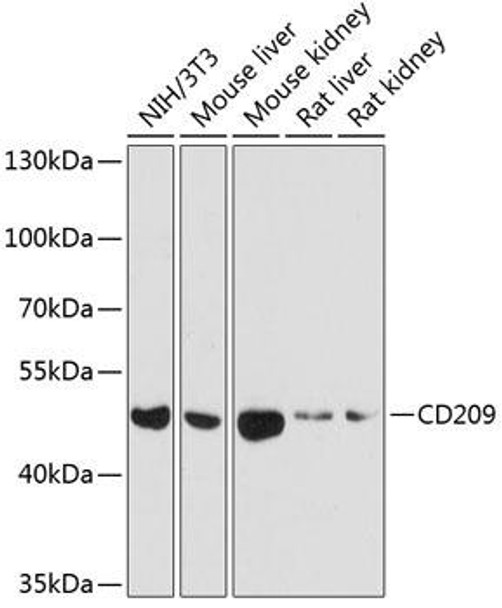
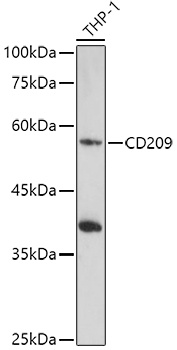
46kDa
Observed MW:
55kDa
This gene encodes a C-type lectin that functions in cell adhesion and pathogen recognition. This receptor recognizes a wide range of evolutionarily divergent pathogens with a large impact on public health, including leprosy and tuberculosis mycobacteria, the Ebola, hepatitis C, HIV-1 and Dengue viruses, and the SARS-CoV acute respiratory syndrome coronavirus. The protein is organized into four distinct domains: a C-terminal carbohydrate recognition domain, a flexible tandem-repeat neck domain, a transmembrane region and an N-terminal cytoplasmic domain involved in internalization. This gene is closely related in terms of both sequence and function to a neighboring gene, CLEC4M (Gene ID: 10332), also known as L-SIGN. The two genes differ in viral recognition and expression patterns, with this gene showing high expression on the surface of dendritic cells. Polymorphisms in the neck region are associated with protection from HIV-1 infection, while single nucleotide polymorphisms in the promoter of this gene are associated with differing resistance and susceptibility to and severity of infectious disease, including rs4804803, which is associated with SARS severity. RRID AB_2761536 Gene ID 30835 Swiss Prot Synonym CDSIGN; CLEC4L; DC-SIGN; DC-SIGN1; hDC-SIGN; CD209
Purification Method:
Affinity purification
Gene ID:
30835
RRID:
AB_2761536
Buffer Information:
Store at -20℃. Avoid freeze / thaw cycles. Buffer: PBS containing 50% glycerol, preserved with proclin300 or sodium azide, pH 7.3.
Western blot analysis of lysates from THP-1 cells, using CD209 Rabbit pAb (CAB1466) at 1:1000 dilution. Secondary antibody: HRP-conjugated Goat anti-Rabbit IgG (H+L) (AS014) at 1:10000 dilution. Lysates/proteins: 25μg per lane. Blocking buffer: 3% nonfat dry milk in TBST. Detection: ECL Basic Kit (AbGn00020). Exposure time: 90s.
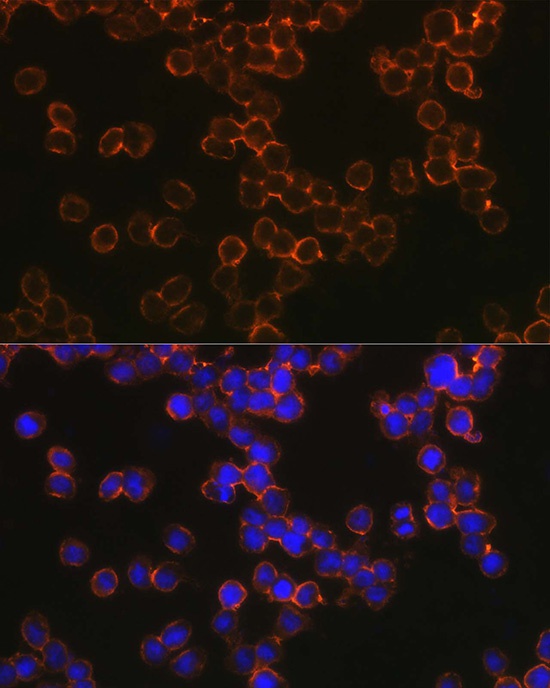
Immunofluorescence analysis of U-937 cells using CD209 Rabbit pAb (CAB1466) at dilution of 1:100 (40x lens). Secondary antibody: Cy3-conjugated Goat anti-Rabbit IgG (H+L) (AS007) at 1:500 dilution. Blue: DAPI for nuclear staining.