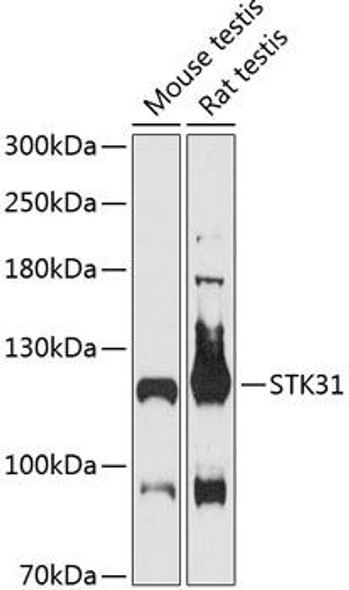
The IFT57 Antibody (CAB7191) is a high-quality antibody developed for reliable detection and analysis of target proteins. Predicted to enable DNA binding activity. Acts upstream of or within activation of cysteine-type endopeptidase activity involved in apoptotic process; apoptotic process; and regulation of apoptotic process. Predicted to be located in ciliary basal body. Predicted to be part of axoneme and intraciliary transport particle B. Predicted to be active in Golgi apparatus; centrosome; and cilium. Implicated in orofaciodigital syndrome.
This antibody is validated for use in WB, ELISA applications and has demonstrated reactivity against Human, Mouse, Rat samples.
Product Name:
IFT57 Antibody
SKU:
CAB7191
Size:
100μL, 20μL
Reactivity:
Human, Mouse, Rat
Conjugate:
Unconjugated
Immunogen:
Recombinant protein (or fragment).This information is considered to be commercially sensitive.
Tested Applications:
WBELISA
Recommended Dilution:
WB
1:500 - 1:2000
ELISA
Recommended starting concentration is 1 μg/mL. Please optimize the concentration based on your specific assay requirements.
Predicted to enable DNA binding activity. Acts upstream of or within activation of cysteine-type endopeptidase activity involved in apoptotic process; apoptotic process; and regulation of apoptotic process. Predicted to be located in ciliary basal body. Predicted to be part of axoneme and intraciliary transport particle B. Predicted to be active in Golgi apparatus; centrosome; and cilium. Implicated in orofaciodigital syndrome.
Purification Method
Affinity purification
Gene ID
55081
RRID
AB_2767741
Buffer Information
Store at -20℃. Avoid freeze / thaw cycles. Buffer: PBS containing 50% glycerol, preserved with proclin300 or sodium azide, pH 7.3.
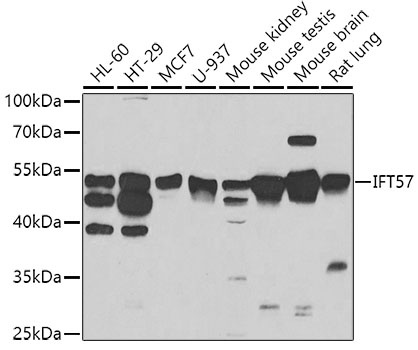
Western blot analysis of various lysates using IFT57 Rabbit pAb (CAB7191) at 1:1000 dilution. Secondary antibody: HRP-conjugated Goat anti-Rabbit IgG (H+L) (AS014) at 1:10000 dilution. Lysates/proteins: 25μg per lane. Blocking buffer: 3% nonfat dry milk in TBST. Detection: ECL Basic Kit (AbGn00020). Exposure time: 90s.