The PPARA Polyclonal Antibody (CAB24835) is a high-quality antibody developed for reliable detection and analysis of target proteins. Peroxisome proliferators include hypolipidemic drugs, herbicides, leukotriene antagonists, and plasticizers; this term arises because they induce an increase in the size and number of peroxisomes. Peroxisomes are subcellular organelles found in plants and animals that contain enzymes for respiration and for cholesterol and lipid metabolism. The action of peroxisome proliferators is thought to be mediated via specific receptors, called PPARs, which belong to the steroid hormone receptor superfamily. PPARs affect the expression of target genes involved in cell proliferation, cell differentiation and in immune and inflammation responses. Three closely related subtypes (alpha, beta/delta, and gamma) have been identified. This gene encodes the subtype PPAR-alpha, which is a nuclear transcription factor. Multiple alternatively spliced transcript variants have been described for this gene, although the full-length nature of only two has been determined. RRID Gene ID 5465 Swiss Prot Synonym PPAR; NR1C1; hPPAR; PPARalpha; PPARA
This antibody is validated for use in WB applications and has demonstrated reactivity against Mouse samples.
Product Name:
PPARA Polyclonal Antibody
SKU:
CAB24835
Size:
100μL, 20μL
Reactivity:
Mouse
Clone Number:
-
Conjugate:
Unconjugated
Immunogen:
Synthetic peptide. This information is considered to be commercially sensitive.
Tested Applications:
WB
Recommended Dilution:
WB
,1:500 - 1:1000
Synonyms:
PPAR, NR1C1, hPPAR, PPARalpha, PPARA
Positive Sample:
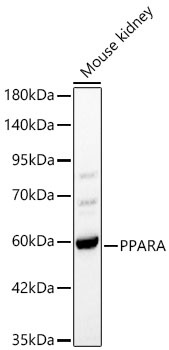
Mouse kidney
Cellular Localization:
Nucleus.
Calculated MW:
52kDa
Observed MW:
52kDa
Peroxisome proliferators include hypolipidemic drugs, herbicides, leukotriene antagonists, and plasticizers; this term arises because they induce an increase in the size and number of peroxisomes. Peroxisomes are subcellular organelles found in plants and animals that contain enzymes for respiration and for cholesterol and lipid metabolism. The action of peroxisome proliferators is thought to be mediated via specific receptors, called PPARs, which belong to the steroid hormone receptor superfamily. PPARs affect the expression of target genes involved in cell proliferation, cell differentiation and in immune and inflammation responses. Three closely related subtypes (alpha, beta/delta, and gamma) have been identified. This gene encodes the subtype PPAR-alpha, which is a nuclear transcription factor. Multiple alternatively spliced transcript variants have been described for this gene, although the full-length nature of only two has been determined. RRID Gene ID 5465 Swiss Prot Synonym PPAR; NR1C1; hPPAR; PPARalpha; PPARA
Purification Method:
Affinity purification
Gene ID:
5465
RRID:
-
Buffer Information:
Store at -20℃. Avoid freeze / thaw cycles. Buffer: PBS with 0.09% Sodium azide,50% glycerol,pH7.3.
Western blot analysis of lysates from Mouse kidney using PPARA Rabbit pAb (CAB24835) at 1:700 dilution. Secondary antibody: HRP-conjugated Goat anti-Rabbit IgG (H+L) (AS014) at 1:10000 dilution. Lysates/proteins: 25 μg per lane. Blocking buffer: 3% nonfat dry milk in TBST. Detection: ECL Basic Kit (AbGn00020). Exposure time: 30s.