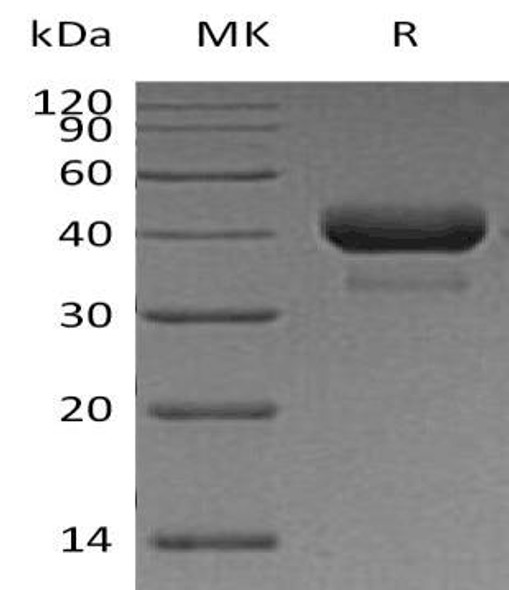
Description
Recombinant Mouse Cathepsin B/CTSB Protein (His Tag)
| Background: | Cathepsin B (CatB) is an enzymatic protein belonging to the peptidase (or protease) families. It is the first described member of the family of lysosomal cysteine proteases. It is known to process a number of proteins, including pro and active caspases, prorenin and secretory leucoprotease inhibitor (SLPI). It is believed to participate in intracellular degradation and turnover of proteins. Cathepsin B may play a role in activation and inactivation of caspases, activation of renin and inactivation of SLPI, the key steps in apoptosis, angiotensin production, and progression of emphysema, respectively. Cathepsin B may also have a role in invasion and metastasis. |
| Name: | Recombinant Mouse Cathepsin B/CTSB Protein (His Tag) |
| Size: | 10µg |
| Assay Genie SKU: | RPES4639 |
| Synonyms: | Cathepsin B;Ctsb;Cathepsin B1 |
| Species: | Mouse |
| Expression host: | Human Cells |
| Sequence: | Met 1-Phe 339 |
| Accession: | P10605 |
| Mol Mass: | 36.4 kDa |
| AP Mol Mass: | 32-50kDa |
| Tag: | C-6His |
| Purity: | > 95 % as determined by SDS-PAGE |
| Endotoxin: | < 1.0 EU per ?g as determined by the LAL method. |
| Storage: | Lyophilized proteins are stable for up to 12 months when stored at -20 to -80°C. Reconstituted protein solution can be stored at 4-8? for 2-7 days. Aliquots of reconstituted samples are stable at < -20'C for 3 months. |
| Shipping: | This product is provided as lyophilized powder which is shipped with ice packs. |
| Formulation: | LyopHilized from a 0.2 um filtered solution of PBS, pH 7.4. |
| Reconstitution: | Please refer to the printed manual for detailed information. |
| UniProt Protein Function: | CTSB: Thiol protease which is believed to participate in intracellular degradation and turnover of proteins. Has also been implicated in tumor invasion and metastasis. Dimer of a heavy chain and a light chain cross-linked by a disulfide bond. Interacts with SRPX2. Belongs to the peptidase C1 family. |
| UniProt Protein Details: | Protein type:Motility/polarity/chemotaxis; EC 3.4.22.1; Protease; Autophagy Cellular Component: extracellular space; cell surface; intracellular membrane-bound organelle; mitochondrion; lysosome; extracellular region; caveola; perinuclear region of cytoplasm; apical plasma membrane; cytoplasm; nucleolus; sarcolemma; external side of plasma membrane Molecular Function:peptidase activity; collagen binding; proteoglycan binding; protein self-association; hydrolase activity; cysteine-type endopeptidase activity; endopeptidase activity; protein complex binding; kininogen binding; peptide binding; cysteine-type peptidase activity Biological Process: collagen catabolic process; proteolysis involved in cellular protein catabolic process; regulation of catalytic activity; decidualization; proteolysis |
| NCBI Summary: | This gene encodes a member of the peptidase C1 family and preproprotein that is proteolytically processed to generate multiple protein products. These products include the cathepsin B light and heavy chains, which can dimerize to generate the double chain form of the enzyme. This enzyme is a lysosomal cysteine protease with both endopeptidase and exopeptidase activity that may play a role in protein turnover. Homozygous knockout mice for this gene exhibit reduced pancreatic damage following induced pancreatitis and reduced hepatocyte apoptosis in a model of liver injury. Pseudogenes of this gene have been identified in the genome. [provided by RefSeq, Aug 2015] |
| UniProt Code: | P10605 |
| NCBI GenInfo Identifier: | 115712 |
| NCBI Gene ID: | 13030 |
| NCBI Accession: | P10605.2 |
| UniProt Secondary Accession: | P10605,Q3UDW7, |
| UniProt Related Accession: | P10605 |
| Molecular Weight: | 37,280 Da |
| NCBI Full Name: | Cathepsin B |
| NCBI Synonym Full Names: | cathepsin B |
| NCBI Official Symbol: | Ctsb |
| NCBI Official Synonym Symbols: | CB |
| NCBI Protein Information: | cathepsin B; cathepsin B1 |
| UniProt Protein Name: | Cathepsin B |
| UniProt Synonym Protein Names: | Cathepsin B1Cleaved into the following 2 chains:Cathepsin B light chain; Cathepsin B heavy chain |
| Protein Family: | Cathepsin |
| UniProt Gene Name: | Ctsb |
| UniProt Entry Name: | CATB_MOUSE |