The ACSL4 Polyclonal Antibody (CAB16848) is a high-quality antibody developed for reliable detection and analysis of target proteins. This antibody, generated in rabbits, exhibits high reactivity with human samples and is validated for use in Western blot applications.ACSL4, also known as long-chain-fatty-acid-CoA ligase 4, plays a crucial role in lipid metabolism by catalyzing the conversion of long-chain fatty acids to their respective acyl-CoA derivatives. Dysregulation of ACSL4 has been implicated in various diseases, including cancer, neurodegenerative disorders, and metabolic syndromes.
This antibody is validated for use in WB, IHC-P, IF/ICC, ELISA applications and has demonstrated reactivity against Human, Mouse, Rat samples.
Product Name:
ACSL4 Polyclonal Antibody
SKU:
CAB16848
Size:
20μL, 100μL
Reactivity:
Human, Mouse, Rat
Immunogen:
Recombinant protein (or fragment).This information is considered to be commercially sensitive.
Recommended starting concentration is 1 μg/mL. Please optimize the concentration based on your specific assay requirements.
Synonyms:
ACS4, FACL4, LACS4, MRX63, MRX68, XLID63, ACSL4
Positive Sample:
HepG2, Rat liver
Cellular Localization:
Endoplasmic Reticulum Membrane, Microsome Membrane, Mitochondrion Outer Membrane, Peroxisome Membrane, Single-Pass Type Iii Membrane Protein.
Calculated MW:
79kDa
Observed MW:
79kDa
The protein encoded by this gene is an isozyme of the long-chain fatty-acid-coenzyme A ligase family. Although differing in substrate specificity, subcellular localization, and tissue distribution, all isozymes of this family convert free long-chain fatty acids into fatty acyl-CoA esters, and thereby play a key role in lipid biosynthesis and fatty acid degradation. This isozyme preferentially utilizes arachidonate as substrate. The absence of this enzyme may contribute to the cognitive disability or Alport syndrome. Alternative splicing of this gene generates multiple transcript variants.
Purification Method
Affinity purification
Gene ID
2182
RRID
AB_2768227
Buffer Information
Store at -20℃. Avoid freeze / thaw cycles. Buffer: PBS containing 50% glycerol, preserved with proclin300 or sodium azide, pH 7.3.
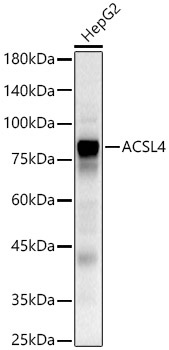
Western blot analysis of lysates from HepG2 cells, using ACSL4 Rabbit pAb (CAB16848) at 1:500 dilution. Secondary antibody: HRP-conjugated Goat anti-Rabbit IgG (H+L) (CABS014) at 1:10000 dilution. Lysates/proteins: 25μg per lane. Blocking buffer: 3% nonfat dry milk in TBST. Detection: ECL Basic Kit (AbGn00020). Exposure time: 20s.
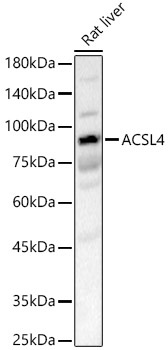
Western blot analysis of lysates from Rat liver, using ACSL4 Rabbit pAb (CAB16848) at 1:500 dilution. Secondary antibody: HRP-conjugated Goat anti-Rabbit IgG (H+L) (CABS014) at 1:10000 dilution. Lysates/proteins: 25μg per lane. Blocking buffer: 3% nonfat dry milk in TBST. Detection: ECL Basic Kit (AbGn00020). Exposure time: 30s.