Description
ALK Monoclonal Antibody (CAB22791)
The ALK Monoclonal Antibody (CAB22791) is a high-quality antibody developed for reliable detection and analysis of target proteins. This antibody, derived from mouse cells, is highly specific and sensitive for detecting ALK in human samples, making it an essential tool for immunohistochemistry and immunofluorescence studies.ALK, also known as anaplastic lymphoma kinase, is a receptor tyrosine kinase that is frequently mutated or overexpressed in various cancers, particularly in lymphomas and non-small cell lung cancer. By targeting ALK with this antibody, researchers can gain valuable insights into the role of this protein in tumorigenesis and potentially identify new targets for therapy.
This antibody is validated for use in WB, ELISA applications and has demonstrated reactivity against Human samples.
| Product Name: | ALK Monoclonal Antibody |
| SKU: | CAB22791 |
| Size: | 20μL, 100μL |
| Reactivity: | Human |
| Clone Number: | ARC58012 |
| Conjugate: | Unconjugated |
| Immunogen: | Recombinant protein (or fragment).This information is considered to be commercially sensitive. | ||||
| Sequence: | SNQE VLEF VTSG GRMD PPKN CPGP VYRI MTQC WQHQ PEDR PNFA IILE RIEY CTQD PDVI NTAL PIEY GPLV EEEE KVPV RPKD PEGV PPLL VSQQ AKRE EERS PAAP PPLP TTSS GKAA KKPT AAEI SVRV PRGP AVEG GHVN MAFS QSNP PSEL HKVH GSRN KPTS LWNP TYGS WFTE KPTK KNN | ||||
| Tested Applications: | WB ELISA | ||||
| Recommended Dilution: |
| ||||
| Synonyms: | ALK1, CD246, NBLST3, ALK |
| Positive Sample: | SH-SY5Y |
| Cellular Localization: | Cell Membrane, Single-Pass Type I Membrane Protein. |
| Calculated MW: | 176kDa |
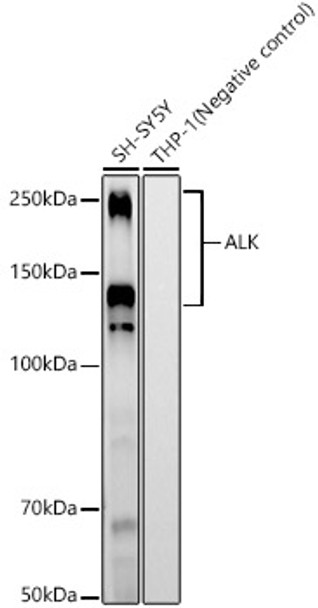
| Observed MW: | 140kDa/220kDa |
This gene encodes a receptor tyrosine kinase, which belongs to the insulin receptor superfamily. This protein comprises an extracellular domain, an hydrophobic stretch corresponding to a single pass transmembrane region, and an intracellular kinase domain. It plays an important role in the development of the brain and exerts its effects on specific neurons in the nervous system. This gene has been found to be rearranged, mutated, or amplified in a series of tumours including anaplastic large cell lymphomas, neuroblastoma, and non-small cell lung cancer. The chromosomal rearrangements are the most common genetic alterations in this gene, which result in creation of multiple fusion genes in tumourigenesis, including ALK (chromosome 2)/EML4 (chromosome 2), ALK/RANBP2 (chromosome 2), ALK/ATIC (chromosome 2), ALK/TFG (chromosome 3), ALK/NPM1 (chromosome 5), ALK/SQSTM1 (chromosome 5), ALK/KIF5B (chromosome 10), ALK/CLTC (chromosome 17), ALK/TPM4 (chromosome 19), and ALK/MSN (chromosome X).
| Purification Method | Affinity purification |
| Gene ID | 238 |
| Buffer Information | Store at -20℃. Avoid freeze / thaw cycles. Buffer: PBS containing 50% glycerol and 0.05% BSA, preserved with proclin300 or sodium azide, pH 7.3. |
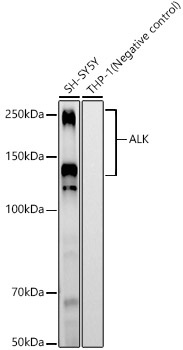 | Western blot analysis of various lysates, using ALK Rabbit mAb (CAB22791) at 1:2000 dilution. Secondary antibody: HRP-conjugated Goat anti-Rabbit IgG (H+L) (CABS014) at 1:10000 dilution. Lysates/proteins: 25μg per lane. Blocking buffer: 3% nonfat dry milk in TBST. Detection: ECL Basic Kit (AbGn00020). Exposure time: 180s. |