Description
ALX4 Antibody (CAB2834)
The ALX4 Antibody (CAB2834) is a high-quality antibody developed for reliable detection and analysis of target proteins. This antibody is produced in rabbits and has been extensively validated for use in Western blot applications, providing accurate and reliable detection of ALX4 in human samples.ALX4 is a critical regulator of embryonic development and cell differentiation, making it a key player in processes such as bone formation and neural tube development.
This antibody is validated for use in WB, ELISA applications and has demonstrated reactivity against Human, Mouse, Rat samples.
| Product Name: | ALX4 Antibody |
| SKU: | CAB2834 |
| Size: | 20μL, 100μL |
| Reactivity: | Human, Mouse, Rat |
| Conjugate: | Unconjugated |
| Immunogen: | Recombinant protein (or fragment).This information is considered to be commercially sensitive. | ||||
| Sequence: | MNAE TCVS YCES PAAA MDAY YSPV SQSR EGSS PFRA FPGG DKFG TTFL SAAA KAQG FGDA KSRA RYGA GQQD LATP LESG AGAR GSFN KFQP QPST PQPQ PPPQ PQPQ QQQP QPQP PAQP HLYL QRGA CKTP PDGS LKLQ EGSS GHSA ALQV PCYA KESS LGEP ELPP DSDT VGMD SSYL SVKE AGVK GPQD RASS DLPS PLEK ADSE SNKG KKRR NRTT | ||||
| Tested Applications: | WB ELISA | ||||
| Recommended Dilution: |
| ||||
| Synonyms: | CRS5, FND2, ALX4 |
| Positive Sample: | HepG2 |
| Cellular Localization: | Nucleus. |
| Calculated MW: | 44kDa |
| Observed MW: | 44kDa |
This gene encodes a paired-like homeodomain transcription factor expressed in the mesenchyme of developing bones, limbs, hair, teeth, and mammary tissue. Mutations in this gene cause parietal foramina 2 (PFM2); an autosomal dominant disease characterized by deficient ossification of the parietal bones. Mutations in this gene also cause a form of frontonasal dysplasia with alopecia and hypogonadism; suggesting a role for this gene in craniofacial development, mesenchymal-epithelial communication, and hair follicle development. Deletion of a segment of chromosome 11 containing this gene, del(11)(p11p12), causes Potocki-Shaffer syndrome (PSS); a syndrome characterized by craniofacial anomalies, cognitive disability, multiple exostoses, and genital abnormalities in males. In mouse, this gene has been shown to use dual translation initiation sites located 16 codons apart.
| Purification Method | Affinity purification |
| Gene ID | 60529 |
| RRID | AB_2764664 |
| Buffer Information | Store at -20℃. Avoid freeze / thaw cycles. Buffer: PBS with 0.01% thimerosal,50% glycerol,pH7.3. |
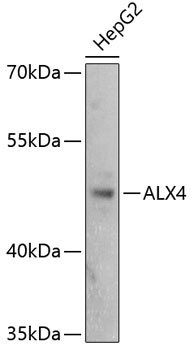 | Western blot analysis of lysates from HepG2 cells, using ALX4 Rabbit pAb (CAB2834) at 1:3000 dilution. Secondary antibody: HRP-conjugated Goat anti-Rabbit IgG (H+L) (CABS014) at 1:10000 dilution. Lysates/proteins: 25μg per lane. Blocking buffer: 3% nonfat dry milk in TBST. Detection: ECL Basic Kit (AbGn00020). Exposure time: 10s. |