The 5-Methylcytosine (5mC) Monoclonal Antibody (CAB20599) is a high-quality antibody developed for reliable detection and analysis of target proteins. In the mammalian genome, DNA methylation is an epigenetic mechanism involving the transfer of a methyl group onto the C5 position of the cytosine to form 5-methylcytosine. DNA methylation regulates gene expression by recruiting proteins involved in gene repression or by inhibiting the binding of transcription factor(s) to DNA. During development, the pattern of DNA methylation in the genome changes as a result of a dynamic process involving both de novo DNA methylation and demethylation. As a consequence, differentiated cells develop a stable and unique DNA methylation pattern that regulates tissue-specific gene transcription.? Intriguingly, postmitotic neurons still express DNA methyltransferases and components involved in DNA demethylation. Moreover, neuronal activity can modulate their pattern of DNA methylation in response to physiological and environmental stimuli. The precise regulation of DNA methylation is essential for normal cognitive function.
This antibody is validated for use in ELISA, DB applications and has demonstrated reactivity against Species independent samples.
Product Name:
5-Methylcytosine (5mC) Monoclonal Antibody
SKU:
CAB20599
Size:
100μL, 20μL
Reactivity:
Species independent
Clone Number:
ARC50801
Immunogen:
Chemical compounds corresponding to 5-Methylcytosine (5mC).
Tested Applications:
ELISADB
Recommended Dilution:
DB
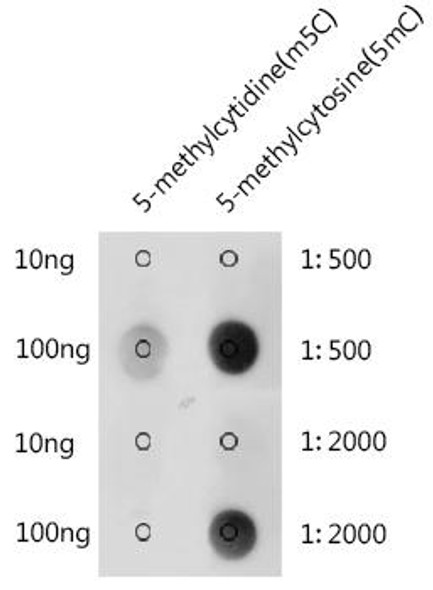
1:500 - 1:1000
ELISA
Recommended starting concentration is 1 μg/mL. Please optimize the concentration based on your specific assay requirements.
Synonyms:
5mC, 5-Methylcytosine (5mC)
Observed MW:
Refer to figures
In the mammalian genome, DNA methylation is an epigenetic mechanism involving the transfer of a methyl group onto the C5 position of the cytosine to form 5-methylcytosine. DNA methylation regulates gene expression by recruiting proteins involved in gene repression or by inhibiting the binding of transcription factor(s) to DNA. During development, the pattern of DNA methylation in the genome changes as a result of a dynamic process involving both de novo DNA methylation and demethylation. As a consequence, differentiated cells develop a stable and unique DNA methylation pattern that regulates tissue-specific gene transcription.? Intriguingly, postmitotic neurons still express DNA methyltransferases and components involved in DNA demethylation. Moreover, neuronal activity can modulate their pattern of DNA methylation in response to physiological and environmental stimuli. The precise regulation of DNA methylation is essential for normal cognitive function.
Purification Method
Affinity purification
Buffer Information
Store at -20℃. Avoid freeze / thaw cycles. Buffer: PBS containing 50% glycerol and 0.05% BSA, preserved with proclin300 or sodium azide, pH 7.3.
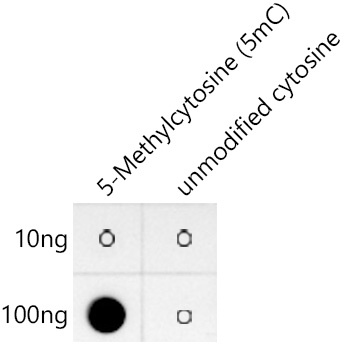
Dot-blot analysis of 5-Methylcytosine (5mC) and unmodified cytosine using 5-Methylcytosine (5mC) Rabbit mAb antibody (CAB20599) at 1:1000 dilution. 5-Methylcytosine (5mC) : Biotin-5'CGATAACCACTAGT(5mC)3' unmodified cytosine : Biotin-5'CGATAACCACTAGTC3'