The ALDH7A1 Monoclonal Antibody (CAB20888) is a high-quality antibody developed for reliable detection and analysis of target proteins. This antibody, generated in rabbits, has high specificity for human samples and has been validated for use in Western blot applications. By binding to the ALDH7A1 protein, researchers can easily detect and analyze its expression in various cell types, making it a valuable asset for studies in neuroscience, metabolic disorders, and neurodevelopmental diseases.ALDH7A1, also known as antiquitin, plays a crucial role in maintaining the balance of amino acid metabolism and neurotransmitter synthesis in the brain.
This antibody is validated for use in WB, ELISA applications and has demonstrated reactivity against Human, Mouse samples.
Product Name:
ALDH7A1 Monoclonal Antibody
SKU:
CAB20888
Size:
20μL, 100μL
Reactivity:
Human, Mouse
Clone Number:
ARC2837
Conjugate:
Unconjugated
Immunogen:
Synthetic peptide. This information is considered to be commercially sensitive.
Recommended starting concentration is 1 μg/mL. Please optimize the concentration based on your specific assay requirements.
Synonyms:
EPD, PDE, ATQ1, ALDH7A1
Positive Sample:
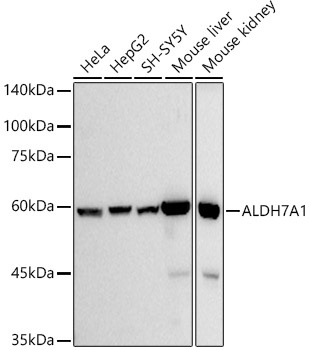
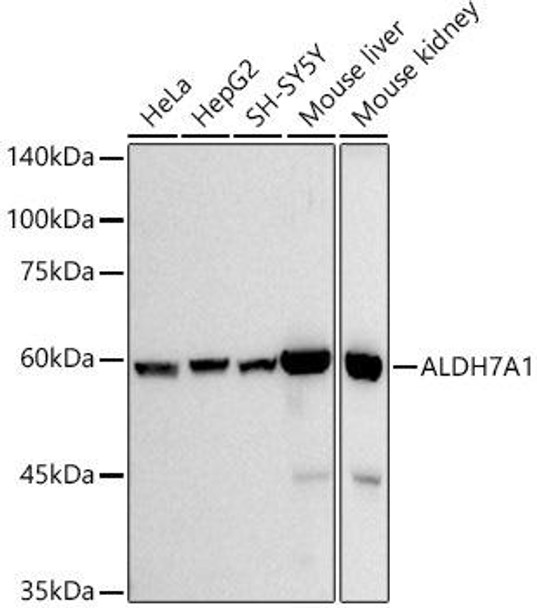
HeLa, Hep G2, SH-SY5Y, Mouse liver, Mouse kidney
Cellular Localization:
Cytoplasm, Cytosol, Mitochondrion, Nucleus.
Calculated MW:
58kDa
Observed MW:
58kDa
The protein encoded by this gene is a member of subfamily 7 in the aldehyde dehydrogenase gene family. These enzymes are thought to play a major role in the detoxification of aldehydes generated by alcohol metabolism and lipid peroxidation. This particular member has homology to a previously described protein from the green garden pea, the 26g pea turgor protein. It is also involved in lysine catabolism that is known to occur in the mitochondrial matrix. Recent reports show that this protein is found both in the cytosol and the mitochondria, and the two forms likely arise from the use of alternative translation initiation sites. An additional variant encoding a different isoform has also been found for this gene. Mutations in this gene are associated with pyridoxine-dependent epilepsy. Several related pseudogenes have also been identified.
Purification Method
Affinity purification
Gene ID
501
Buffer Information
Store at -20℃. Avoid freeze / thaw cycles. Buffer: PBS containing 50% glycerol and 0.05% BSA, preserved with proclin300 or sodium azide, pH 7.3.
Western blot analysis of various lysates using ALDH7A1 Rabbit mAb (CAB20888) at 1:500 dilution. Secondary antibody: HRP-conjugated Goat anti-Rabbit IgG (H+L) (CABS014) at 1:10000 dilution. Lysates/proteins: 25μg per lane. Blocking buffer: 3% nonfat dry milk in TBST. Detection: ECL Basic Kit (AbGn00020). Exposure time: 10s.