The Btbd11 Antibody (CAB20192) is a high-quality antibody developed for reliable detection and analysis of target proteins. This antibody, produced in rabbits, has been validated for use in multiple applications, including Western blot analysis. It specifically binds to the BTBD11 protein, allowing for accurate detection and analysis in a variety of cell types.BTBD11, also known as BTB/POZ domain-containing protein 11, is involved in regulating gene expression and cell signaling pathways. Its function in these processes makes it a key player in understanding developmental disorders, cancer progression, and other diseases.
This antibody is validated for use in WB, ELISA applications and has demonstrated reactivity against Human, Mouse, Rat samples.
Product Name:
Btbd11 Antibody
SKU:
CAB20192
Size:
20μL, 100μL
Reactivity:
Human, Mouse, Rat
Conjugate:
Unconjugated
Immunogen:
Recombinant protein (or fragment).This information is considered to be commercially sensitive.
Recommended starting concentration is 1 μg/mL. Please optimize the concentration based on your specific assay requirements.
Synonyms:
Btbd11, 6330404E16Rik
Positive Sample:
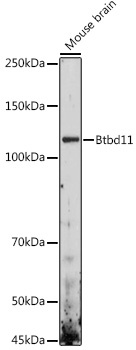
Mouse brain
Calculated MW:
122kDa
Observed MW:
121kDa
Predicted to enable protein heterodimerization activity. Acts upstream of or within SMAD protein signal transduction. Predicted to be located in membrane. Predicted to be integral component of membrane. Is expressed in central nervous system; dorsal root ganglion; genitourinary system; and thymus primordium. Orthologous to human BTBD11 (BTB domain containing 11).
Purification Method
Affinity purification
Gene ID
74007
Buffer Information
Store at -20℃. Avoid freeze / thaw cycles. Buffer: PBS with 0.01% thimerosal,50% glycerol,pH7.3.
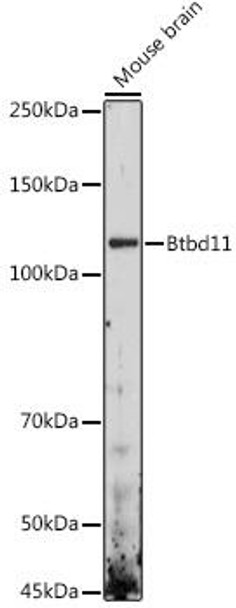
Western blot analysis of lysates from Mouse brain, using Btbd11 Rabbit pAb (CAB20192) at 1:1000 dilution. Secondary antibody: HRP-conjugated Goat anti-Rabbit IgG (H+L) (CABS014) at 1:10000 dilution. Lysates/proteins: 25μg per lane. Blocking buffer: 3% nonfat dry milk in TBST. Detection: ECL Enhanced Kit (AbGn00021). Exposure time: 180s.