The Pseudouridine/5-ribosyluracil Monoclonal Antibody (CAB20988) is a high-quality antibody developed for reliable detection and analysis of target proteins. This antibody, raised in rabbits, is highly reactive with human samples and has been validated for use in Western blot applications.Pseudouridine 5'-ribosyluracil is a modified nucleoside found in various types of RNA and plays a crucial role in regulating RNA stability, structure, and function. This antibody binds specifically to pseudouridine 5'-ribosyluracil, enabling researchers to study and analyze this modification in different cell types and tissues.
This antibody is validated for use in ELISA, DB applications and has demonstrated reactivity against Species independent samples.
Product Name:
Pseudouridine/5-ribosyluracil Monoclonal Antibody
SKU:
CAB20988
Size:
20μL, 100μL
Reactivity:
Species independent
Clone Number:
ARC50719
Immunogen:
Chemical compounds corresponding to Pseudouridine / 5-ribosyluracil.
Tested Applications:
ELISADB
Recommended Dilution:
DB
1:1000 - 1:10000
ELISA
Recommended starting concentration is 1 μg/mL. Please optimize the concentration based on your specific assay requirements.
Observed MW:
Refertofigures
Pseudouridine (Ψ) was among the first post-transcriptional modifications discovered and is overall one of the most abundant(1). It is present in a wide range of cellular RNAs and is highly conserved across species. Ψ is derived from uridine (U) via base-specific isomerization catalyzed by Ψ synthases. The site-specific pseudouridylation goes through either snoRNA-dependent (requires H/ACA RNP) or -independent mechanism (requires pseudouridine synthase (PUS) family enzymes)(2). It has an extra hydrogen-bond donor at its non-Watson-Crick edge. When incorporated into RNA, Ψ can alter RNA secondary structure by increasing base stacking, improving base pairing and rigidifying sugar-phosphate backbone5. The chemical and physical properties of RNA can be altered with the incorporation of Ψ, which could contribute to subsequent cellular functions.
Purification Method
Affinity purification
Gene ID
CAS: 1445-07-4
Buffer Information
Store at -20℃. Avoid freeze / thaw cycles. Buffer: PBS containing 50% glycerol and 0.05% BSA, preserved with proclin300 or sodium azide, pH 7.3.
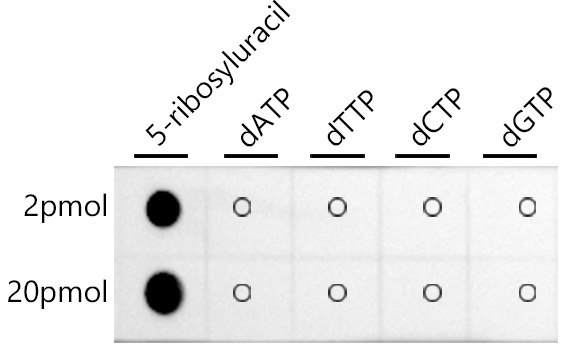
Dot-blot analysis of different sorts of chemical compounds using Pseudouridine / 5-ribosyluracil Rabbit mAb (CAB20988) at 1:1000 dilution.