Description
ATP5H Antibody (CAB4425)
The ATP5H Antibody (CAB4425) is a high-quality antibody developed for reliable detection and analysis of target proteins. This antibody is raised in rabbits and is highly specific to human samples, making it ideal for experiments involving ATP5H detection and analysis.ATP5H is a key component of the mitochondrial ATP synthase complex, responsible for generating ATP, the energy currency of the cell. Dysfunction in ATP5H has been linked to various human diseases, including mitochondrial disorders and metabolic syndromes.
This antibody is validated for use in WB, IHC-P, IF/ICC, ELISA applications and has demonstrated reactivity against Human, Mouse, Rat samples.
| Product Name: | ATP5H Antibody |
| SKU: | CAB4425 |
| Size: | 20μL, 100μL |
| Reactivity: | Human, Mouse, Rat |
| Conjugate: | Unconjugated |
| Immunogen: | Recombinant protein (or fragment).This information is considered to be commercially sensitive. | ||||||||
| Sequence: | MAGR KLAL KTID WVAF AEII PQNQ KAIA SSLK SWNE TLTS RLAA LPEN PPAI DWAY YKAN VAKA GLVD DFEK KFNA LKVP VPED KYTA QVDA EEKE DVKS CAEW VSLS KARI VEYE KEME KMKN LIPF DQMT IEDL NEAF PETK LDKK KYPY WPHQ PIEN L | ||||||||
| Tested Applications: | WB IHC-P IF/ICC ELISA | ||||||||
| Recommended Dilution: |
| ||||||||
| Synonyms: | ATPQ, APT5H, ATP5H |
| Positive Sample: | COS-7, HepG2, U-251MG, BxPC-3, HeLa, Mouse kidney, Mouse thymus, Mouse brain, Rat spinal cord |
| Cellular Localization: | Mitochondrion, Mitochondrion Inner Membrane. |
| Calculated MW: | 18kDa |
| Observed MW: | 18kDa |
Mitochondrial ATP synthase catalyzes ATP synthesis, utilizing an electrochemical gradient of protons across the inner membrane during oxidative phosphorylation. It is composed of two linked multi-subunit complexes: the soluble catalytic core, F1, and the membrane-spanning component, Fo, which comprises the proton channel. The F1 complex consists of 5 different subunits (alpha, beta, gamma, delta, and epsilon) assembled in a ratio of 3 alpha, 3 beta, and a single representative of the other 3. The Fo seems to have nine subunits (a, b, c, d, e, f, g, F6 and 8). This gene encodes the d subunit of the Fo complex. Alternatively spliced transcript variants encoding different isoforms have been identified for this gene. In addition, three pseudogenes are located on chromosomes 9, 12 and 15.
| Purification Method | Affinity purification |
| Gene ID | 10476 |
| RRID | AB_2765668 |
| Buffer Information | Store at -20℃. Avoid freeze / thaw cycles. Buffer: PBS containing 50% glycerol, preserved with proclin300 or sodium azide, pH 7.3. |
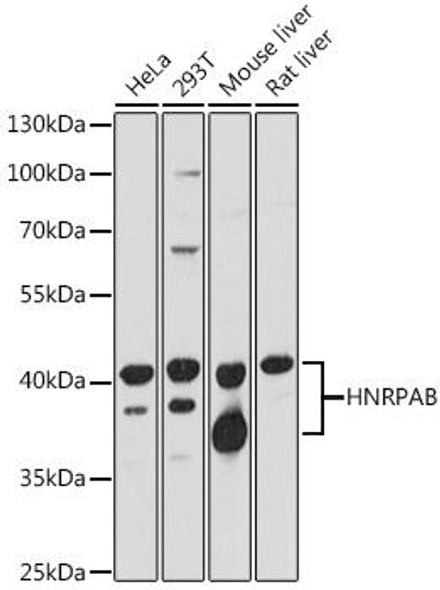
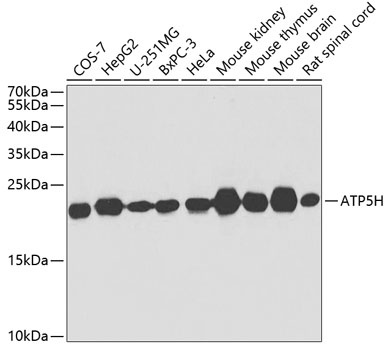 | Western blot analysis of various lysates using ATP5H Rabbit pAb (CAB4425) at 1:1000 dilution. Secondary antibody: HRP-conjugated Goat anti-Rabbit IgG (H+L) (CABS014) at 1:10000 dilution. Lysates/proteins: 25μg per lane. Blocking buffer: 3% nonfat dry milk in TBST. Detection: ECL Basic Kit (AbGn00020). Exposure time: 60s. |
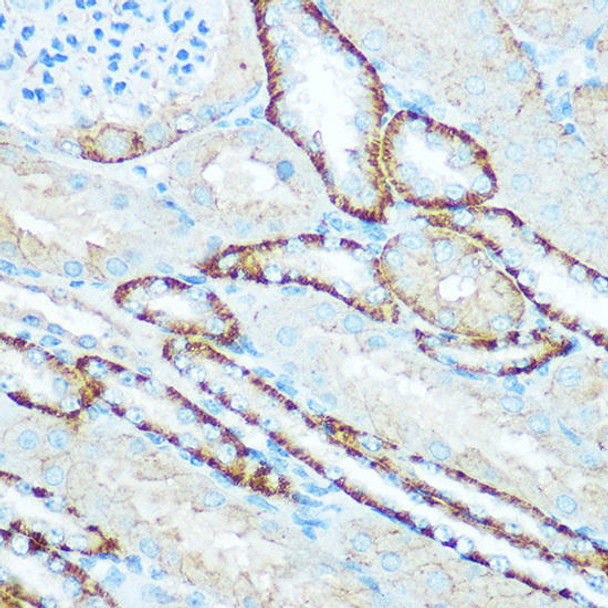
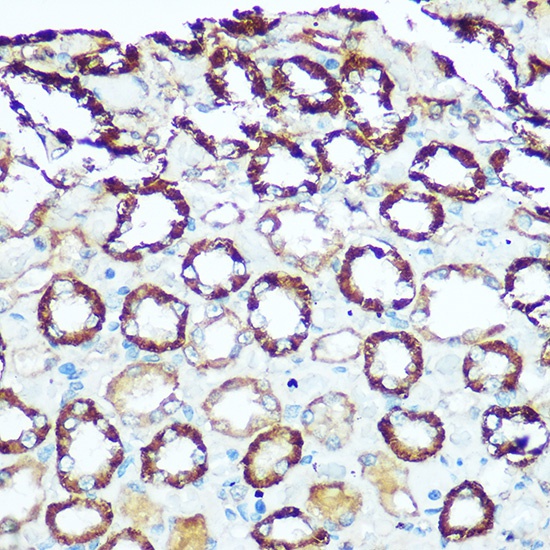 | Immunohistochemistry analysis of paraffin-embedded Rat kidney using ATP5H Rabbit pAb (CAB4425) at dilution of 1:100 (40x lens). Microwave antigen retrieval performed with 0.01M Tris/EDTA Buffer (pH 9.0) prior to IHC staining. |
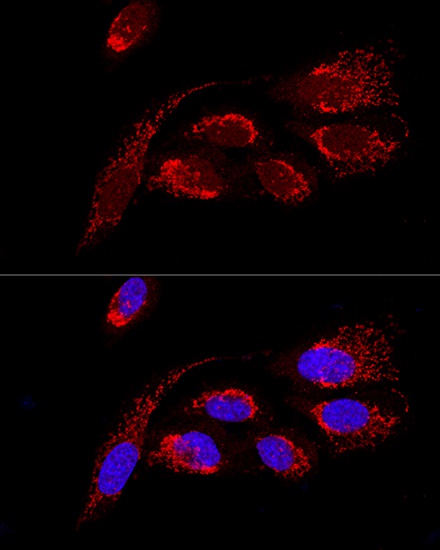 | Confocal immunofluorescence analysis of U2OS cells using ATP5H Rabbit pAb (CAB4425) at dilution of 1:100. Blue: DAPI for nuclear staining. |