Description
BCAR1 Antibody (CAB18270)
The BCAR1 Antibody (CAB18270) is a high-quality antibody developed for reliable detection and analysis of target proteins. This antibody, produced in rabbits, exhibits high reactivity with human samples and has been validated for use in Western blot applications. By specifically binding to the BCAR1 protein, this antibody enables the detection and analysis of BCAR1 expression in various cell types, making it an ideal choice for studies in oncology and cancer research.
This antibody is validated for use in WB, IHC-P, IF/ICC, ELISA applications and has demonstrated reactivity against Human, Mouse, Rat samples.
| Product Name: | BCAR1 Antibody |
| SKU: | CAB18270 |
| Size: | 20μL, 100μL |
| Reactivity: | Human, Mouse, Rat |
| Immunogen: | Recombinant protein (or fragment).This information is considered to be commercially sensitive. | ||||||||
| Sequence: | EPQE PLVQ DLQA AVAA VQSA VHEL LEFA RSAV GNAA HTSD RALH AKLS RQLQ KMED VHQT LVAH GQAL DAGR GGSG ATLE DLDR LVAC SRAV PEDA KQLA SFLH GNAS LLFR RTKA TA | ||||||||
| Tested Applications: | WB IHC-P IF/ICC ELISA | ||||||||
| Recommended Dilution: |
| ||||||||
| Synonyms: | CAS, CAS1, CASS1, CRKAS, P130Cas, BCAR1 |
| Positive Sample: | HeLa, Mouse brain |
| Cellular Localization: | Cell Junction, Cytoplasm, Focal Adhesion. |
| Calculated MW: | 93kDa |
| Observed MW: | 130kDa |
The protein encoded by this gene is a member of the Crk-associated substrate (CAS) family of scaffold proteins, characterized by the presence of multiple protein-protein interaction domains and many serine and tyrosine phosphorylation sites. The encoded protein contains a Src-homology 3 (SH3) domain, a proline-rich domain, a substrate domain which contains 15 repeat of the YxxP consensus phosphorylation motif for Src family kinases, a serine-rich domain, and a bipartite Src-binding domain, which can bind both SH2 and SH3 domains. This adaptor protein functions in multiple cellular pathways, including in cell motility, apoptosis and cell cycle control. Dysregulation of this gene can have a wide range of effects, affecting different pathways, including cardiac development, vascular smooth muscle cells, liver and kidney function, endothelial migration, and cancer.
| Purification Method | Affinity purification |
| Gene ID | 9564 |
| RRID | AB_2862044 |
| Buffer Information | Store at -20℃. Avoid freeze / thaw cycles. Buffer: PBS containing 50% glycerol, preserved with proclin300 or sodium azide, pH 7.3. |
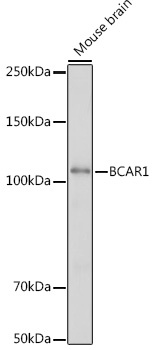 | Western blot analysis of lysates from Mouse brain, using BCAR1 Rabbit pAb (CAB18270) at 1:500 dilution. Secondary antibody: HRP-conjugated Goat anti-Rabbit IgG (H+L) (CABS014) at 1:10000 dilution. Lysates/proteins: 25μg per lane. Blocking buffer: 3% nonfat dry milk in TBST. Detection: ECL Basic Kit (AbGn00020). Exposure time: 90s. |
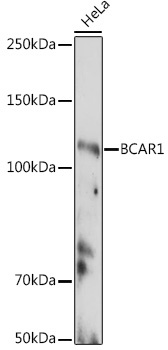 | Western blot analysis of lysates from HeLa cells, using BCAR1 Rabbit pAb (CAB18270) at 1:500 dilution. Secondary antibody: HRP-conjugated Goat anti-Rabbit IgG (H+L) (CABS014) at 1:10000 dilution. Lysates/proteins: 25μg per lane. Blocking buffer: 3% nonfat dry milk in TBST. Detection: ECL Enhanced Kit (AbGn00021). Exposure time: 180s. |
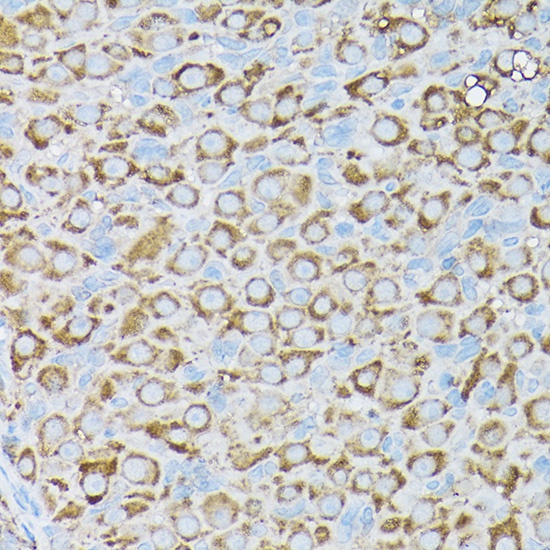 | Immunohistochemistry analysis of paraffin-embedded Rat ovary using BCAR1 Rabbit pAb (CAB18270) at dilution of 1:50 (40x lens). High pressure antigen retrieval performed with 0.01M Citrate buffer (pH 6.0) prior to IHC staining. |