
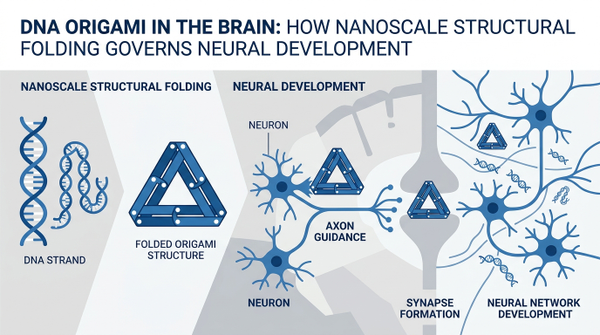
DNA Origami in the Brain: How Nanoscale Structural Folding Governs Neural Development
Imagine a world where we can fold the very fabric of life into microscopic machines, guiding the growth of a single neuron with the precision of a master architect. This isn't science fiction; it is the reality of DNA origami. By leveraging the natural base-pairing rules of genetic material, researchers are now building nanoscale scaffolds that don't just sit in the brain—they actively shape its development, offering a radical new blueprint for neuroregeneration and precision medicine.
Introduction
The human brain is perhaps the most complex structure in the known universe, a dense thicket of billions of neurons connected by trillions of synapses. For decades, our understanding of how this intricate network develops has been limited by the tools we use to study it. Traditional scaffolds often lack the structural nuance required to mimic the brain's delicate microenvironment. However, the emergence of structural DNA nanotechnology has changed the game. By using a long 'scaffold' strand of DNA and hundreds of shorter 'staple' strands, scientists can create custom-shaped 2D and 3D nanostructures with near-atomic precision. Interestingly, these structures are more than just static shapes; they are programmable interfaces capable of interacting with cellular receptors at the nanoscale. Beyond this, the ability to visualize these devices in situ has reached a new frontier, as OrigamiFISH visualizes DNA nanodevices at single-molecule level, allowing researchers to track their behavior within complex biological samples. This level of control is essential for understanding the subtle mechanical and chemical cues that govern neural development, from the first sprout of an axon to the formation of a functional circuit.
Architecting the Axon: How DNA Scaffolds Guide Nerve Growth
One of the most significant hurdles in treating spinal cord injuries or neurodegenerative diseases is the brain's limited ability to repair itself. When a nerve is severed, the environment becomes hostile to regrowth, often forming a physical and chemical barrier that axons cannot cross. This is where the 'origami' approach offers a breakthrough. By creating 3D scaffolds that display precise gradients of growth factors, researchers can provide a literal roadmap for regenerating neurons. These structures don't just provide a surface; they actively manipulate the cell's internal signaling. For instance, recent studies have shown that DNA origami scaffolds promote enhanced nerve regeneration by presenting biochemical cues in a spatially controlled manner. This spatial organization is critical because neurons are highly sensitive to the distance between ligands. By mimicking the natural extracellular matrix, these DNA-based architectures can coax axons to grow across gaps that were previously thought impassable, effectively bridging the divide between injury and recovery.
The Power of Spatial Precision
The effectiveness of these scaffolds lies in their ability to organize molecules with nanometer accuracy, which is vital for:
- Mimicking the natural density of the extracellular matrix
- Creating stable gradients of Nerve Growth Factor (NGF)
- Reducing off-target effects by localizing bioactive molecules
- Providing mechanical support for migrating neural progenitor cells
Molecular Gatekeepers: DNA Nanopores and the Future of Neural Sensing
Beyond structural support, DNA origami is being used to create functional components that mimic the brain's own molecular machinery. Ion channels and nanopores are the gatekeepers of neural communication, regulating the flow of ions that trigger electrical impulses. Engineering synthetic versions of these pores allows scientists to study neural transport mechanisms with unprecedented detail. Interestingly, DNA origami nanopores revolutionize molecular sensing by providing a customizable platform for detecting neurotransmitters and other signaling molecules. These synthetic pores can be designed to open or close in response to specific stimuli, acting as programmable sensors within the neural environment. This capability is not just a tool for basic research; it represents a new class of diagnostics that could detect the earliest chemical imbalances associated with epilepsy or depression. By integrating these nanopores into larger DNA frameworks, we are essentially building a 'smart' interface that can listen to and interact with the brain's internal dialogue.
The Robotic Neuron: Autonomous Switches for Precision Therapy
What if a drug delivery vehicle could 'think' for itself, releasing its cargo only when it detects a specific pathological signature in the brain? This is the promise of DNA-based nanorobotics. By incorporating aptamers and molecular switches, DNA origami structures can be programmed to undergo conformational changes in response to their surroundings. For example, robotic DNA switches enable autonomous ligand display, ensuring that therapeutic agents are only exposed to target cells. This level of autonomy is particularly valuable in the brain, where the blood-brain barrier and the risk of neurotoxicity make traditional drug delivery extremely challenging. Furthermore, these nanostructures can be used to regulate the activity of receptors on the cell surface. Recent advancements highlight how DNA nanostructures regulate membrane proteins for therapy, offering a way to 'turn off' overactive receptors or 'turn on' those that have become dormant. This precision ensures that the treatment is as focused as a laser, minimizing side effects and maximizing therapeutic impact.
Seeing the Unseen: Deep Learning and Single-Cell Visualization
The ultimate test of any neural technology is how it performs within the living brain. For a long time, tracking nanocarriers across the entire mouse body—let alone at the single-cell level—was an insurmountable task. However, the marriage of nanotechnology and artificial intelligence has opened a new window into the brain. By using advanced imaging techniques, deep learning enables single-cell nanocarrier imaging, providing a high-resolution map of where DNA origami structures go and how they interact with different brain regions. This data is crucial for refining the design of these nanodevices. Interestingly, this imaging isn't just about location; it's about function. We can now see how DNA origami controls multivalent insulin receptor activation, a process that is vital for metabolic health and cognitive function. By combining these high-resolution 'eyes' with the programmable 'hands' of DNA origami, we are entering an era where we can not only observe neural development but actively participate in its orchestration.
Detecting the Early Warning Signs of Neurodegeneration
While much of the focus is on growth and development, DNA origami also plays a critical role in the early detection of disease. Neurodegenerative conditions like Alzheimer's and Parkinson's are characterized by the misfolding of proteins, such as amyloid-beta and alpha-synuclein. Detecting these misfolded proteins before they form large, toxic plaques is the 'holy grail' of neurology. Recent breakthroughs have shown that DNA origami nanoantennas detect amyloid misfolding markers with extreme sensitivity. These nanoantennas use gold nanoparticles positioned on a DNA scaffold to amplify the signal from single molecules of thioflavin T, a common marker for amyloid. This technology allows for the selective recognition of pathological markers in their infancy, potentially years before clinical symptoms appear. By providing a platform for such sensitive diagnostics, DNA origami is not just helping us build the brain of the future; it is helping us protect the brain of the present.
A New Blueprint for the Mind
The journey from simple DNA base-pairing to complex neural scaffolds represents one of the most exciting frontiers in modern science. DNA origami has moved beyond a laboratory curiosity to become a robust tool for guiding neural development, sensing molecular changes, and delivering life-saving therapies. By mastering the art of nanoscale folding, we are gaining the ability to speak the language of the brain at its most fundamental level. As we continue to refine these biological machines, the line between technology and biology will continue to blur, offering hope for millions of people affected by neurological disorders. The blueprint for the mind is no longer written in stone; it is being folded, one base pair at a time, into a future of limitless potential.
References
- Luo J, Molbay M, et al. (2025). Nanocarrier imaging at single-cell resolution across entire mouse bodies with deep learning.. Nat Biotechnol. 43(12):2009-2022. PMID: 39809933
- Liu F, Arai T, et al. (2025). Engineering DNA nanopores: from structural evolution to sensing and transport.. Mater Today Bio. 34:102137. PMID: 40761509
- Wang Y, Baars I, et al. (2024). A DNA robotic switch with regulated autonomous display of cytotoxic ligand nanopatterns.. Nat Nanotechnol. 19(9):1366-1374. PMID: 38951595
- Spratt J, Dias JM, et al. (2024). Multivalent insulin receptor activation using insulin-DNA origami nanostructures.. Nat Nanotechnol. 19(2):237-245. PMID: 37813939
- Wang WX, Douglas TR, et al. (2024). Universal, label-free, single-molecule visualization of DNA origami nanodevices across biological samples using origamiFISH.. Nat Nanotechnol. 19(1):58-69. PMID: 37500778
- Giron J, Antman-Passig M, et al. (2024). DNA origami scaffold promoting nerve guidance and regeneration. Biotechnol J. 19(5):e2300734. PMID: 38719571
- Cheng Z, Liu Y, et al. (2025). DNA-based nanostructures for cell membrane receptor regulation and disease treatment.. Adv Drug Deliv Rev. 225:115674. PMID: 40816654
- Kaur C, Kaur V, et al. (2023). Selective recognition of the amyloid marker single thioflavin T using DNA origami-based gold nanobipyramid nanoantennas.. Nanoscale. 15(13):6170-6178. PMID: 36917482
24th Mar 2026
Recent Posts
-
Immunopeptidomics: Mapping the Hidden Landscape of the Cancer Immunome
Imagine a high-stakes game of hide-and-seek where the seeker is your immune system and the hider is …24th Mar 2026 -
DNA Origami in the Brain: How Nanoscale Structural Folding Governs Neural Development
Imagine a world where we can fold the very fabric of life into microscopic machines, guiding the gr …24th Mar 2026 -

IgG1 Plasma Cells: The Emerging Biomarker for Predicting Cancer Immunotherapy Success
In the relentless fight against cancer, immunotherapy has emerged as a beacon of hope, harnessing t …24th Feb 2026