
Turning Tumors Against Themselves: In Vivo Reprogramming of Cancer Cells into Dendritic Sentinels
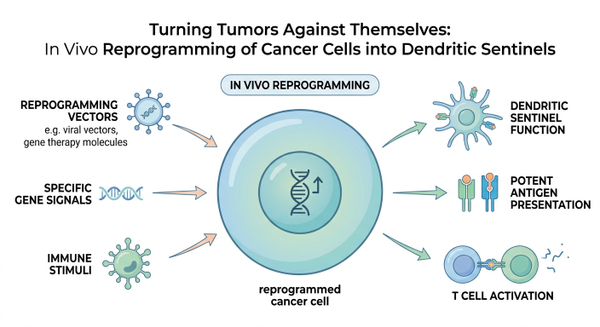
Imagine a future where cancer cells, once masters of disguise, are forced to reveal themselves and even train the body's immune system to fight back. This isn't science fiction; it's the groundbreaking reality emerging from the latest advancements in cancer immunotherapy. Researchers are now exploring a revolutionary strategy: turning tumors against themselves by reprogramming their very cells into powerful immune sentinels.
Introduction
For decades, the fight against cancer has been a relentless pursuit, marked by both triumphs and formidable challenges. While traditional treatments like chemotherapy and radiation have saved countless lives, they often come with significant side effects and limitations. The advent of immunotherapy, particularly checkpoint inhibitors and CAR-T cell therapies, has revolutionized the landscape, offering unprecedented hope for many patients. However, a persistent hurdle remains: many tumors develop sophisticated mechanisms to evade immune detection and attack, rendering these therapies ineffective for a substantial portion of individuals. This immune evasion is a critical barrier to achieving widespread, durable remissions.
To overcome this, scientists are looking beyond simply activating the immune system from the outside. What if the enemy itself could be transformed into an ally? This audacious idea forms the core of in vivo cellular reprogramming, a cutting-edge approach that seeks to convert cancer cells directly within the body into antigen-presenting cells. These reprogrammed cells could then act as "dendritic sentinels," alerting and activating the immune system to launch a potent, targeted attack against the tumor. This paradigm shift holds immense promise for developing therapies that are not only more effective but also more universally applicable across diverse cancer types.
The Immune System's Blind Spot: Why Tumors Evade Detection
Cancer cells are notoriously cunning. They evolve intricate strategies to hide from the immune system, often by downregulating the expression of tumor-specific antigens or by creating an immunosuppressive microenvironment. This "blind spot" allows tumors to grow unchecked, even in the presence of a potentially potent immune response. Traditional immunotherapies aim to lift this veil, but their success is often limited by the tumor's inherent heterogeneity and its ability to adapt. The challenge lies in making every cancer cell visible and vulnerable to immune attack.
Recent research highlights that a critical component of a robust anti-tumor immune response is the presence of type 1 conventional dendritic cells (cDC1s). These specialized immune cells are exceptional at capturing and presenting tumor antigens to T cells, thereby initiating a powerful cytotoxic T-lymphocyte response. Without sufficient cDC1 activity within the tumor microenvironment, the immune system struggles to mount an effective assault. This understanding has paved the way for innovative strategies focused on enhancing cDC1 function, or even creating them where they are most needed: directly within the tumor itself.
Unmasking the Enemy: Reprogramming Cancer Cells into Immune Sentinels
The concept of cellular reprogramming, once largely confined to regenerative medicine, is now being powerfully applied to oncology. The breakthrough lies in the ability to genetically convert cancer cells into cDC1-like cells directly within the tumor. Pioneering work by Fábio Rosa and his team has demonstrated that a specific trio of transcription factors—PU.1, IRF8, and BATF3—can orchestrate this remarkable transformation Reprogramming tumor cells into cDC1-like cells in vivo. These transcription factors, essentially master switches for gene expression, compel the cancer cells to shed their tumor identity and adopt the characteristics of antigen-presenting dendritic cells.
This in vivo reprogramming bypasses the need for complex ex vivo cell manipulation, offering a more direct and potentially scalable therapeutic approach. The reprogrammed tumor cells not only acquire the ability to present antigens but also trigger powerful anti-tumor responses, effectively turning the tumor into its own vaccine. This strategy addresses the fundamental problem of immune evasion by forcing the cancer cells to become the very agents that alert the immune system to danger Converting cancer cells into professional antigen-presenting cells. The implications are profound: instead of merely attacking the tumor, we are teaching it to self-destruct by activating the body's natural defenses from within.
A Blueprint for Transformation: The Mechanics of In Vivo Conversion
The precise methodology behind this in vivo conversion is a testament to sophisticated genetic engineering. Researchers utilize adenoviral vectors to deliver the critical transcription factors (PU.1, IRF8, and BATF3) directly into tumor cells. Once inside, these factors initiate a cascade of genetic changes, fundamentally altering the cell's identity and function. The resulting cDC1-like cells express key markers and exhibit the functional capabilities of natural dendritic cells, including antigen processing and presentation.
This transformation is not merely cosmetic; it leads to a tangible enhancement of anti-tumor immunity. Studies have shown that this in situ reprogramming increases T-cell infiltration into the tumor, expands the population of tumor-reactive T cells, and, crucially, leads to complete tumor regression in animal models Boosting anti-tumor immunity through in situ reprogramming. The effectiveness is further amplified when combined with existing checkpoint blockade immunotherapies, suggesting a synergistic approach that could overcome current resistance mechanisms. The development of a standardized protocol for this process is also underway, paving the way for more consistent and reproducible results in future research and clinical applications Standardized protocol for in vivo tumor cell reprogramming.
From Discovery to Delivery: The Road Ahead for Reprogramming Immunotherapy
The journey from a groundbreaking scientific discovery to a widely available clinical treatment is often long and arduous, but the early successes of in vivo cellular reprogramming are incredibly promising. The ability to map the transcriptional pathways involved in converting somatic cells into cross-presenting dendritic cells has been crucial in refining this technology Mapping the transcriptional path to induced dendritic cells. This foundational understanding allows for more precise and efficient reprogramming strategies.
Currently, the focus is on translating these preclinical triumphs into human trials. Fábio Rosa and his team at Asgard Therapeutics are actively working towards submitting a clinical trial application in 2027, aiming to bring this innovative therapy to patients. This represents a significant step towards realizing the full potential of harnessing cellular reprogramming for durable cancer eradication Harnessing cellular reprogramming for durable cancer eradication. The vision is to make these transformative outcomes the norm, rather than the exception, for a broader spectrum of cancer patients, ultimately redefining the future of cancer treatment.
A New Era in Cancer Immunotherapy: The Tumor as Its Own Cure
The concept of turning tumors against themselves through in vivo cellular reprogramming marks a pivotal moment in cancer research. By transforming cancer cells into immune-activating dendritic sentinels, scientists are developing a powerful new weapon in the immunotherapy arsenal. This innovative approach holds the potential to overcome many of the limitations of current treatments, offering hope for more effective and universally applicable therapies. As research progresses and moves towards clinical trials, we stand on the cusp of a new era where the very cells that once threatened life could become the key to its preservation, ushering in a future where cancer is not just treated, but truly conquered from within.
References
- Ascic E, Åkerström F, et al. (2024). In vivo dendritic cell reprogramming for cancer immunotherapy.. Science. 386(6719):eadn9083. PMID: 39236156
- Zimmermannova O, Ferreira AG, et al. (2023). Restoring tumor immunogenicity with dendritic cell reprogramming.. Sci Immunol. 8(85):eadd4817. PMID: 37418548
- Kwon Y, Choi K. (2024). Enhancing tumor immunity via in vivo cDC1 reprogramming.. Trends Immunol. 45(12):934-936. PMID: 39578119
- Ascic E, Fontanari G, et al. (2025). Tractable In Vivo Reprogramming of Tumor Cells to Type 1 Conventional Dendritic Cell-like Cells.. J Vis Exp. (222). PMID: 40824830
- Rosa FF, Pires CF, et al. (2022). Single-cell transcriptional profiling informs efficient reprogramming of human somatic cells to cross-presenting dendritic cells.. Sci Immunol. 7(69):eabg5539. PMID: 35245086
- Chronis C. (2024). A New Frontier in Tumor Eradication: Harnessing In Vivo Cellular Reprogramming for Durable Cancer Immunotherapy.. Cell Reprogram. 26(5):132-134. PMID: 39387283
Recent Posts
-
Turning Tumors Against Themselves: In Vivo Reprogramming of Cancer Cells into Dendritic Sentinels
Imagine a future where cancer cells, once masters of disguise, are forced to reveal themselves and …3rd Apr 2026 -
Programmable Synthetic Hybrid Receptors (Hybrid-Rs): The Next Generation of Precision Immunotherapy
Imagine a world where cancer treatment is no longer a blunt instrument but a precision-guided surgi …31st Mar 2026 -
The Neural Shield: How Cancer-Induced Nerve Injury Drives Immunotherapy Resistance
For years, our understanding of cancer focused primarily on the tumor cells themselves and the immu …29th Mar 2026