The Carbonic Anhydrase 9 (CA9/G250) Antibody (CAB1658) is a high-quality antibody developed for reliable detection and analysis of target proteins. Carbonic anhydrases (CAs) are a large family of zinc metalloenzymes that catalyze the reversible hydration of carbon dioxide. They participate in a variety of biological processes, including respiration, calcification, acid-base balance, bone resorption, and the formation of aqueous humor, cerebrospinal fluid, saliva, and gastric acid. They show extensive diversity in tissue distribution and in their subcellular localization. CA IX is a transmembrane protein and is one of only two tumor-associated carbonic anhydrase isoenzymes known. It is expressed in all clear-cell renal cell carcinoma, but is not detected in normal kidney or most other normal tissues. It may be involved in cell proliferation and transformation. This gene was mapped to 17q21.2 by fluorescence in situ hybridization, however, radiation hybrid mapping localized it to 9p13-p12. RRID AB_2763715 Gene ID 768 Swiss Prot Synonym MN; CAIX; Carbonic Anhydrase 9 (CA9/G250)
This antibody is validated for use in WB, ELISA applications and has demonstrated reactivity against Mouse, Rat samples.
Product Name:
Carbonic Anhydrase 9 (CA9/G250) Antibody
SKU:
CAB1658
Size:
100μL, 20μL
Reactivity:
Mouse, Rat
Clone Number:
-
Conjugate:
Unconjugated
Immunogen:
Recombinant protein (or fragment).This information is considered to be commercially sensitive.
Tested Applications:
WBELISA
Recommended Dilution:
WB
1:500 - 1:2000
ELISA
Recommended starting concentration is 1 μg/mL. Please optimize the concentration based on your specific assay requirements.
Synonyms:
MN, CAIX, Carbonic Anhydrase 9 (CA9/G250)
Positive Sample:
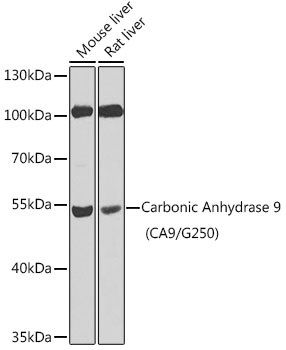
Mouse liver, Rat liver
Cellular Localization:
Cell Membrane, Cell Projection, Nucleus, Single-Pass Type I Membrane Protein, Microvillus Membrane, Nucleolus.
Calculated MW:
50kDa
Observed MW:
54kDa
Carbonic anhydrases (CAs) are a large family of zinc metalloenzymes that catalyze the reversible hydration of carbon dioxide. They participate in a variety of biological processes, including respiration, calcification, acid-base balance, bone resorption, and the formation of aqueous humor, cerebrospinal fluid, saliva, and gastric acid. They show extensive diversity in tissue distribution and in their subcellular localization. CA IX is a transmembrane protein and is one of only two tumor-associated carbonic anhydrase isoenzymes known. It is expressed in all clear-cell renal cell carcinoma, but is not detected in normal kidney or most other normal tissues. It may be involved in cell proliferation and transformation. This gene was mapped to 17q21.2 by fluorescence in situ hybridization, however, radiation hybrid mapping localized it to 9p13-p12. RRID AB_2763715 Gene ID 768 Swiss Prot Synonym MN; CAIX; Carbonic Anhydrase 9 (CA9/G250)
Purification Method:
Affinity purification
Gene ID:
768
RRID:
AB_2763715
Buffer Information:
Store at -20℃. Avoid freeze / thaw cycles. Buffer: PBS containing 50% glycerol, preserved with proclin300 or sodium azide, pH 7.3.
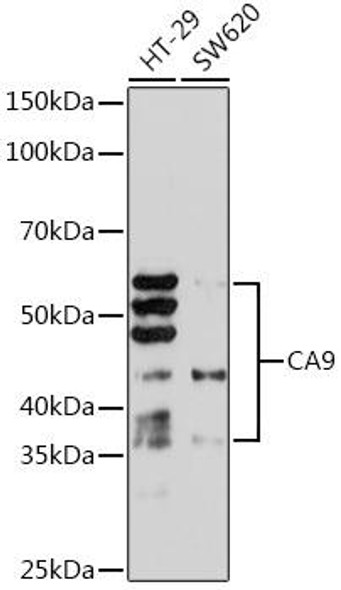
Western blot analysis of various lysates using Carbonic Anhydrase 9 (CA9/G250) Rabbit pAb (CAB1658) at 1:100 dilution. Secondary antibody: HRP-conjugated Goat anti-Rabbit IgG (H+L) (AS014) at 1:10000 dilution. Lysates/proteins: 25μg per lane. Blocking buffer: 3% nonfat dry milk in TBST. Detection: ECL Basic Kit (AbGn00020). Exposure time: 30s.