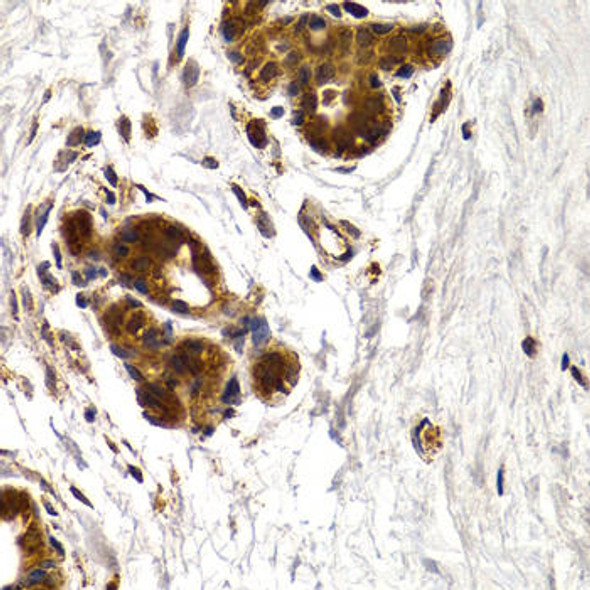
The CTSS Antibody (CAB1874) is a high-quality antibody developed for reliable detection and analysis of target proteins. This antibody, produced in rabbits, exhibits high reactivity with human samples and is validated for use in various applications, including Western blot and immunohistochemistry.Cathepsin S is known for its role in the immune system, specifically in the degradation of antigens for presentation to T cells. This process is crucial for the activation of immune responses and the regulation of inflammatory reactions.
This antibody is validated for use in WB, IF/ICC, ELISA applications and has demonstrated reactivity against Human, Mouse, Rat samples.
Product Name:
CTSS Antibody
SKU:
CAB1874
Size:
20μL, 100μL
Reactivity:
Human, Mouse, Rat
Conjugate:
Unconjugated
Immunogen:
Recombinant protein (or fragment).This information is considered to be commercially sensitive.
Recommended starting concentration is 1 μg/mL. Please optimize the concentration based on your specific assay requirements.
Synonyms:
CTSS
Positive Sample:
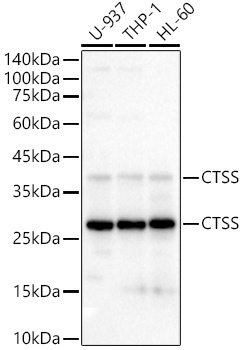
U-937, THP-1, HL-60
Cellular Localization:
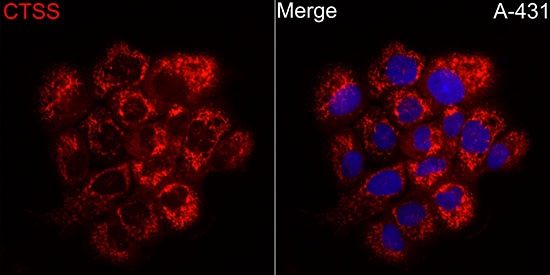
Lysosome.
Calculated MW:
37kDa
Observed MW:
25kDa/37kDa
The preproprotein encoded by this gene, a member of the peptidase C1 family, is a lysosomal cysteine proteinase that participates in the degradation of antigenic proteins to peptides for presentation on MHC class II molecules. The mature protein cleaves the invariant chain of MHC class II molecules in endolysosomal compartments and enables the formation of antigen-MHC class II complexes and the proper display of extracellular antigenic peptides by MHC-II. The mature protein also functions as an elastase over a broad pH range. When secreted from cells, this protein can remodel components of the extracellular matrix such as elastin, collagen, and fibronectin. This gene is implicated in the pathology of many inflammatory and autoimmune diseases and, given its elastase activity, plays a significant role in some pulmonary diseases. Alternatively spliced transcript variants encoding distinct isoforms have been found for this gene.
Purification Method
Affinity purification
Gene ID
1520
RRID
AB_2763907
Buffer Information
Store at -20℃. Avoid freeze / thaw cycles. Buffer: PBS containing 50% glycerol, preserved with proclin300 or sodium azide, pH 7.3.
Western blot analysis of various lysates using CTSS Rabbit pAb (CAB1874) at 1:800 dilution. Secondary antibody: HRP-conjugated Goat anti-Rabbit IgG (H+L) (CABS014) at 1:10000 dilution. Lysates / proteins: 25 μg per lane. Blocking buffer: 3 % nonfat dry milk in TBST. Detection: ECL Basic Kit (AbGn00020). Exposure time: 10s.
Immunofluorescence analysis of A-431 cells using CTSS Rabbit pAb (CAB1874) at dilution of 1:200 (40x lens). Secondary antibody: Cy3-conjugated Goat anti-Rabbit IgG (H+L) (CABS007) at 1:500 dilution. Blue: DAPI for nuclear staining.